 Update in late 2019 with the release of Dark Fate: The glum and more self-consciously morose later sequels track, recode, and needlessly convolute this film’s elegant, inescapable trudge toward oblivion, shading and sharding Cameron’s original vision in various ways, but they all completely miss the original’s brilliance: its sense of soul-death. Nominally an action film but far divorced from the self-amused tone of the Schwarzenegger pictures that were in the can as soon as this one made a fortune, The Terminator is as implacable and monosyllabic as its namesake: a blood-and-guts slasher film in a metallic overcoat, and one with significantly less Pavlovian satisfaction at the death it deals. Brutal simplicity at its finest, The Terminator essays a dystopic future that ultimately, tragically, realizes its far-flung visions of eventual catastrophe already came to pass in the present while it wasn’t looking. How far this franchise has fallen …
Original Review:
Those who’ve only seen the sequels to this truly distressing Reagan-era portrait of social aimlessness and blight, a film that typifies menace itself, may be forgiven for thinking this first film is something it has no interest in being. The later films focused on action, action, and more action (the first sequel being one of the greatest slam-bang thrill rides ever made, and with a touching human-machine relationship to boot), emphasizing escalating narrative stakes rather than deepening emotional texture, and have since run out of steam. While this lean-and-mean low-budget 1984 film starring a mostly unknown who couldn’t speak much English is plenty thrilling, it’s tempered with an overpoweringly grim sensibility, a magisterial sense of mounting dread and desperation that establishes a mood of forlorn malaise more than fist-pumping aplomb. Horror is as appropriate as action. Fortunately, it happens to be one of the grimiest, most caustic horror films to take over the public consciousness in that decade, and one of the best.
Continue reading →

 For this week’s Midnight Screenings, being that Halloween is upon us and all, here are reviews of three modern would-be Halloween films destined for years of “Midnight” Screenings all throughout the land.
 For this week’s Midnight Screenings, being that Halloween is upon us and all, here are reviews of three modern would-be Halloween films destined for years of “Midnight” Screenings all throughout the land.
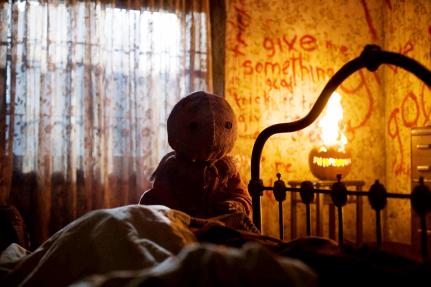 For this week’s Midnight Screenings, being that Halloween is upon us and all, here are reviews of three modern would-be Halloween films destined for years of “Midnight” Screenings all throughout the land.
  I Walked with a Zombie was the second film Val Lewton produced once given complete control of RKO’s horror unit, and it was released only a year after Cat People, his most famed horror film. Given this, one might expect a retread, but I Walked with a Zombie is certainly not the film anyone then or now would be expecting. A tension seethes in the air and grasps all, but the film doesn’t demand in the way a work like Cat People is so tersely constructed to fight for our attention. Absent are the soul-deep colors of Cat People which lighted up the screen with black energy. And in place of the rampant diluted German Expressionism of American horror throughout the ’30s and ’40s, all caught up in harsh and angular nightmares, we have something that more closely approximates a hazy dream, a curious cross between an English period drama and a work of French impressionism that centers mournful, elegiac long takes and has room enough for lost secrets deviously begging to get out . It is, above all, wholly distant from anything resembling horror logic, and it is all the more fascinating for it.
 Update fall 2018: Been a few years since I last saw this before the current viewing, but After Hours remains truly unstable, and clearly too brutally crazed to be labeled a psychoanalytic “portrait” of Scorsese, with all the easily-contained clarity and visibility the notion of a portrait implies. After Hours is much more of a working-through than it is a legible work of art; it’s the rattled consciousness of a director obviously exposing himself to nervous tendons in search of transcending them, and it’s gloriously untamed.
 With the summer release of Jeff Mickle’s new film, Cold in July, set to prove him as a director of considerable skill who’s in it for the long haul, it seems appropriate to look back on his two previous, relatively unknown and under-appreciated films, truly strong efforts both and films any discerning horror fan can appreciate. 2010’s Stake Land and 2013’s We Are What We Are are scary films, but their horror comes not from shocks but slowly building dread (don’t worry, though, Mickle knows how to underline his composed filmmaking in blood-red strokes when necessary) . He doesn’t give us choppy quick cuts. He lingers, letting his characters define his horror and giving us a blood-curdling melancholy.
 A Field in England opens with a warning about the film’s psychotic, psychedelic imagery, but it serves, and was likely intended, as much as a badge of honor– the film’s visuals are gloriously perturbed, and the trickery on display is the film’s biggest selling point. This is all the truer when one considers the film’s enigmatic narrative and its clear subversions, even from its opening moments. If the film opens with the aforementioned warning about its visual nature, it immediately cuts to a black screen with only chaotic sound for thirty or so seconds, pointedly delaying what it’s just promised us. Then, of course, there’s the film’s black-and-white monotony when we now automatically associate visual splendor with cheerful color, and the fact that the film opens with a battle scene captured purely in close-ups and shots of single, atomized people, as well as quavering images of bushes. It doesn’t play like a battle in reality, but as the arch impression of a battle, the sense of chaos and loneliness ever-present but indescribable when on the edge of life and death – it’s an almost abstract collage of imagery divorced from context to convey the holistic difficulty of understanding war representationally or experientially. A Field in England is a pure, distilled cinematic hell.
 Edited Dec 2014 after I watched a second time and noticed how jaw-dropping the sound design is; sometimes the beauty of images, and the fact that film is a primarily visual medium, distract from the wondrous world of noise.
  Updated mid-2015
 The Long Take