
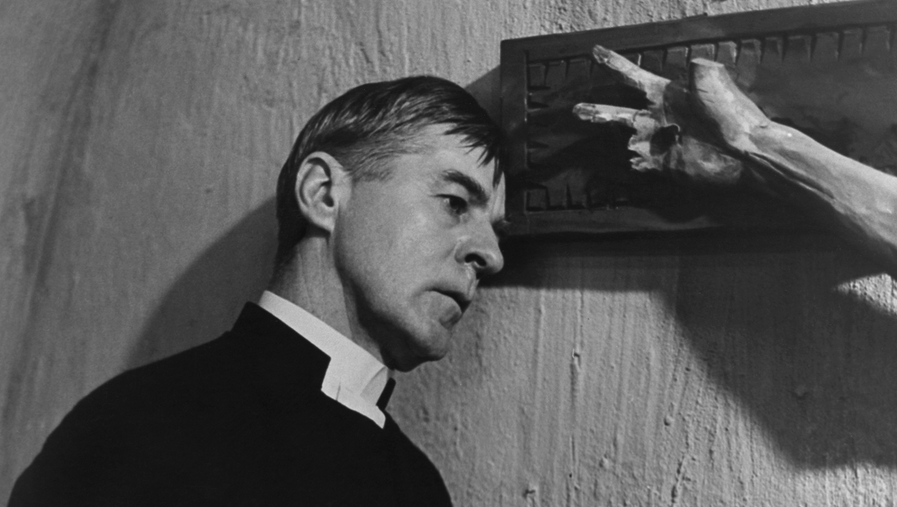
Early in Winter Light, Max von Sydow’s Jonas Persoon gives voices to one of the major throughlines of director Ingmar Bergman’s career, a subcutaneous current that unites many otherwise ostensibly disparate films. When Jonas’s wife Karin (Gunnel Lindblom)asks to meet with pastor Tomas Ericsson (Gunnar Bjornstrand) to discuss her husband’s crippling depression, a neurotic aftershock of the nuclear armaments he is obsessed with, the couple – her ability to voice to terror and his ability to bespeak it through his reticence to speak – bring to life many of the abiding conundrums of Bergman’s cinema. What does it mean to speak for another person, and how are our capacities to find life emboldened and sabotaged by our entanglement with others and with the world? And what does this mean when we as a species have decided that the capacity to wipe ourselves out with nuclear weapons is the only way to pacify our existential uncertainty at having created them? How can we, knowing this, go on speaking in the first place?
The Persoons are only the most manifest evocation of Winter Light’s vision of the mid-century as an ambivalent netherworld salvaged from its slow, inexorable decline into the abyss only by those moments of human connection that ultimately come back to mock the idea that we believed they could save us. The largely disinterested way Tomas moves through his daily rituals suggests a weary soul who has become a wayward traveler of life. Real fatigue seeps through every inch of Bergman’s frame, and in his unshakable dread, Persoon only makes Bergman’s lingering spiritual disquiet manifest. His was a trepidatious cinema, one that, as Susan Sontag famously claimed, may be genuinely uninterpretable. That’s perhaps more poetic than, well, interpretive, but the man definitely made movies that beg the question of whether interpretation can do anything in the modern world, and why it would be worthwhile to even bother interpreting in the first place. Bergman’s anxiety about the certainty of meaning in a world where mutually assured destruction dwarfs any other kind of certainty suggests that terror has become its own sublime, seemingly worshipful God (as scholars of nuclear destruction have long argued), something that frightens and disturbs the search for truth, that induces an apprehension beyond the capacity to intellectualize. The austere severity of Bergman’s film seems to state its case so bluntly only because it is trembling with disquiet, with an unease that shudders so much, at such a low frequency, that it actually stills the film, and grants it a capacity to rend the soul.
Yet, if sublimity can excite and dull the mind, Winter Light also suggests that we need to sharpen ours. Interpret, we must. Thus, although Winter Light is among Bergman’s most spartan efforts, a far cry from the radioactive kaleidoscope known as Persona three years later, a film in which fallout seems to have mutated the very capacity to produce a traditional narrative structure, it remains a distinctly cinematic moan, a filmic plea for renewed understanding. Consider the second conversation between Ericsson and Jonas Persson, where Persson discusses his soul and Ericsson reveals more about his, in which Bergman modulates the relation of the two men to one another, their belief in themselves, and their desire to engage with the world at all through editing rhythms, blocking, and the simple, seemingly non-intrusive but actually devastating shift from, say, a shot in which Ericsson and Persson cohabitate the frame to one in which Ericsson seems unable to coexist with anyone. There are entire imaginative worlds, and fluctuations between those worlds, contained in who is facing forward, who is slanting inward, and whether they are even visualized in the same frame as one another or on their own, each of which speaks eons about their capacity to reveal themselves or to perform a social projection of what one is “supposed” to look like. Winter Light isn’t as omnivorously cinematic as Persona – it does not feel like it needs to rewrite the medium in order to ensure its own survival in a rapidly mutating world – but the brutal clarity of two people in conversation, one in the background looking slantwise and forward at the other who is in relative profile, facing off into the ether, vaguely at the other person but not quite, is the definition of what we used to call “casual mastery” of the filmic form.
It sounds easy, but tell that to the number of highly respected AAA directors today who seem to have forgotten that where the characters are in the frame, and where they are in relation to one another, actually *gasp* implies meaning. The thing, of course, is that many directors from the past, even those we might call “hacks,” used to essentially understand their medium like this, used to recognize that the screen was a canvas on which existence was written, not only a vehicle for stories. Today, it seems, directors plan incredibly elaborate technical displays of their visual acumen, partitioning them throughout otherwise visually anodyne films. They lack a sense of the fundamentals, while Bergman pares cinema down to its most fundamental elements – composition, editing rhythms, blocking – to explore what, if anything, constitutes the fundamental nature of humanity, or what they used to call the human condition. Just compare how Bergman uses relatively, but not obtrusively, long takes throughout the entire film that bare the weight of the world on them, that seem to be asking what can be connected with what, whether humans in the same town really want to exist in the same frame, with the way that modern directors mobilize them as technical showpieces of personal formal ability. Their style is all-too frequently a showcase of duration as a celebration of phallic excess and personal egotism. Bergman’s is a meditation on duration as a eulogy for the kinds of compassion that would require letting go of the ego and releasing oneself to others.
Winter Light is a kind of exorcism, a horror movie of the soul that seeks, through forcing us to confront the limits of our beneficence, the recovery of the sacred. Fittingly, Bergman’s gaze feels inquisitive but somehow devotional, connected but skeptical, exercising a kind of cinematic penitence, a refusal of the overtly ostentatious or the otherworldly to return us to the otherworldliness of ourselves, to our own capacity for petty awfulness and genuine care. Sven Nykvist’s astonishingly mercurial grayscale cinematography refuses anything like a Manichaean worldview, suffusing every event in a fluctuating luminosity between antipathy and conciliation, a labyrinth of confusion as a gossamer thread connecting absolute abjection to spiritual renewal. In Bergman’s cinema, the exposure to damnation and the possibility of sanctuary are inseparable.
It is thus that Ericsson is an unusually tricky figure to pin down, and that his final act is astonishingly inconclusive. He is a man who is not only not a scion of the Church but a tortured soul for whom belief is a kind of performative inertia. He enacts his socially designated role, but his engagement seems hollow, and Bjornstrand, a comic actor by trade, infuses him with the brutish inner frustration of a man who has to, but cannot fully, hide the ironic distance with which he confronts his apparent life calling. The death of his wife, occurring years before the film begins, has turned him into a walking corpse. Yet he summons enough courage, or belief, or self-delusion, to climax the film with a final ambivalent attempt at humanistic empathy, leading a mass for an audience consisting of no one other than himself, the church piano player who exhibits the casual indifference of a session musician at a children’s birthday party, and Ingrid (Märta Lundberg), the only person who cares about him even though she is an avowed atheist and he is acutely unable to return the favor. Ericsson has seemingly risen to the challenge to enact a performance of faith in the world, offering what appears to be proof of devotion tested and genuinely restored. Like a Winter Light, he seems finally willing to gamble on enlightenment in the face of bitter and unabating darkness. Yet Bergman’s shatteringly desolate image of belief implies that redemption, his and ours, may finally be just another trick of the light.
Score: 10/10

