
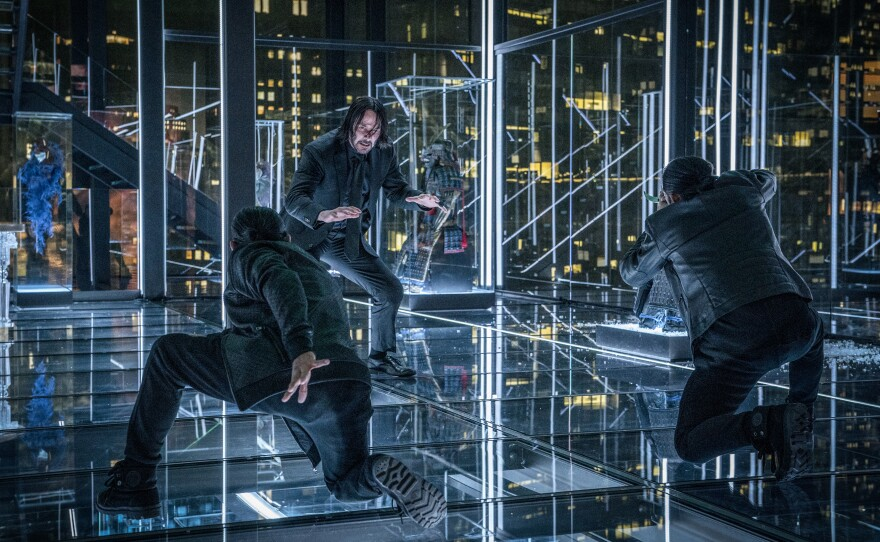
Just as we previously left him, at the end of John Wick: Chapter 2, our man Wick was hurtling down the suspicious streets of Manhattan, fearing for his life after having been recently excommunicated from the worldwide assassin community for (deservedly, in the film’s view) killing a person on hallowed ground. That ground was New York’s Continental Hotel, one of the many hubs of official assassin activity in, as we learn, an increasingly wide and complicated network and economy of murder. Its owner is Winston (Ian McShane), and he has used his power to delay the ensuing hit on Wick by one hour. We open John Wick: Chapter 3 – Parabellum mere minutes before that hit is to be sent out to, seemingly, every hit-person on earth. Parabellum’s Latin subtitle suggests – promises, really – no shortage of ego on the part of the film. And the dense and forbidding aura of its world, and the controlling and manhandling showmanship of this behemoth of a film, do not disappoint. This is a work that will summon swarms of extended forces, out of nowhere, to bear on one man who has to call forth an equally forceful reserve of will to survive, a celebration of one man’s capacity to survive a sheer, overbearing, unending onslaught of raw, leviathan-like cinema.
Wick 3 was the most highly stylized, most ornate of the series up to that point – the most continental of the Wick features, if you will, a kindred spirit of the aesthetic sensibilities more commonly associated with Continental Europe. That the one ostensible refuge in the film’s world suggests a hyper-controlled aesthetic sensibility seems to imply that the film’s aesthetic proclivities are ways of evacuating the ungovernable traces of real-world human spontaneity and uncertainty. This is a film that has been painstakingly manicured for us, to our liking, to do our bidding, to exert supreme effort and control in punishing one man and to take pleasure in his ability to survive that punishment. It asks that we revel in controlled chaos and the possibility of coming out the other side undaunted. It is pristine in the force of its construction, the single-minded brutality of its monomaniacal and thoroughly, violently uncomplicated imagination.
And revel we do. John Wick: Chapter 3 – Parabellum makes a pretty immaculate, almost indefensible, case for itself. The obvious criticism of the film is that its sound and fury signifies nothing, and that this film is so well-mounted and anointed that it can’t really register any suspense. That’s all true: we watch hundreds of people try to kill John Wick, and we delight as he kills them. In a sense, though, Wick’s over-modulated hollowness isn’t really so much a decrement as a sheer fact. While the film may seem empty on first blush, it might rather be that Wick refuses the injunction to make meaning out of its cornucopia of senses and perceptions. John Wick does not unearth some divine essence beneath all the madness, nor does it pluck any manna from heaven that unlocks the film’s mysteries for us. It just is.
The original film tied this (potential) limitation into its sense of character: Wick was so single-minded that he didn’t really have time to take-in the details of the world around him, or to question his own myopic moral philosophy. But the first sequel diverged and spread out considerably, which meant that the view that this is all the world-view of a circumstantially myopic protagonist wasn’t as easy to defend anymore. The increasingly baroque excess of the second Wick film, so distracting and disabling toward the original film’s streamlined, minimalistic purity, seemed like a display of hubris, a film self-consciously doubling down on complication just to scintillate us and satiate our Pavlovian desire for more. It felt like a decoder ring, an explanation that pacified the original film’s mysteries by explaining too much for its own good.
There is no decoder ring for John Wick 3, which threatens to invert its predecessor as well. It is so organized and catalogued, so dogmatically self-composed like its protagonist, that it becomes paradoxically satirical. The more this film clarifies its world, the more it seems to slip away from us, to leave us at a remove, hopeless to make any sense of it. The more confusing and overstuffed it gets, the more hollow and paradoxically empty it seems, the more it doesn’t “hang-together”. Rather than a failing though, this increasingly suggests a statement of impurity, a vision of a chaotic world overstuffed with arcane structures and subterranean forces, a modernity of conflicting, overlapping, parallel, and perpendicular lines devoid of any essential coherence, of baroque and absurdist rules popping up by the moment that we cannot possibly keep track of and which Wick himself can only grimace or smirk at.
It’s a highly oblique film, self-consciously artistic, but also comically incredulous, self-aware that beneath all its order and composure lies an extreme sort of instability, something the film teases in an early moment where Wick stumbles into Times Square, the fractured editing (atypical for the series) and circling camera helpless to explain or make sense of the swarm of advertisements and phantasmagorical, spectral presences around him. This chaos is modernity, and in trying to suggest that some secret clandestine organization gatekeeps it, that this film can organize it before our eyes, the film only reveals how silly that very idea is, an illusion crumbling before the chaos. In all its foolish grandiosity and reckless complexity, John Wick 3 is an abstraction of our world, not an escape from it.
Parabellum’s vision is both exquisitely controlled and desperately adrift, as though everything about this world can change on a whim and any logic meant to tie one scene to the next collapses in the next scene. It’s sort of like Chuck Jones’s “Duck Amuck,” Keanu Reeves as a much more taciturn and competent Daffy hurtling through a terrifying space without rules. Early on, its image of New York, from a backdoor doctor’s office to antique knife store to inner-city horse stable, is transparently absurd, linked together not by spatial logic but quasi-surreal interest, the sense that it would be amusing to put Wick into these spaces and for the audience to see him make his way out of them, a pre(or post)-narrative attraction with Reeves as the organizing principle behind the spectacle. Throughout all of this, there’s no attempt to transcend the viewing experience – and the perspectival meditation so central to it – by unearthing any essential truths about reality that exists prior to any given moment. John Wick reveals a defiantly but also tragically un-transcendent reality: the only way to survive the game is to play it, and to keep on trucking in spite of the fact that the world is so stacked against you and seems to be changing the game underfoot with every step.
In this regard, the image that sticks out most in that Times Square sequence is a video of Buster Keaton’s classic 1926 comedy The General, a film that famously ironizes the narrative of the lone everyman mastering the flow of modernity and triumphing over cause and effect to heroically saving the day. That film’s parody of cause-effect editing mocks the essence of bootstrap individualism, of the iconographic character who survives the world and its onslaught by linking it together via personal causal agency. The scene in John Wick implicitly figures Keaton as a kind of guardian angel for Wick, a guiding light physically above him and metaphorically putting him on his path. Keaton was another figure who wrestled with the increasingly unstable channels (to him, at least) of modernity, confronting physical and sensory motion that no longer seemed to contour his prescribed notions of The Way Things Go.
Keaton was another prophet of modernity who, like many of the figures from the era, attempted to grapple with technological sights, sounds, and sensations that he could not quite get a handle on. This, the most humorous of the Wick features, although that word seems inapt, rekindles that spirit, offering an accumulation of set-pieces that in no way sketches a sensible story or a unity of narrative but simply watches as one man attempts to keep afloat in the film’s deranged inability to cohere. Like Keaton, all he has is his body and its machine-like restlessness, most soberly recognized by Parabellum in an absurdly wonderful early fight where Wick and his assailants keep throwing knives at each other and pulling the knives out of their bodies to throw them back at their enemies. Their bodies, the film suggests, must become, and are always threatening to become, metal, and they must weaponize their own becoming-metal against one another even as this very process simply pushes them further down the path of having no internal life beyond his quest. To survive the chaos of modernity, the early 20th century intellectual Randolph Bourne wrote, requires putting “soul into iron,” but it always risks putting “iron” into one’s “soul”. We are left wondering why a film would exert so much effort to reduce a man to nothing, and to ask us to celebrate that reduction.
It all comes to a head in the film’s phenomenally blunt final scene (really, its final word), so matter-of-fact and deflationary, not building-on everything we’ve seen but puncturing it. The film somehow suggests that the only reasonable summation for everything we’ve witnessed is no summation, but, rather, a pragmatic, human, one-word terseness that cuts through the preceding 2 ½ hours and hundreds of millions of dollars like a knife into the film’s skull. It suggests that the only reasonable response to any of this is, in fact, one of the most common words in the English language, but also one of the hardest to truly mean, one which Reeves utters with a paradoxically ironic seriousness. Thus, the film suggests, bad things will happen, and the floor will come out from under you, and the only thing to be done is to keep doing what you do so, so well.
Score: 9/10

