 Woody Allen is back at bat with Cafe Society, another story of a writer and the spaces that inspire and threaten him. Obviously, we’re not at a loss for opportunities in Woody Allen’s back catalogue to examine the director in exactly this mode; the very sense of a fictive past that has tormented his characters for decades has come home to roost, with Allen’s films doomed to repeat themselves much like the work of his characters. That doesn’t mean they can’t repeat in style, but it is unlikely that they will be more stylish than the exemplary peak of Allen’s evolution as a serious artist throughout the ’70s.
In stark, almost combative contrast to the prickly ennui of Scorsese’s Catholic-guilt stricken version of the city or Spike Lee’s hot-box from hell, Woody Allen’s New York has typically taken the form of a watchful angel that tests and teases but ultimately loves all of its inhabitants. In Allen’s films, people rely implicitly on physical spaces and ideological places like New York to redraw and redefine themselves. In Manhattan, and maybe only in Manhattan, this self-definition feels threatened by a city that is itself threatened by its own constant makeover, a city that is always reimagining itself until it encroaches on evaporating from reality altogether.
Manhattan is Woody Allen’s most transcendent motion picture, and possibly his most deceptively thorny, because it is an unabashedly incomplete and contradictory ode to the city that has infected almost all of his masterpieces with a kinetic jubilance. A radical treatise on the redefinition of love, it is a film that pretends to cast its lot in with human relationships and ultimately exhibits its greatest curiosity about spatial geometry and the possibilities that percolate within the mental prism that nominally corporealizes as a cross-hatch of streets and avenues. Love here isn’t simply human connection but self-definition, and it has much more on its mind than a pas de deux of two people in an otherwise anonymous space. Continue reading →

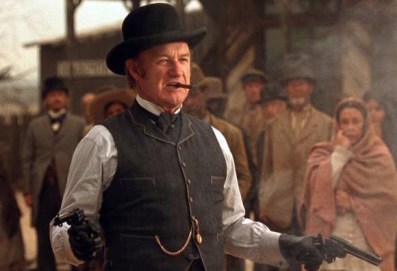 With Cutthroat Island as the never-off-the-ground bottom leg and Waterworld as the high-flying upright obelisk standing up on 175 million, the right triangle of box office halitosis spewing out from weird genre adventures in 1995 was completed with the dismal performance of Sam Raimi’s Sharon Stone-vehicle The Quick and the Dead. Which, in this metaphor, is the gnarly hypotenuse, the connective leg between Waterworld’s hyper-production-designed, outré weirdness and Cutthroat’s illogical idiocy. Continue reading
 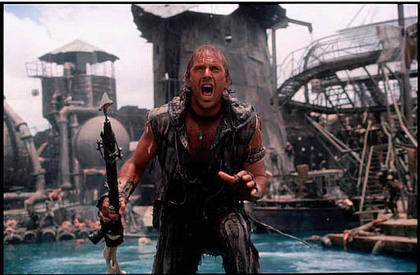 Waterworld
 Between roughly 1993 and 1998, the post-Tarantino brio that was at one point the most scorching lightning-bolt in cinema shifted to a self-immolating fire, a pox on the cinematic landscape, almost overnight. The beacon of the Weinstein-fronted American independent success story, Tarantino was a shining light on the cinematic landscape until a deluge of golden-child followers (see Boondock Saints) cast their mettle in Tarantino’s gilded name and overindulged in his post-coital cool and sometimes smug pearly whites without actually backing their versions of the tale up with the wit, elan, or the cinematic rattle and hum of Tarantino’s style. Posing had suddenly become an art form.
 I meant to get to this a couple weeks ago when The BFG was failing to tear up the box office, but with the Spielberg-loving Stranger Things tearing up Netflix, now is as good a time as any.
 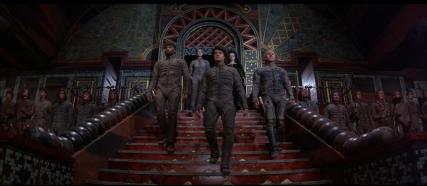 David Lynch’s Dune opens with a blissfully presentational monologue, a female face plastered onto the screen as she intones about spices like some intergalactic trade princess as her head glints in and out in a tease of a disappearing magic act that implicitly asks us whether we really care about anything she’s saying. It’s a dose of post-Star Wars and anti-Star Wars nonsense, a mocking of a genre by a director who had in 1977, the same year as that genre’s entrance into the mainstream, blasted a cavern out of the crevice in cinema left in the wake of Luis Buñuel’s quasi-retirement. Actually offered Return of the Jedi, Lynch accepted mega-producer and mega-trend-jumper Dino De Laurentiis’ offer to throw down with Frank Herbert’s story of space drugs and sand worms instead, and what came out of that unholy matrimony was one of the most famous misfires in cinema history.
  Glimpsed in light of Bob Rafelson’s youthful Head, released in the same year and theoretically covering the same territory, Otto Preminger’s gloriously screw-loose screw-up Skidoo is frankly mortifying, but it’s embarrassment with a purpose. While the former film burrows headfirst into a subterranean bebop of drug-crazed hyperbole with an editing rhythm like deranged improvisational jazz band and a mind ready to explode like the decade the film concluded, Skidoo is an improbable parade of Old Hollywood leftovers struggling on a voyage to The Way Things Are Now without a clue in the world how to chart their way. Head rushed around picking up the pieces of the world collapsing around it, while Skidoo is already in free-fall. An air of malfeasance and curiosity hovering overhead, Skidoo suggests a collection of trapped animals trying to figure out what the hell got them there. While the youths of Head are searching for an escape from an oncoming apocalypse they clearly see coming, the cadavers in Skidoo look about ready to enter a mausoleum.
 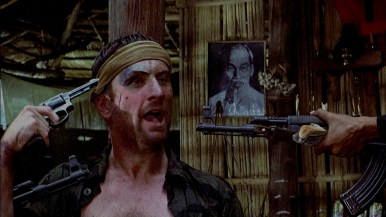 After resurrecting Hollywood from the stench of indulgent grotesque fantasias of the ‘60s that suggested only that everyone in LA had lost touch with reality, the rage and the recalcitrance that epitomized the American directors of the ‘70s swamped the nation with the renewed vigor of a country that was terrified about its own future. By The Deer Hunter’s release in 1978, the pandemonium of the decade had infested the films about the decade as well. The Deer Hunter, along with its even more improbable, free-wheeling follow-up Heaven’s Gate and Francis Ford Coppola’s fever dream Apocalypse Now, is among the most torridly unhinged films of the decade, an operatic dementia conclusion to the slow-burn of a decade, and a decade’s cinema, losing its mind. Something like the Great American Tall Tale of the 20th Century, The Deer Hunter is precisely the mess that the Vietnam Generation was. And, as an explosion of unmitigated, almost uncontrolled filmmaking that pursues the New Hollywood ambition to its limits, Michael Cimino’s most famous film is the perfect work to serve as the last bow on the New Hollywood style of filmmaking.
 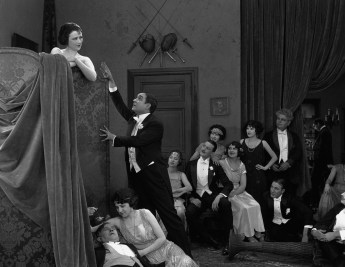 After the gargantuan, epoch-defining success of The Kid, Charlie Chaplin’s superstar status obviously moved him to illustrate his adventurousness and not rest on his laurels. His follow-up film, 1923’s A Woman of Paris, was rewarded with commercial confusion, owing primarily to Chaplin’s temporary rejection of his on-screen persona (he appears only in a Hitchcockian cameo). Advancing his tenure as a behind-the-scenes artist, Chaplin was perhaps tormented by the belief that audiences only appreciated him for the cane, the mustache, and the bowler hat and not for his visual wit or mastery of cinematic form (but of course, the accouterments of Chaplin’s Tramp character were among the defining features of his mastery of the cinematic form none the less). Indeed, in A Woman of Paris, Chaplin allows himself, temporarily, the sin of the title card (which he usually disdained) to explicitly remind the audience that he does not appear in corporeal form in the film, and that we should not request that he do so in order to value his art.
  The Long Take