
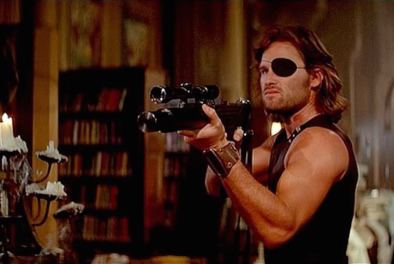
 Update June 2019: After a rewatch, I’m struck by how much Escape from New York’s essentially anti-authoritarian stance also feels like a quintessentially early ’80s response to the failures of the liberal project of the ’60s and the New Hollywood project of radicalizing cinematic form in the ’70s. Carpenter’s film undeniably paints a picture of the powers that be as deluded autocrats and maniacal functionaries, but its post-hippie validation of anarchy defines itself individually and skeptically rather than communally and with a utopian accent. On balance, I don’t know how I feel about this any more than I do Carpenter’s deliberately fearful Assault on Precinct 13, where a black cop and an old-school white criminal learn to get along only while under siege from an interracial army of cinematographically-zombified gang members putting aside their racial differences to assault the status quo. That said, while Assault merely updates and urbanizes Western conventions, Escape ironizes its, offering up cinema’s greatest ode to and takedown of the John Wayne archetype, one who refuses to coopt societally-accepted norms of the “good” (even if it means doing “bad”). Plus, it’s pretty great filmmaking nearly forty years later, a phenomenal exploration of Carpenter’s singularly elastic ability to massage visual absence into a vision of apocalypse, be it at the level of the individual (Halloween, faceless evil), the local (The Thing, evil in our own image), or the world, as in this film.
Original Review:
Scruffy and stubborn as a mule, Escape from New York is probably a failure for director John Carpenter, but it is a treat for anyone else all the same. Carpenter has been vocal about his genre-DJ dreams of hopscotching from horror to action to Westerns to fulfill his inner-desires of throwing pebbles toward all outsider genres under the sun. More pragmatically, he sought new genres to avoid type-casting as a master of horror. Trouble is that Carpenter’s soul, despite his brain telling him otherwise, was a horror director, and his eye followed his soul. Even Carpenter’s best action material – 1986’s Big Trouble in Little China for one – doesn’t work so much as an action movie; it’s more a deconstruction of American action movie tropes that tickles the rib with how foolish American action movies could be. Whether or not that was Carpenter’s intent, the arguably accidental success of Big Trouble reveals a director who didn’t have much of an eye for conventional action directing, for his action directing was too sluggish and stilted to function as a serious work of the form.
Continue reading

 With the summer release of Jeff Mickle’s new film, Cold in July, set to prove him as a director of considerable skill who’s in it for the long haul, it seems appropriate to look back on his two previous, relatively unknown and under-appreciated films, truly strong efforts both and films any discerning horror fan can appreciate. 2010’s Stake Land and 2013’s We Are What We Are are scary films, but their horror comes not from shocks but slowly building dread (don’t worry, though, Mickle knows how to underline his composed filmmaking in blood-red strokes when necessary) . He doesn’t give us choppy quick cuts. He lingers, letting his characters define his horror and giving us a blood-curdling melancholy.
.jpg) I’ve seen a lot of Westerns. I actively seek out the genre for two reasons. Firstly, existing within a genre of B-pictures with lesser commercial prospects, the films often have a freedom to poke and prod at the nature of film and storytelling in ways films with more money put into them, and thus with more money expected in return, might not have the unexpected freedom for. Secondly, and perhaps more importantly, the Western was historically perhaps the genre where America and its desires are most wont to play themselves out for audiences. Westerns explore a mythic version of traditional American life – some uphold it, some read it past itself to create untold postmodern myths, and some take a knife to the genre and skewer it for all to see.
I’ve seen a lot of Westerns. I actively seek out the genre for two reasons. Firstly, existing within a genre of B-pictures with lesser commercial prospects, the films often have a freedom to poke and prod at the nature of film and storytelling in ways films with more money put into them, and thus with more money expected in return, might not have the unexpected freedom for. Secondly, and perhaps more importantly, the Western was historically perhaps the genre where America and its desires are most wont to play themselves out for audiences. Westerns explore a mythic version of traditional American life – some uphold it, some read it past itself to create untold postmodern myths, and some take a knife to the genre and skewer it for all to see.  Update early 2019: Never a fun time reading these college-age early reviews, especially when you don’t have time to write-up a new take in full, but I’ll say after a rewatch that Carpenter’s film remains one of the quintessential films in its genre, and its decade: a portrait of geographic seclusion as abyssal isolation that doubles as a study in the breakdown of democracy, all while replacing the proverbial conservative “Other” of horror with the Other within. It’s greatest trick, then, is that it turns one’s opacity to one’s own self into a truly terrifying dispatch from the fringes of society, both a final transmission from flickering-out ’70s ennui and an inaugural howl of ’80s malaise. And it achieves this inward turn, forcing us not onto an outsider but back onto our own frightening selves, without ever resorting to any “psychological horror” tools to launder the horror by ensconcing it only within one character’s head-space. Truly disquieting stuff.
 Halloween was writer-director-composer-producer-fanboy John Carpenter’s introduction to the world of the cinematic masters (befitting his name, he probably is a carpenter too for god’s sake). It is, above all else, a master-class in pure style as well as a reminder that in horror, filmmaking skill and raw dread drive the narrative rather than the other way around. It’s economical, ruthlessly efficient, and spare. There’s a sense that every shot holds a purpose, and that Carpenter knows how to stage his camera for maximum impact. The film feels planned, rigorously so, and ruthlessly composed to a point bordering on obsession. It’s a masterpiece of slowly unnerving tension that builds at just the right amount throughout – every image adds to the film, and edits don’t so much transition as ransack the previous shot and take control. It’s fitting that its creator bears the last name of a craftsman – this film is all ruthless, clinically potent, monstrously well-constructed craft. If, in fact, he did hold the profession of his surname, this would be an oak chair assembled guerilla style and with little funding or time (the film was shot on an extremely meager budget), but which would bear the love and care of someone who truly loved woodwork and put every ounce of his skill and passion into making that one chair. That it would be the devil’s throne is just the other half of the fun.
 The Long Take