
 Now, for “Film Favorites”, two of the most beautiful experiments in color ever made: Akira Kurosawa’s Ran and Michael Powell and Emeric Pressburger’s The Red Shoes.
Beauty comes in all shapes and sizes, they say, but seldom has a film been so accidentally beautiful as Akira Kurosawa’s final epic of the cinema. Nearing his ’80s, the ever-productive Kurosawa could no longer see across the great distances required to aim a camera at the monumental swaths of chaos and order he wished to assemble and unleash in front of the camera. Functionally, in essence, he couldn’t direct the film he wanted to, but that didn’t stop him, nor did it hamstring him.
 Edited
 Thirty six years later, with the release of the grandly, boisterously cinematic carnival opera of Mad Max: Fury Road, it is difficult to peer back through the looking glass and glimpse the humble origins of the Mad Max fiction. It is difficult to remember that, for all its commercial and critical success, the 1979 release of Mad Max was nothing more than a budget of 400,000 dollars (a paltry sum then and now) and one of the great modern cinematic visualists doing everything they could together to disturb, provoke, and ultimately, to entertain and thrill. It is difficult to remember how intimately inhuman the original Mad Max is, how nonchalantly brutal and matter-of-factly nihilistic it is in its almost impressionist depiction of apocalypse and social malaise propped up by stunning, startling car chases of unquenchable viciousness. It is also difficult, in lieu of the great majesty of the second film in the series, Mad Max 2:the Road Warrior, to remember how effective the original grinding house classic of action entertainment is to this day.
 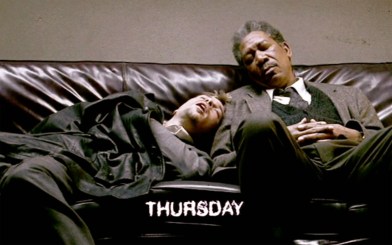 Yet 1995 was not simply a year of corporate indulgence; it was also a period where the rampant nihilist streak inherent to much of the cinema of the late ’90s and the 2000s and still running wild today came to fruition in the eyes of one music video director…
 The idea that a film could “kill” the career of one of America’s most loved stars seems a tad bit antithetical in today’s increasingly safe world, but then we don’t have many daring, singular stars like the ever fearless provocateur in a clown’s body that was Charlie Chaplin. Although the much-loved star carved out a lovable niche as a tragicomic by donning the rumpled clothing of a tramp and the heart of humanity at its simplest and most direct, he was always ready for a fight. His quasi-silent masterpiece Modern Times is one of the least hidden anti-capitalist films ever to be spooled up before an audience, damningly positing the internalization of mechanical soullessness into the human capacity for movement and survival. As if that wasn’t enough, he went on to fancy himself a Hitler-pastiche in The Great Dictator, playing with fire by targeting the holiest of subjects before it was even quiet enough for mourning.
 Updated mid-2015
 The Long Take