
 The Hunger Games: Catching Fire follows in the footsteps of its predecessor, being both a welcome surprise and a disappointment. A surprise because, ultimately, it is good, and in some ways more than good, and a disappointment because the ways in which it is good are essentially carbon-copies of its predecessor. Still, they are improved carbon-copies, and if we are in the business of deciding whether Catching Fire is better than The Hunger Games, it would be a great quest to find a way in which it is not.
Certainly, director Francis Lawrence is a notable improvement over Gary Ross, and although he doesn’t create the best version of this tale, he understands how to treat a scorched-earth with a tempo that seems poetic and evocative rather than simply solemn and stoic. It is no Malick film, although the filmmakers would probably want you to think otherwise, but there is a definite sense that Lawrence understands how to link shots together with an eye for the distressing dejection of a corrupt world without ever sinking into outright miserablism. It also helps that he is a distinctly superior action director to Gary Ross, but we will get to that when the film does, namely, near the end. Continue reading
 The Hunger Games is not a bad film, although it must be said that it is a decidedly superficial one. Which isn’t a bad thing, per-se. When Phillip Messina’s production design does wonders to sell the contrast between the dusted-earth Appalachia of District 12 and the pop-fiction of the Capitol district (locations which you can probably derive a function for without specific information from me), the film is a veritable hoot anyway. When the superficial is this good – take Judianna Makovsky’s loopy but dementedly blissful David-Bowie-at-the-circus costume design, for one – it can be easy to overlook how insubstantial all of it is.
 Alice’s Adventures in Wonderland, the novel, is naughty. Alice in Wonderland, the Tim Burton film, is just nasty. An expatriated perversion of Lewis Carroll if ever there was one, it is the culmination of Tim Burton’s decade-long trek to shoot in the back any of the good will he earned doing more with film history than any mainstream American director during the 1990s.
 Man of Steel is exactly the film its creators were always going to make, and too little of the film it needs to be. Obviously, with director Zack Snyder in the director’s chair, a grotesquely serious, stodgy take on teenage wish fulfillment is expected, and a great deal of the unease about the film before its release was directed entirely at his superficial eye for fetishistic violence-porn. Indeed, the concern was not only valid but imperative. Very little about Man of Steel indicates that Snyder thinks of Superman as anything else than a fist with a body attached, and the final act leaves no doubt. The man in the blue suit being carted around the film hurts and broods and bruises. He has the rippling abs and the stoic back story, but he is an imposter, plain and simple, a mechanical man with a fancy suit.
 Joe Johnston is not much of a director, perhaps because his heart lies outside of the modern sensibilities of film and he has proven unable to scrounge up the money to make the passion projects that lie in his dreams, and the dreams of so many children who went to the movies in the 1940s and 1950s. This is a reach, but his two best films are of a kind: 1991’s off-hand ode to old-school matinee thrills The Rocketeer and its spiritual successor, 2011’s Captain America, suffixed with the unfortunate subtitle The First Avenger. It isn’t a particularly exploratory or demanding film, or even a particularly fun one, but its mild geniality and melodramatic sense of charisma and fascination with comic book panache combine for a somewhat indifferent but well-meaning and usually well-playing exercise in pulp. It doesn’t always work, but unlike so many other superhero movies in the 2010s, it tries to work not by playing to the rafters, but to the matinee.
  Iron Man 2
 George Miller really wanted Mad Max: Fury Road. The back-story, the thirty year gap between Fury Road and its predecessor Mad Mad: Beyond Thunderdome, and the troubled, stop-start production for Fury Road itself all conspire to tell us this much. The beauty of the resulting film is that this back-story is both instantly extraneous and essential to unlocking its mysteries. All the hurt, all the torment, all the passion to release that which had been denied to Miller; all are instantly identifiable on the screen, but the film speaks for itself. Right before it blows your head off, but that is the Miller way. After releasing two extraordinary vehicles for tactile, sand-encrusted action under the Mad Max name, he went Hollywood and lost his edge with the third feature, the one whose biggest addition was Tina Turner. He spent the ensuing thirty years intermittently pursuing his craft in often stellar family films to recuperate, but his heart was elsewhere.
 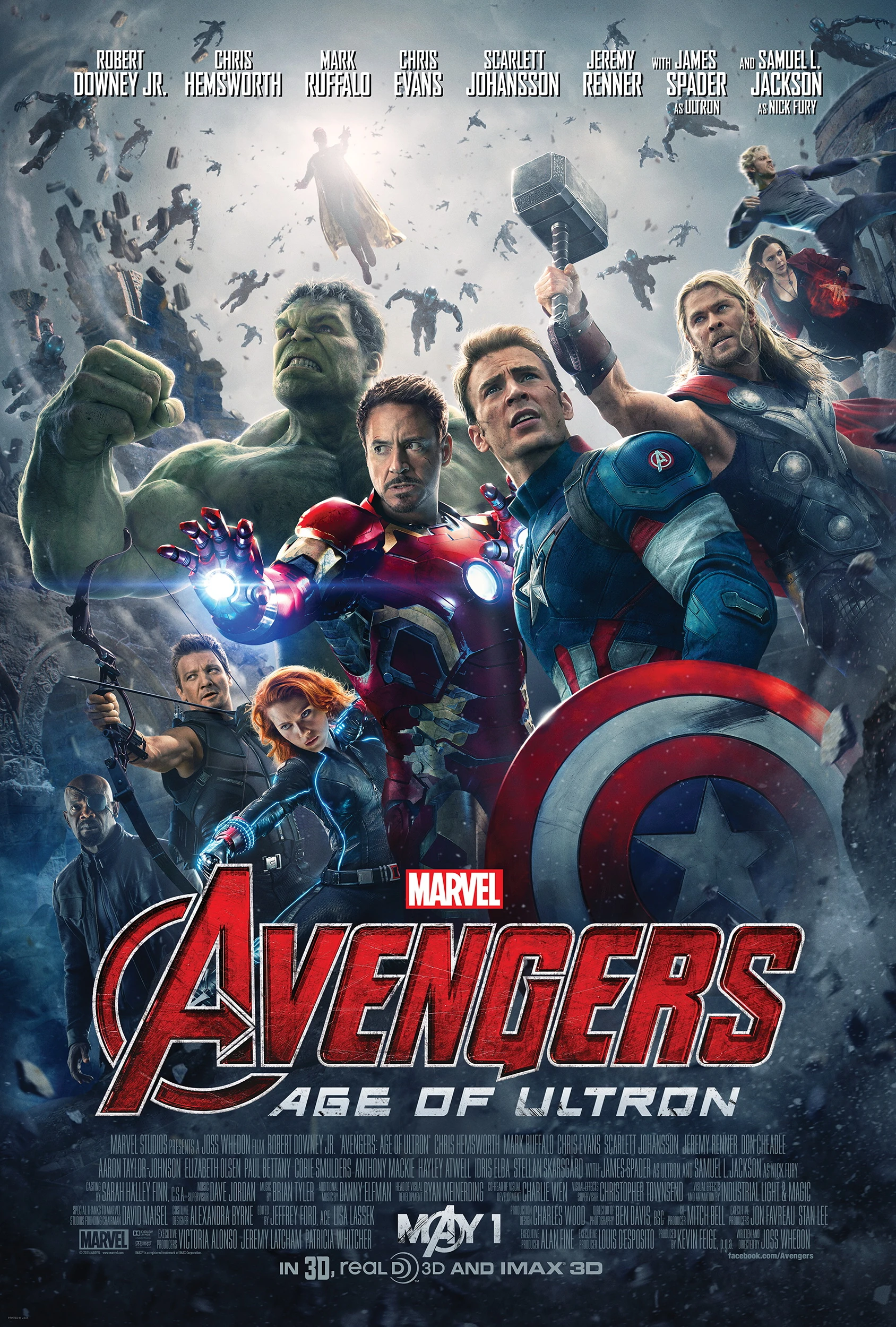 The most enticing moment in Avengers: Age of Ultron is successful because it is so elusive, and it may very well be the worst moment as well. When it begins, we are informed that the titular superhero smack-down squadron and consummate bickerers are off to Africa. We know we are going to Africa because the characters essentially say “we are going to Africa”. Smash-cut to a helicopter shot of a derelict shipyard. We know this is a shipyard because there are ships. It is also, one would assume, on a coast line, for that is where ships tend to reside. At this point, everyone’s favorite quasi-military font appears in lower screen with text that informs us, in as many words, “Shipyard, Off the Coast of Africa”, in case we were wondering if the ships were, in fact, airplanes, or whether they were docked in Nebraska.
 With Furious 7, sincerity is ubiquitous. It is ubiquitous in the discussion surrounding the film, and I’m afraid I will not be the one to butt heads with this claim, for sincerity is as ubiquitous in the film itself. Furious 7 is an idiot stew, sure, but for the entirety of its run time, there is never one second where it is less than fully committed to being itself, or less than entirely on board with its own idiocy. There’s a miniscule sliver of self-awareness thrown in for flavor, but by and large Furious 7 believes in itself. All of the nonsense about family crumbles in the abstract, but on camera it sizzles with zest. The film is nothing more than a soap opera where cars, guns, and and explosions sometimes (but not always) take the place of emotional breakdowns and cancer, but like any soap opera that works, it does so because it believes in itself and never tries to be anything it isn’t. Furious 7 is not a perfect movie, and in many respects it isn’t a very good one, but it is too busy having fun with itself to care.
  The Long Take