 To dispense with formalities: The Sixth Sense is not that good, but nor is it that bad. Its writer-director has never been a man subject to well-manicured, non-explosive statements – probably because he has never himself been prone to non-explosive statements (he did, after all, cast himself as a writer who saved the Earth in Lady in the Water). In his early days, he was, to his followers, a filmic genius, a genuine auteur in an age with precious few singularly great filmic voices. In recent years, he has become a filmic landfill, a genuine auteur for evil in an age with precious few singularly awful filmic voices. Everyone, regardless of what they think of him, seems to not understand the meaning of putting on the breaks. Either wonderful or despicable, he is a director who inspires opinions of great magnitude regardless of direction.
To some extent, both magnitudes are over-stated. His recent slate of films have managed the insurmountable task of consistent awfulness, but he is not the worst director in the history of cinema. Still, claims of his badness are more fitting than claims of his goodness. Even his best works are, if we are being honest, merely solid showpieces for a frequently confused writer with a better-than-average visual sense that at its best moments manages to convince audiences they are watching a better film than they really are. Case in point: The Sixth Sense, which is a sometimes sharp, occasionally sterling, often misguided work most notable for the frankly bizarre fact that it managed to rake in almost 700 million dollars at the global box office. Being a supernatural thriller, mind you. Ahh, movie-goers were different in the far-flung past of 1999. It dances vision of when The Exorcist (a similarly overrated film, although not as confused at the level of basic writing as The Sixth Sense) exploded into theaters in 1973 and ushered in a new age of respectable auteur-driven horror films for public audiences. But then, 1973 really was a different, pre-Jaws and pre-Star Wars, time culturally and filmically. 1999 is practically still in the womb. It was just yesterday, or so it seems at first glance. Continue reading →

 It is said that the best horror films traffic in the slithering, slimy replacement of the mundane by the uncanny. True, to some extent, but the best of the best posit something more. Take 1974’s The Texas Chainsaw Massacre by Tobe Hooper, a work that posits the mundane as the uncanny, locating a world where the mundane regions of American society were the most uncanny. A world where mundane and innocent society never really existed except in the romantic dreams of the American imagination. A world where everyday life is actually an uncanny abyss of demonic activity just waiting to swallow goodness and human life up whole. Continue reading
 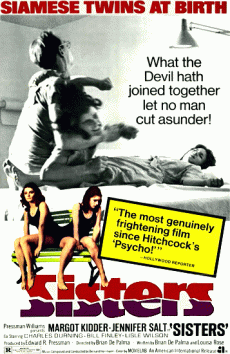 A Brian De Palma double-feature this week on Midnight Screenings.
  Amidst the sinew and cartilage of cinema during 1999, so many new cinematic talents emerged from the fray that it can be easy to overlook some of the talents who, charitably speaking, took a while to truly do any emerging. One such force, David O. Russell, spent the better part of the next decade generally hiding from the cameras and doing his damnedest to sour his indie-goodwill, keeling over his once-bright reputation until he was known more as a blistering brute, an angry young discontent of a director behind-the-camera, than as a genuine talent whose skills were readily viewable on-screen. He became an untouchable, in other words, scaring off actors as far as the eye can see and sending them scouring for the new next young upstart director.
  If 1999 is an important year in cinema history – which most believe it to be – The Iron Giant is arguably the most important single film in the entire year’s canon, beginning as it does a great trend of films both wonderful and abysmal we have not yet escaped from: films based off of Pete Townshend concept albums.
 Eyes Wide Shut was Stanley Kubrick’s final completed feature film, and fittingly for a director who did more to redefine and test narrative cinema than arguably any other director of the 20th century, it feels like the summation of his decades-long quest to test how Machiavellian cinema could be. It feels like the completion of his life quest, but it also feels pointedly incomplete, like a work that remains alive and growing to this day. A work that refuses to be batted down or defined. A work that always has something to say to us, that invites discontent and disagreement, and a work that shows a talent still learning new tricks right up until his final moments. Kubrick was a director who always seemed both wise beyond his years and too young, too reckless, and too much of a social provocateur to fit in with the supposedly mature, normative adult world of cinema. Eyes Wide Shut, inviting both the age of wither of a great old-school fable and the heedless, impulsive, devil-may-care gravitas of an unformed New Hollywood bad-boy, is the culmination of all the contrasts that made Kubrick himself.
  Edited
 Photographed by canonical cinematographer Conrad Hall near the end of his long and varied career, American Beauty is a luminously, exasperatingly gorgeous motion picture. It also makes you feel a little sick for caring about cinematography at all, especially when it is put to use excusing and gussying up Alan Ball’s amateurish, ruthlessly self-apologetic, largely confused screenplay. Ball is a fully capable writer – his television shows have their place in a society currently convincing itself it is in the midst of a sort of Golden Age of Television. But he has never been particularly suited to the cinematic medium, and his exercises in concision truncate and confuse what is given episodes upon episodes to expand itself on the small screen. In particular, he has a severe difficulty managing tone, shooting from sickeningly sentimental monologues about modern society to cruel and unusual acerbic put-downs of a great majority of its cast, not to mention the paltry, piece-meal questions raised by his simplistic treatment of the modern middle-class. American Beauty is a troublesome, troubled film, and all the beauty in the world can’t make up for a screenplay as hurtful as this.
 With Jurassic World’s 500 million global first-weekend box office take, it is already commonplace to glorify the return of a franchise that has been some combination of long-dormant and actively awful for almost two decades now. Championing its return to quality is not a new point, although it is an incorrect one. Jurassic World is a bad film. Not only that, it is peculiar and abnormal in its badness. A great number of corporate tentpole blockbusters are soulless and mediocre – look at Age of Ultron just a month post-release – but seldom are they bad in a particular and notable way. Corporate spending on audience-testing mandates that blockbusters will be spic and span, not necessarily good, but not disconcertingly or notably bad. They may be corporately bad, or bad in a sterile way, but not specifically bad, and not especially bad. Jurassic World does a great many things that are specifically, especially bad, and that is, if not a good thing per-se, at least an accidentally worthwhile one.
  The Long Take