
 This review published, belatedly, in memoriam of the death of author Richard Adams.
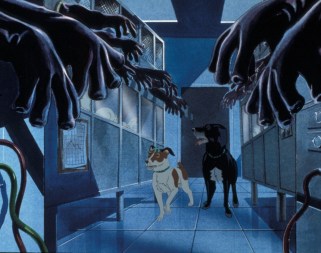
The bubonic and beautiful, hoarse-throated The Plague Dogs, if anything, actually descends even further and more confidently into the morass of melancholy and infestation that made director Martin Rosen’s previous Richard Adams story Watership Down such a famous British miscreant in an era of child-friendly, compromised animated films. Refusing to be defanged, this follow-up to that estimable classic is a blighted wretch gnawing on the face of sanitized American children’s animation. Although Labrador Rowf (Christopher Benjamin) and Terrier Snitter (John Hurt), who escape an animal testing facility, are the protagonists, the diligence that Rosen spends drafting their trek through the countryside scouring for purpose or any scrap of stability they can possibly find is the real standout. The film exudes a quiet devastation metered out in intentionally paltry images of inescapably malnourished beauty, and the film’s fangs never retract. They’re pretty sharp too. Continue reading
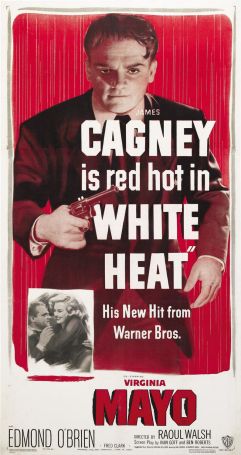 Raoul Walsh’s cold-blooded reptile of a late-period gangster picture finally stills itself only when the genre reaches its apocalyptic acme in the death-scented denouement, the fumes permeating outward off the screen. Even when the credits crawl, the film refuses to be dismissed. The title doesn’t lie – shards and splinters of visual and sonic phosphorous sparkle right into your eyes with infectious charisma – but the punch and gusto are also counterpointed by chills of loneliness and murmurs of exhaustion. Released in 1949, White Heat evokes a genre’s last gasp, a style ready for a nervous breakdown, bracketing staccato bursts of violence to harried melancholia to disheveled, droll comedy. Gone is the wiry little slugger of star James Cagney’s youth found in the likes of The Public Enemy, replaced instead with a self-worrying work that examines its own rat-in-a-cage tempestuousness and ultimately embodies a missing link between Hawks’ Scarface and the downright pernicious onslaught to come in Bonnie and Clyde.
 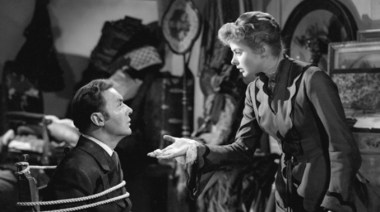 George Cukor’s slightly creaky but undeniably spirited psychological thriller is quite a bit more “potboiler” than it is willing to admit until the Guignol denouement where the old fuss-and-stuff middle-of-the-road “please Knight me now” respectability of the diction and mise-en-scene pounces right into the ditch where it belongs. A B-picture in A-picture threads, it’s only when it unstitches its chest-caving corset that Gaslight finally has room to breathe. Which is to say: Gaslight is a little over-determined and too dignified in its prestige-pic wax to embrace the deliriously illicit trashiness at its core. (De Palma has essentially remade the film three dozen times, and while that statement may be hyperbole, how does one tackle De Palma without exaggeration?). Old Hollywood smut can be oh-so-gallant in its strewn-from-the-gutter and out-on-the-edge charisma when it just smacks some of that musty old regal upbringing right out of its properly-dictioned self. Yet Gaslight, while often killer, spent a little too much time in finishing school, dotting its I’s and crossing its T’s, and not enough time out on the streets learning how to play in the dirt where its heart truly lies.
  A little old-timey cartoon before a feature for you all.
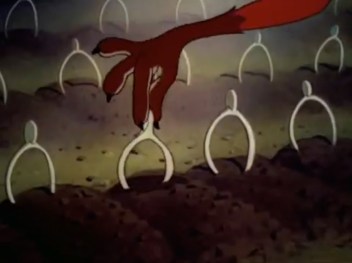 Chicken Little
 I know the post is a little late, but at least I managed to watch these films on Halloween.
  I know the post is a little late, but at least I managed to watch these films on Halloween.
  Defanging the shroud of mystical primitivism cast over African-Americans while also recasting black America as the spiritual center of American modernity, The Negro Soldier is simultaneously mildly hat-tip-able and deeply troubling in its propagandistic ideological concoction of egalitarian American opportunity for even the darkest and most neglected among us. Of the Frank Capra school of not-untroubled but always plausible American possibility, The Negro Soldier is one of the more documented “Why We Fight”-adjacent films even seventy years later, and also among the more inescapably despicable in its morally compromising sanding-over of racially-fraught American history in the name of the kind of hermetically-sealed war-time inclusiveness that only exists … well, it only exist in the motion pictures, as they say. This is the American road to freedom, with no pothole large or oppressive enough for Capra not to blanket over in warmth and saccharine sweetness (of course, a blanket isn’t going to stop you from falling into the American nightmare of racism if you get a little too close to reality for Capra’s comfort). One wonders what hell the devil John Huston would have wrought for one of his wartime propaganda films…
  Mining conflicted stereotypes (alternately positive and negative and typically all of the above) of African-American culture wherein performance is nothing less than a fact of life and a principle of pure being, Stormy Weather reflects both WWII Hollywood’s sudden-onset awareness of black audiences and its indomitable drive to comb every inch of the American identity for souls to claim at the box office. Of course, this “sudden-onset awareness” was hardly circumstantial: with a significant portion of the movie-going audience abroad and embroiled in conflict (not that there wasn’t conflict on the homefront…) Hollywood suddenly discovered a reason to spread out its extremities in search of someone new to market to.
  One doesn’t exactly go into a “Victor Fleming Production” and expect a kind of trashy wail covered in barbed wire. And one doesn’t get it with Red Dust, but it still feels like a specter from another world, the Pre-Code Hollywood world to be exact. In stark contrast to his one-two Gone with the Wind, Wizard of Oz punch in the most golden of Hollywood’s gilded years, 1939, the trim, rough-housed Red Dust never aspires to greatness, and as such, it is never strangled by an imaginative affinity with histrionic hyperbole run amok (the latter mode being MGM’s most cherished tone). Instead, this earthy, husky MGM film is a vortex of lusty, vulgar brashness and disreputable puncture wounds. Unfortunately, though, it’s all haunted over by the never-ending specter of colonialism in an Orientalist world authored by the West to serve as a presentational backdrop, even a manicured garden, for white subjects to battle out their own individual problems while towering over darker faces that are little more than part of the museum-quality scenery. I suppose you can’t change everything that was part of the conservative MGM claw.
  The Long Take