
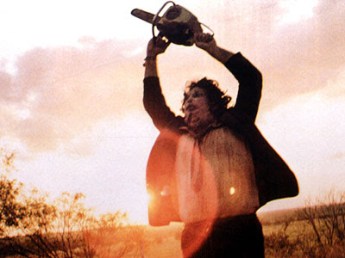
 Updated mid-2017 after another rewatch – such an amazing, amazing film, not particularly violent in a diegetic sense, but one which feels as though violence has been done to it.
This post being in honor of the film’s fortieth anniversary this upcoming Wednesday, October 1. Here’s to forty more years of soul-deadening terror.
The story of five nobodies wandering through rural Texas and running afoul of America’s hidden secrets, The Texas Chainsaw Massacre is infamously violent, which is curious because it’s hardly violent at all. The body-count is shockingly low and deaths happen mostly off-screen, relegated to the abyssal margins of an already poetically empty screen space, one which seemingly voids participation in a wider social milieu. But if the movie feels violent more than it is violent, that’s because it feels positively disgusting. This is grimy, disturbing filmmaking in every possible way, almost toxically fugitive in its disobedience to propriety. It may be one of the grossest-looking famous movies ever released, somehow both punishingly direct and monstrously, mystifyingly oblique, like it’s showing us everything head-on while veiling more submerged truths about American discontent. The film grain, even for the time, is knowingly poor – it feels like a documentary more than a film, lending it an unsettling and grimy immediacy, but also an evasive sense of ambiguity. The film-grain scratches which are testament to the authenticity of its expression of reality also suggest the film’s curiosity about a reality that is ultimately inexpressible, a sense of horror which is both extremely forthright – sometimes breaking through the film screen itself to confront us head-on – and obliquely suggestive of terrors we aren’t, and perhaps can’t be, privy to.
Continue reading
 Update fall 2018: Been a few years since I last saw this before the current viewing, but After Hours remains truly unstable, and clearly too brutally crazed to be labeled a psychoanalytic “portrait” of Scorsese, with all the easily-contained clarity and visibility the notion of a portrait implies. After Hours is much more of a working-through than it is a legible work of art; it’s the rattled consciousness of a director obviously exposing himself to nervous tendons in search of transcending them, and it’s gloriously untamed.
 Terrence Malick didn’t crash into the film-world – he stumbled into it, but the impression he left wouldn’t convey the truth of it. A philosophy student at Harvard who studied Kierkegaard, Wittgenstein, and Heidegger, he went on to teach at MIT after a petty disagreement with his advisor while studying as a Rhodes Scholar at Oxford (although in the world of philosophy, everything and nothing is petty). At some point along the way, he decided he felt like making a movie, and the world was never the same. That film, 1973’s Badlands, is so stunningly like every other kids-on-the-run crime film from the American New Wave from a distance, it’s almost comical. But from up-close (or even medium distance), it’s so glaringly apparent that Badlands is the antithesis of the films it’s often compared to (ahem, Bonnie and Clyde) that the initial comparison seems so superficial as to not even be worth noting. Badlands is unlike any film from the period, and American cinema more genuinely. It is a singular experience, and a towering, titanic one.
 A note: Technically, Wings of Desire is the only one of these two films in the German language and the only which takes place in Germany, but both are thematically very similar and so interconnected it seemed inappropriate to reflect on one without the other. Plus, Paris, Texas is a West German/ English co-production. So, despite taking place in the US (and, pointedly, in the most god-damn US state of all, Texas) and being filmed completely in English, it still technically qualifies. Allow me my questionable logic. Things will go easier from here if you do.
  With the summer release of Jeff Mickle’s new film, Cold in July, set to prove him as a director of considerable skill who’s in it for the long haul, it seems appropriate to look back on his two previous, relatively unknown and under-appreciated films, truly strong efforts both and films any discerning horror fan can appreciate. 2010’s Stake Land and 2013’s We Are What We Are are scary films, but their horror comes not from shocks but slowly building dread (don’t worry, though, Mickle knows how to underline his composed filmmaking in blood-red strokes when necessary) . He doesn’t give us choppy quick cuts. He lingers, letting his characters define his horror and giving us a blood-curdling melancholy.
 First, a note: If not for plot synopses, I might write twice as many film reviews. A synopsis is that desperate time when I have to actually remember (!) what I just saw in narrative terms and commit violence upon my mental understanding of visual storytelling by reducing it to words on paper (well, internet paper) about the “plot” of a film. I have to pretend as though a paragraph explanation of the “event” of a film is an accurate description of what can make a film good or bad. It is no secret that I am a firm believer that just about any plot description can amount to a terrible film as much as a great one, and that it is the storytelling and not the “plot” that a story makes. So this causes me great dysfunction.
 Richard Ayoade’s second film is certainly an ambitious affair. Not only is it an adaptation of a famous work of literature, the novella of the same name by Fyodor Dostoevsky, but it’s more an experiment in filmic language than a narrative proper. The story of a man, Simon James (Jesse Eisenberg), bored with his life and introduced to another, darker and more aggressive version of his self, the narrative is rather proudly enigmatic and obtuse. Writer-director Ayoade and co-writer Avi Korine run layers around themselves as they subvert their narrative not so much through scripting complication but more through visual chicanery. We do not learn much about what is going on from the script – in some sense, it is an experiment in challenging the audience with a narrative that has no real beginning, middle, or conclusion. We’re left to look to the visuals to save us from our confusion, but Ayoade has other things in mind.
  If The Guard was a strong, entertaining if somewhat slight caustic comedy, Calvary keels over and knocks things back down to Earth, hinting at even greater things under John McDonagh’s sleeves in the process. The film, which details one week in the life of Father James (Brendan Gleeson) and takes place in a quintessentially Irish countryside, deals with crises of faith with an uncustomary humanity and sincerity (especially considering John and brother Martin’s reputation for snarky, brittle humor). The warmth shouldn’t be confused for lack of despair though – the center of the plot is James being told in a confession booth that the man confessing plans to kill him at the end of a week. The reason? He was molested by another priest in his childhood and, after trying to cope for years, he can no longer come to terms with himself and needs to lash out to acquire some sense of vengeance.
  A Field in England opens with a warning about the film’s psychotic, psychedelic imagery, but it serves, and was likely intended, as much as a badge of honor– the film’s visuals are gloriously perturbed, and the trickery on display is the film’s biggest selling point. This is all the truer when one considers the film’s enigmatic narrative and its clear subversions, even from its opening moments. If the film opens with the aforementioned warning about its visual nature, it immediately cuts to a black screen with only chaotic sound for thirty or so seconds, pointedly delaying what it’s just promised us. Then, of course, there’s the film’s black-and-white monotony when we now automatically associate visual splendor with cheerful color, and the fact that the film opens with a battle scene captured purely in close-ups and shots of single, atomized people, as well as quavering images of bushes. It doesn’t play like a battle in reality, but as the arch impression of a battle, the sense of chaos and loneliness ever-present but indescribable when on the edge of life and death – it’s an almost abstract collage of imagery divorced from context to convey the holistic difficulty of understanding war representationally or experientially. A Field in England is a pure, distilled cinematic hell.
 Updated mid-2015
 The Long Take