
 Robert Aldrich’s What Ever Happened to Baby Jane? lies perilously close to Sunset Blvd., so much so that the screenplay by Lukas Heller and the visual style by Robert Aldrich would be shameless repeats if they weren’t so rapturously evocative and explosively effective. You can call it whatever you want: a drug-addled fever dream variation on Sunset, a hysterical nightmare that Sunset had about itself, a corrosive purifying of Sunset so that all the relative cleanliness of the material had been washed away until only the abrasive sandpaper at the core remained. Ultimately, what saves What Ever Happened to Baby Jane? is not how it differentiates itself from Sunset, but how it rips into the Sunset aesthetic with such scabrous gusto and full-throated commitment that it exposes the horror cinema trappings of the chiaroscuro noir-speckled visuals and wonderfully garish vulture-like acting of Billy Wilder’s venerable 1950 film, the ultimate Hollywood work on the perils of Hollywood. Continue reading
Midnight Screening: What Ever Happened to Baby Jane?
Leave a reply
 In honor of the thick, physical, downpouring heat of the August Summer nights upon us, the sorts of nights where (quoting Thelma Ritter) rain doesn’t cool anything down, but simply makes the heat wet, I decided to tackle two films from the all time literary master of making the heat feel so wet you can drown in it: Tennessee Williams.
  In honor of the thick, physical, downpouring heat of the August Summer nights upon us, the sorts of nights where (quoting Thelma Ritter) rain doesn’t cool anything down, but simply makes the heat wet, I decided to tackle two films from the all time literary master of making the heat feel so wet you can drown in it: Tennessee Williams.
  If Orson Welles truly did pine for the spotlight, he was nevertheless often at his best devouring all-comers while occupying the fringes. Maybe it was his passive-aggressive drive that forced him into a corner. Maybe having to struggle for his reputation was purifying for him. Maybe having his own little corner of cinema fed his ego and controlling belligerence. Maybe he needed to be left out in the cold, so he could burn even more dangerously. Whatever the case, whether Welles actively retreated into the nether realms of independent cinema or was coerced to hibernate there, Welles never let go of his dream. Becoming a Hollywood outsider, if anything, only made him angrier and more loathsome, and loathsome Welles was Welles at his most playful. His self-serving grandeur and operatic diction could take on a pompous hue when he was already at the top, but when he was picking his battles from the outside, as with Mr. Arkadin, his directorial bravura actually seemed carnivorous and challenging, even combative. Working from the outside gave Welles something to fight for, and Welles with fangs drawn ready to pounce is the only real Welles in my book.
  Two Sam Fuller films this week for Midnight Screenings, one from the very beginning of his career and one from the mature, weary Fuller nearing his end.
 Two Sam Fuller films this week for Midnight Screenings, one from the very beginning of his career and one from the mature, weary Fuller nearing his end.
 Nicholas Ray is not generally considered a canonical director; he’s a deep cuts guy, but he holds a pride of place among the faithful. His films are so unapologetic in their demonic distortion that they seem to decompose the very girders of cinema itself. The films themselves become dangerous. But Ray deserves all the status in the world, for his films were more sincere than arguably any other directors working at the time, or ever. Ray’s films lived with a pure mantra, and arguably the purest mantra of all great directors: cinema should, at its best, be a totally sensory experience, an experiential pang of emotion where story, theme, and character are transmuted into direct experience.
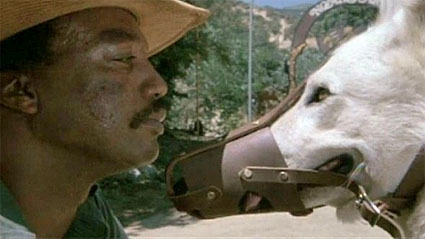
  After Pat Garrett and Billy the Kid, Sam Peckinpah would move away from the 1800s, although that doesn’t mean he left the Western behind. Bring Me the Head of Alfredo Garcia is without a doubt a Western; it is as cracked and craggy as any of Peckinpah’s prior films, and its thematic content is almost identical, although it takes place in the 1970s. This is fitting, and perhaps the only way Peckinpah could have progressed as a director. His prior two Westerns saw the end of the era, with Peckinpah tackling the transition from the individualist, outlaw lifestyle to a more socially sanctioned form of violence bred by corrupt and violent men being buttoned up on the outside without actually curbing their violent tendencies on the inside. The Wild Bunch and Pat Garrett and Billy the Kid were about the end of the West, but also about its continuity, its persistence in the modern era. The deserts and the ten-gallon hats had been replaced with institutions and machinery, with the industrial revolution and government. But the raspy habit of men fighting the only way they’d been taught how, and the curdled fact that these men were being destroyed by these ways, remained.
  It is easy to view Pat Garrett and Billy the Kid, Sam Peckinpah’s first Western post-The Wild Bunch, and examine it as a follow-up to that seminally shrieking exercise in wolf-like nihilism. It would be easy to do so, and probably correct, but also incomplete. Pat Garrett, which follows ex-outlaw turned lawman Pat Garrett (James Coburn) as he vengefully hunts down his ex-partner Billy the Kid (Kris Kristofferson), bears an outline that is almost identical to The Wild Bunch. In both films, an ex-outsider who becomes a man of respectable society is strangled by his dogmatic commitment to hiding the memories of his lawless days by killing the last reminder he has of those days. In both films, the violence of wild society gives way to the violence of so-called “civilized” society, and in both cases, the social outlaws must die so that the corporate, conglomerate violence of civil people can live.
  This week’s pair of Midnight Screenings will return us to the far-flung past of 2006 and 2007, a more innocent time in film history …
 The Long Take