
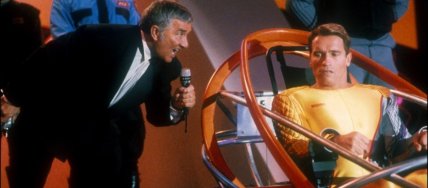
 It’s been a while since I’ve done these Friday B and/or cult movie reviews, and I’ve decided to return with two dystopian films set in the year of our Lord 2019, offering visions of THE FUTURE that may or may not have come to pass.
… And then there are those films which receive consummate passes in the mainstream simply because they’re “prescient,” a word that should, at this point, clearly join “honest” in the critics’ jailhouse. Running Man is one such film, far less provocative in its embodiment and critique of fascistic tendencies (and its ability to recognize the fascism latent in capitalism) than Paul Verhoeven’s fellow 1987 action-sci-fi classic Robocop, lacking Verhoeven’s almost psychotically perfect understanding of blockbuster mimicry (without ever tipping his hand), not to mention Verhoeven’s impish, gleeful bloodletting. Compared to Verhoeven’s film, The Running Man delights in showing us the cards early on: this is a broad, unashamed Hollywood action film, and a satire totally ashamed that we won’t realize what kind of social commentary it has on its mind. Continue reading
 One might think TCM2 is an obvious proposition: director Tobe Hooper attempting to escape the dark days of artistic poverty known as the ‘80s by returning to his most demonic days, forging a communion with the film devil and resurrecting the zombified corpse of his most famous film, The Texas Chainsaw Massacre. But TCM2’s is no sycophant wearing its father’s clothes; more like a renegade fugitive dressing up like a horror film to throw the authorities off its trail. It is its predecessor’s polar opposite, as overt a case of a cinematic progeny rebelling against its parent with youthful indiscretion as the medium has ever birthed. Anticipating the devil-may-care comic mania of The Evil Dead 2 with as much brio but much less skill, Tobe Hooper’s sequel to his most famous film at least deserves points for attempting – rather openly – to misdiagnose its predecessors’ successes and run around in its own bizarre head-trip version of the original. An overt comedy, the film’s combustible zaniness is spirited even if it isn’t really inspired, and it sometimes feels like a colossally misjudged entity that is worth seeing only for the courage with which it misjudges itself. The quasi avant-garde set design and the ludicrous, anarchic disinterest in conventional mood skeletons mark Texas Chainsaw 2 as a fugitive inferno of sustained weirdness.
 With the untimely passing of another horror icon, a quick look at a few of his films that aren’t *that one*.
 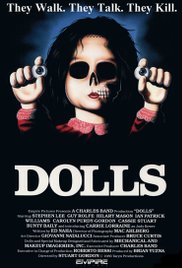 A new Annabelle sequel I haven’t seen is out; faced with the grim opportunity of reviewing its immediate predecessor, here is a much better killer doll film.
 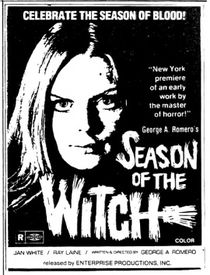 Season of the Witch
 I can think of hundreds of better films, but Face/Off is some kind of zenith, like a pure slab of movie-making distilled. Beyond being a gleefully trashy amped-up B-movie delight, as gloriously dysfunctional as it is intoxicatingly sure-handed, John Woo’s best (and only good) American film is a blockbuster treatise on the nature of identity, the only American picture he handled that remains truly permissive to his personal predilection for films about the dualistic nature of identity and the loss and retention of self. Hard Target (dementedly designed climax aside), Broken Arrow, Mission Impossible II, and certainly Windtalkers and the abominably luke-warm Paycheck all feel like imposters, but Face/Off has the special sauce, that auteurist alacrity and deliciously eccentric sense of self that only Woo could bring to a production like this. Nervously coiled interpersonal drama interpolated with orgasmic explosions of pressured-violence, this radioactive tangle of a film is exultant movie-making from beginning to end.
 I know I should stop beating the dead horse of The Untouchables (it just doesn’t kick enough to truly live), but, Raising Cain? Now we’re talking. Five years after The Untouchables, and De Palma is back where he belongs: up to no good. Vigorously so, at that. Taking a sabbatical from tent-pole films (to be resumed soon enough with Carlito’s Way and, of course, Mission Impossible), Cain is a full-throated, fully-equipped expressionistic cluster-bomb of De Palma’s stylistic slipperiness, throwing his outre configurations of canted, dubious-perspective angles at us like a self-propagating fire. Avoiding any pretense of a sympathetic protagonist or a moral opponent for main character Dr. Nix (John Lithgow), Raising Cain lives up to its riotous name and then some.
 The depressing timidity of Brian De Palma’s mercenary The Untouchables, a paycheck directorial role if ever there was one, is consummated in the centerpiece sequence, a verbatim riff on the famous staircase rumble and tumble from Eisenstein’s Battleship Potemkin (which was itself not as good as anything in Eisenstein’s prior film Strike). De Palma’s version is technically proficient – maybe even perfect – but purposeless and entirely rudimentary, excoriated of Eisenstein’s surrealistic flourishes and political-revolution tectonics. De Palma’s detractors tend to think of him as a Hitchcock plagiarist who debases that cinematic master of the macabre, but their argument falls apart when De Palma’s hedonistic formal pirouettes and wry, audience-blackmailing comic filigrees push Hitchcock way over the sanity edge. For scholars who ghettoize De Palma as a copy-cat and a reduction-artist, the real lynchpin of their argument should be The Untouchables, which repeats Eisenstein only to render him null and void.
  Freud and Superman and Fellini and sleaze-house dens all make walk-on appearances just in the introductory passages of Brian de Palma’s Hi, Mom!, a quasi-satire, or at least a loosening up of, the malevolent Hitchcockian Rear Window. A bizarre-world antecedent to Taxi Driver, this is a film with Robert De Niro obsessively subjecting New York to his viewfinder until he is himself victim to and participant in an artistic nightmare. Relentlessly aware of its own spectatorship and shot-through with neurotic ambivalences, the film always has film on the brain, and the muscles, and the loins. But De Palma refuses to rest on this tried-and-true meta-textual laurel, instead wandering off – skipping, even tumbling – in untold and untested directions. Call him a Hitch parasite all you want, but Hi, Mom! commandeers Hitch for its own sinful purposes.
  Hectoring becomes a professional endeavor, or professional filmmaking becomes a form of hectoring the audience in John Huston’s whacked-out Beat the Devil, entirely denounced when it was first released and somehow bent and mutated even further sixty four years later. Temptation begs that I reclaim the film by arguing that it was “misconstrued’ upon release, but I’m not entirely certain it exists to be construed. That might only breed domestication, curbing the film’s vigorous unruliness. With a regular goon squad of odd cartoon shapes masquerading as people waiting around in a squalid sea-port town, the whole film seems to exist to breathe in the salt water. The most exciting moment is entirely about an aging, wheezy Bogart and a pair of portly fellows schlepping after a runaway car, teasingly dramatic music massaging out the irony of their failure to exert more than a modicum of effort. It’s awkward, heinous, mismatched, and oddly brilliant in its idiom.
  The Long Take