
 Hectoring becomes a professional endeavor, or professional filmmaking becomes a form of hectoring the audience in John Huston’s whacked-out Beat the Devil, entirely denounced when it was first released and somehow bent and mutated even further sixty four years later. Temptation begs that I reclaim the film by arguing that it was “misconstrued’ upon release, but I’m not entirely certain it exists to be construed. That might only breed domestication, curbing the film’s vigorous unruliness. With a regular goon squad of odd cartoon shapes masquerading as people waiting around in a squalid sea-port town, the whole film seems to exist to breathe in the salt water. The most exciting moment is entirely about an aging, wheezy Bogart and a pair of portly fellows schlepping after a runaway car, teasingly dramatic music massaging out the irony of their failure to exert more than a modicum of effort. It’s awkward, heinous, mismatched, and oddly brilliant in its idiom. Continue reading
Midnight Screening: Beat the Devil
Leave a reply
 Recast as a fair-weather Hollywood rebel with Terry Gilliam’s 12 Monkeys – breaking the rules only just enough to accrue a superficial glaze of strangeness – Chris Marker’s La Jetee is the real deal. It’s as aesthetically radical as any film this side of, well, Hiroshima, Mon Amour three years earlier, at least, but La Jetee was released in the most aesthetically radical period of cinema ever, so “as (blank) as any film since (blank)” has the misfortune of not really working here. Marker’s short-film is an elegy for the cohesive illusion of time as a passive process, as an unalienable fact to be perceived identically by all and regurgitated out by scores of films more or less in unison. Most films grant themselves safe passage to erase time, to treat time as a background specter to be shocked into corporeality when a film needs to increase its own stakes via a ticking clock bomb or parallel editing that expands time to increase suspense. Films escape time, essentially, and they ask us to escape with them; they whisk us away, projecting a parallel universe where the events of the world are liberated from death, from age, from vulnerability to the physical realm, to the material reality that conditions their own existence.
  Contrary to its reputation as a one-sided morass of sobriety, Ingmar Bergman’s The Seventh Seal is prismatic in its consciousness, a fitful and lithe creature that can crawl on its belly like a dark acolyte of existential Swedish woe one minute and cartwheel to celestial fields of comic (and cosmic) foolishness the next. Although accruing the dredged-in reputation of a stilted monolith afforded to only the most holier-than-thou, protected-by-the-Vatican masterpieces, Bergman’s film is a Janus-headed creature that matches its bristling dread and ability to turn terror into torpor with a spontaneous brio and elastic mood permissive to sparks that constantly disturb any tonal equilibrium. The film’s detractors conveniently fail to notice its many appetites, such as how it leverages it doleful imagery for its more amusing undercurrents, or how it teases out symbols that are as cheekily self-reflexive as they are morbidly pious. And, although Bergman’s representation of Death has been parodied too many times to count, none of them match Bergman’s Death and his statuesque, unwavering anti-charisma for sly suggestion. The film’s detractors are more-so trapped in a state of arrested development than the film.
 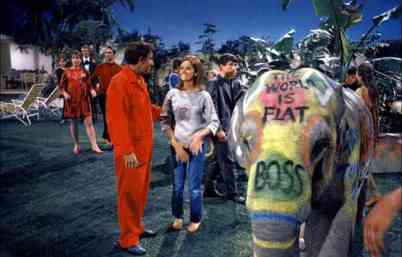 Blake Edwards does Jacques Tati in this natural evolution (or devolution, if you prefer) of the unwinding chaos of The Pink Panther and A Shot in the Dark. Toying with the perception of physical space and middle-century domesticity, The Party begins with a simple premise – an Indian actor adrift and misconstrued in a bourgeois Hollywood party – and stokes into a case for pandemonium as an ultimate liberation. If his fellow Brit Richard Lester was uniquely keyed into the beats of Beat and the menace of Mod, Edwards’ film seems to find a mantra for life in visual bedlam. Charting a path from lone Indian infection in a white person’s world to full-bore mansion pandemic, Edwards not only massages an ethnic minority’s failure to assimilate into virtue but ignites it to demolish the implicit codes, customs, rituals, and aesthetics of the Western bourgeoisie.
  Meant to review this in memoriam for Bill Paxton earlier this year, but with Powers Boothe passing as well, I had no choice but to get around to it. Both are great in this underrated horror film from arguably the worst period for the genre in film history.
 The path of least resistance for Dusan Makavejev’s WR: Mysteries of the Organism is to demarcate its boundaries to the realm of a frank and unadorned depiction of sex in all its musty and fleshy glory. This is itself highly valuable, especially as a respite from, and a riposte to, decades of puritanical and repressive arms of society and cinema that have abstracted the body beyond itself symbolically to make it more than itself and, in doing so, less than itself, unable to acknowledge the fact that the body’s tangibility cannot be contained by a symbol.
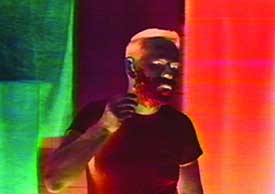 Not simply a nostalgic death-trip into the nooks and crannies of memory, the virtually unknown Jerome Hill’s filmic autobiography represents a filmmaker kindling his impending demise into a reason to forage for new refreshment in the untested future of the imagination. Although beset by illness, he tackles previously unexplored currents of the self in the present, specifically the mind’s capacity to invent, predict, and propose partial and potential futures for itself. More conventional passages as temporary pause points rather than the overall skeletal framework, Hill largely deposes the rulebook for autobiography and, particularly, the almost infernally dull, antiseptic tone of most cinematic biopics. Whereas many biopics devolve into trials by information or an unceasing march of event rather than a parade of exploration or dangerous cinematic interpretation, Film Portrait does not define life by moments lived so much as moments imagined in the life of the mind. Film Portrait is, one might say, overtaken with death, but in rumination on the past and projection into the future, it reenergizes the cinema of the then-present. It is a film as vital and coursing with life as anything the American New Wave young-bloods like Scorsese could muster at the time.
  Released in a time of mass-scale social disruption and near-cataclysmic unrest of a decidedly corporeal character, the Maysles’ Brothers’ Salesman is careful to remind us that plain old fashioned social malaise and boredom had not dissipated either. While Southern men were burning crosses, as Neil Yong reminds us, they also sometimes cared less about “what their good book said” than whether hoking the word of the Bible could provide them a stable living. Southern men, and Northern men too, all bible salesmen. And all drowning in the mire of the mid-century American Dream failing them in small, pin-prick increments by the day.
 Cross-pollinating drift-less images of New York City – disabused of cause and effect linkages – and vocalized letters written from director Chantal Akerman – in New York – to her mother in Belgium, the urban miasma in News from Home is at once bereft of life and brimming with space to impregnate with meaning. Partially, the film is a compendium of an adventure by a still-jejune filmmaker, Akerman, who was nonetheless extraordinarily knowing and prematurely wise beyond her years. But rather than a carefully synchronized, highly stylized metropolis with scores of people and interlocking pistons of motion bordering on entropy, Akerman sketches New York as an inoperative world that could easily be Venus, or a Tarkovsky film. This is New York as disembodied specter.
 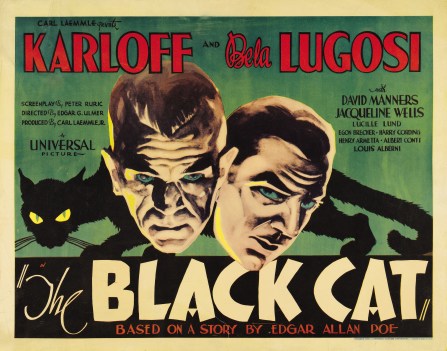 With The Mummy generally serving no one’s interests and possibly nailing down the coffin on Universal’s Dark Universe project, let us look back at one of the best – and most underrated, non-canonical – Universal Horror films, and the first to feature their two biggest stars.
  The Long Take