
 M. Night Shyamalan is the gift that keeps on giving. Just when you thought he’d hit his true low, and just when you thought less creative control over his material would save the day, he pulls a fast one and comes up with something even worse. As it turns out, Shyamalan can vividly ruin a known property about as well as he can dream up mindless drivel of his own creation.
The Nickelodeon television show Avatar: The Last Airbender is generally regarded as a high-flying adventure with characters that fly even higher, a work of spirited kinetics that isn’t afraid to share in its character’s pain. All of this is accomplished via a broad narrative about a brother and sister of the water tribe (this world is ruled over by four tribes each aligned with an element). In the show, and in the film, these two are Katara and Sokka (played by Nicola Peltz and Jackson Rathbone in the film, and I use “played” in a broad sense here). One day while exploring they discover a young boy named Aang (Noah Ringer), and the film follows the earlier portions of the television show as they come to realize he is the last of the air benders (benders being people who can control their affiliated element with panache). Continue reading
 And then he made The Happening. Lady in the Water was a collage of self-important grand movie statements about the state of the world doctored up by a man who had not one clue what the world was, let alone how to convey that on the screen. What could be a better counter to the big-boy statements of a preachy message film than an elementally chilly exercise in pure nihilism and horror? With the idea for The Happening, Shyamalan seemed to be at least listening and returning back to the muck and earthen horror of what he does best (indeed, atmospheric horror is the only thing he ever did well). Ideally, The Happening could have been an exercise in humorless style and pure cinematic horror, entirely visual and lacking in any of the pretentious import of Shyamalan at his worst.
 A note on “worst”: As mentioned before, this series is an attempt to dissect some of the alleged “worst” movies of all time, and primarily not a hope to actually find them. It is ridiculous and arguably mean-spirited to refer to any of M. Night’s films as among the worst ever made. They are a special sort of badness, and he is now four films deep into a wonderful, scorching form of incompetence, but it is wrong-headed to claim that “the worst movies ever made” all happen to be well-budgeted Hollywood films from the past ten years from a major director and with major stars.
 It isn’t difficult to find issue with Beyond Thunderdome, nor is it difficult to pinpoint the root cause of the problems: Hollywood money, and the desire to go big or go home. Both things that Miller used like a sledgehammer in Fury Road 30 years later to wonderful effectiveness, but which here see him step up and trip over the need to focus on a plot that doesn’t much go anywhere. The pure cinema appeal of the series is certainly lost (with Fury Road, Miller managed to go big without inducing a case of the talkies), but it doesn’t do well to overly criticize something for simply having a more elaborate story. Still, admittedly, the focus on “plot” for Beyond Thunderdome sacrifices the queasy, nihilistic immediacy of the original Max and the off-kilter humor and the implacable malaise hanging over The Road Warrior, a malaise brought on precisely by the fact that the film never much “went” anywhere plot wise and established, instead, a feeling of stagnancy.
 Update 2018 with Roeg’s passing: Slightly less taken with Walkabout’s politics this time out. As a critique of settler colonialism, it’s both vaguer and less eloquently abstract than Peter Weir’s wonderful Picnic at Hanging Rock, a truly poignant and critical take on a cloistered community corseted by their own haze of superiority and indifferent curiosity about other ways of life.
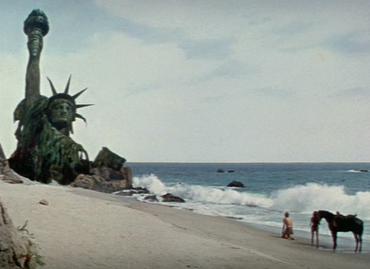 Right from the beginning, Planet of the Apes settles itself on a nexus between tactile action and implacable inaction. The prologue, set on a spaceship as astronaut George Taylor (Charlton Heston) throws his throaty baritone into a mission log, establishes the very 2001: A Space Odyssey sub-Kubrickian cosmic chill of the material. Taylor, along with Landon (Robert Gunner) and Dodge (Jeff Burton), are on an amorphous vision of an intentionally nebulous, even pointless nature; what matters is not where they are going or why, but the existential frostiness of the pallid white of the ship’s interior and the very present deadened quality in Heston’s worrisome but unconcerned voice.
 When we last left him, former police office Max Rockatansky (Mel Gibson) lost his family and his best friend, and had fulfilled a most unfulfilling form of revenge on the now lawless highways of the Australian outback. He had lost and repaid the loss only to realize that there was nothing to be won back. When we last left him, there was nothing left for him but the empty road.
 Thirty six years later, with the release of the grandly, boisterously cinematic carnival opera of Mad Max: Fury Road, it is difficult to peer back through the looking glass and glimpse the humble origins of the Mad Max fiction. It is difficult to remember that, for all its commercial and critical success, the 1979 release of Mad Max was nothing more than a budget of 400,000 dollars (a paltry sum then and now) and one of the great modern cinematic visualists doing everything they could together to disturb, provoke, and ultimately, to entertain and thrill. It is difficult to remember how intimately inhuman the original Mad Max is, how nonchalantly brutal and matter-of-factly nihilistic it is in its almost impressionist depiction of apocalypse and social malaise propped up by stunning, startling car chases of unquenchable viciousness. It is also difficult, in lieu of the great majesty of the second film in the series, Mad Max 2:the Road Warrior, to remember how effective the original grinding house classic of action entertainment is to this day.
  Many of the films I’ve reviewed for this month’s descent into the darker regions of cinema at least welcome the benefit of general acceptance. They are, if horrible, known quantities in their horror and thus well-equipped to inform the viewer of their badness beforehand. Put simply, you know what you are getting into. Yet, deep down, any traversing adventurer of the medium secretly knows that the movies that are regularly trumpeted for their badness cannot truly take the cake, that the real depths of incompetence are almost certainly unknown to anyone but the form’s most cherished devotees. When you get down into it, we know that the films that are generally well-known to be the “worst movies ever” benefit from a certain functional quality that makes their badness understandable to the general public. It makes them actual movies, in other words, capable of being judged in relation to other movies and considered worse.
  In the frantic next-big-thing post-haste grab-bag of follow-the-leader early ’80s pop cinema, the successes of Star Wars and, to a lesser extent, more barbaric works like Conan the Barbarian, took the cinematic landscape for a ride and everyone was struggling mightily to stay on board. The general thrust of the plan was “make it like the 1950s would have, but add in just a bit more violence for the kiddies”, and with this, we can single out a few filmic years caught searching for cover under the perpetual hail of hyper-masculinized, macho bro-forces that mistook the likes Rambo: First Blood for a Reaganistic hagiography of big dudes with bigger guns. Littered deep under the fallout, after you move away the rubble for a few hours, one of the most culpably misguided, and among the earliest of these films, emerges: Megaforce, perhaps the most perfectly captured distillation of the year 1982 anyone was ever capable of dreaming up.
 The Long Take