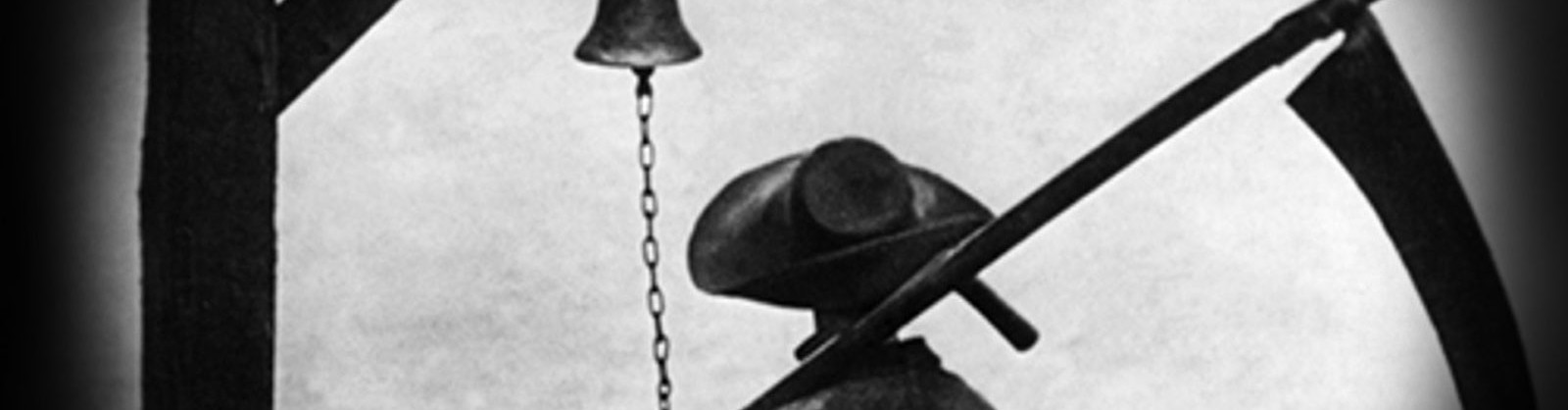
Update 2018: Uhhh these early reviews from my youth burn my eyes so. Vampyr is too sublime a film for the quality of review below to do it any kind of justice, yet there is never enough time to revisit even such a foundational film in writing. (I mean, it is only the banner image of my website!) Of course, part of the reason that I don’t have time to fully explain the film is that a work like Vampyr so capably resists any definition or sedimentation. All these years later, my favorite thing about it remains that, despite its heavily imagistic texture, Dreyer’s conjuration seems to resist imaging, to thrive primarily below the perceptual barrier, like a shadowy outline or impression discarded on an abandoned wall.
Dreyer’s work is quite pragmatic in this sense; its images burn into our brain not with the tendentious force of a grand theory but with a worrisome in-definition, a sense in which the images aren’t solidified enough to “represent” anything. They dislocate us with their refusal to additively mount-up as most films do. Instead, they seem to unfurl outwards without emanating from any perceived essence or center, not even a portal to hell. Thoroughly estranging in its refusal to declare, the only thing Vampyr mounts are moments of severe uncertainty, curiosity, active deconfiguration, ultimately effusing a bewildering refusal to illustrate certainty to us, a prophetic inclination to decline revelation. Instead of subterranean tunneling toward essence, Dreyer’s films hover over unstable, constantly fluctuating foundations, in this particular case witnessing space as a diaphanous flutter while remaining thoroughly removed from it.
In this sense, the film’s modality is truly singular, resistant to any definitive statements. Despite frequent comparisons to German Expressionism, the film’s contours actually incline quite a ways away from that estimable Weimar tradition. Absent in Dreyer’s phantasm are any of expressionism’s aspirations to manifest the latent, to tear apart the exterior surfaces of the world and extract the psychological interior beneath. Vampyr holds no psychological pretensions, no suggestion of access to the furthest reaches of the human mind. Perhaps because psychology can so easily tilt from modernistic advance guard of the mind to rote regurgitation of heavily prescribed, obviously underlined meaning emboldened in cinematic boldface, carefully keyed to “tell us” what the characters are thinking and feeling, Vampyr’s resistance to the sublime actualization of crystalline imagery is all the more intoxicating today. Its meaning seems not locked in a time and a place, to have been actualized on the screen in the film’s present, but to come from some far gone past, or some alternate plane, and whisper into our future.
To the extent that this is frightening, it is quite a different psychic turmoil than Weimar Expressionism usually offers. If Expressionism tortures us with the realization that our psychological selves will never be as complacent and composed, as whole, as they seem on the surface, Vampyr terrorizes us with a more spectral appreciation of a more fundamental indefinite(ness), one which cannot be reconciled by “telling” us what psychologically dwells beneath that surface. Dreyer’s later films advance this question further, but already in Vampyr, his films seem not sculpted for accessible meaning, but rather divined, even necromanced, from another system of meaning entirely. A system, in this case, where characters are not so much inlaid with psychological architecture – the work of the film being to unpack this architecture as the “core” of the person – but iconographic. They are figures in the wider montage of an artist.
So if Vampyr’s images rhyme with the rest of the world, they are nonetheless all their own, allowed to freely resonate and reverberate on their own terms and at their own frequencies as a portrait of a specific imaginative location. Without any fashionable post-modern opacity, Vampyr lurches about alarmingly at a sinister, slothlike tempo, struggling to represent the seemingly unrepresentable, to visualize a seemingly occult knowledge that seems to be obscuring itself as it comes into being. Not because the film is trying to confuse us, but because it seems to have tapped into a genuinely uncomfortable, unsupportable base, to encrypt a truly ephemeral sense of ontological decomposition, to truly and unabashedly ponder cinema’s fundamental aspirations toward knowledge and truth. Continue reading →
 Update late 2019: Looking back on some old Joaquin Phoenix films with Joker raising such a ruckus, and I’m torn on Her after a six-year gap in viewing. The film certainly feels less monumental than it did six years ago, but that’s also a show of strength: quietly but demonstrably, critically but not-cynically, the film exhibits curiosity about relationships, identity, and the world, and its lack of capital-case textures and showboating maneuvers suggest the subtlety of its craft more than Importance ever could. That said, I’m less certain that Her’s curlicued production design affectations, while kept in check from garish Burtonesque grotesqueness or Wes Anderson-esque excess by Hoyte von Hoytema’s phenomenally diffuse, naturalistic cinematography, are actually the auto-critical gestures the film so clearly thinks them to be. The film’s look is still pointed, and still effective, but at times, it encroaches on the very mannered twee-ness that the style otherwise so thoughtfully diagnoses about modernity, so much so that the film seems cloistered and soul-bearing at once. Is it thoughtfully contradictory for the film to lean so clearly into its very object of critique, as though swirling around in its own critical gaze, or is it simply too-cute by half?
 Richard Ayoade’s second film is certainly an ambitious affair. Not only is it an adaptation of a famous work of literature, the novella of the same name by Fyodor Dostoevsky, but it’s more an experiment in filmic language than a narrative proper. The story of a man, Simon James (Jesse Eisenberg), bored with his life and introduced to another, darker and more aggressive version of his self, the narrative is rather proudly enigmatic and obtuse. Writer-director Ayoade and co-writer Avi Korine run layers around themselves as they subvert their narrative not so much through scripting complication but more through visual chicanery. We do not learn much about what is going on from the script – in some sense, it is an experiment in challenging the audience with a narrative that has no real beginning, middle, or conclusion. We’re left to look to the visuals to save us from our confusion, but Ayoade has other things in mind.
  Edited Dec 2014 after I watched a second time and noticed how jaw-dropping the sound design is; sometimes the beauty of images, and the fact that film is a primarily visual medium, distract from the wondrous world of noise.
  Updated mid-2015
 Edited and Updated 2016
 Edited late-2015
 Edited June 2016
 Edited
 The Long Take