
 Edited
Released in the arguable peak year of a particularly turn-of-the-century form of social consumerism undercut by social discontent, Fight Club is uncommonly similar to fellow Class of 99-er The Matrix. Like the era-defining Wachowski sci-fi smorgasbord of high-flying kicks and high-falling ideas, David Fincher’s conniving would-be exercise in cinematic post-modernism is a startling technical showpiece well-versed in genre mechanics that curdles under the weight of its oppressive, over-baked interpretation of social anomie. Except, while The Matrix eventually gave in and realized it was merely an action film putting on airs, Fight Club, adapted by Jim Uhls from the book by Chuck Palahniuk, takes refuge in its pretentious vision of society until the very end. It would seem that the great, unfortunate secret of the cinematic year of 1999 is that a great many of its biggest hits are stunning visual showpieces hiding deeply incompatible or incomprehensible screenplays (it is no surprise then that the year’s best film, Kubrick’s Eyes Wide Shut, succeeds primarily because it is entirely about its visuals, rather than an attempt to marry those visuals to a needlessly over-baked narrative). Continue reading
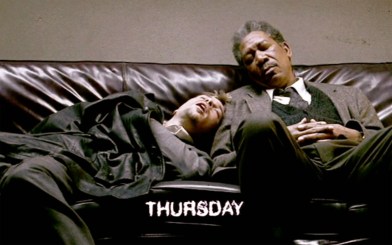 Yet 1995 was not simply a year of corporate indulgence; it was also a period where the rampant nihilist streak inherent to much of the cinema of the late ’90s and the 2000s and still running wild today came to fruition in the eyes of one music video director…
 Doom-and-gloom maestro David Fincher has taken the 2000s and 2010s as his time to find respect, and as we all know, that is one of the worst things for a filmmaker to do. Mainstream success is one of the surest trains to cinematic acquiescence, and there ain’t nothing like acquiescence to numb the lifeblood of cinematic passion. Sure, 2008’s The Curious Case of Benjamin Button was his only overtly Oscarbaity film, and he did follow it up with his second best work, 2010’s The Social Network. But recent years have seen him look back to his lurid earlier days with nostalgia and a drive to recreate his darker and more nihilistic earlier efforts, and his efforts have proven one thing: slick has replaced sick, and Fincher’s desire to find commercial success has smothered any breathing room for his pitch-black cinematic treats to truly submerse themselves in operatic melancholy and deranged lunacies.
 The Social Network proves one thing clearly: the internet is a dangerous place. Many people are aware of the dangers which afflict people using the internet, but few are aware of the consequences of creating an internet site, most of which derive from the simple fact that many sites, like seemingly everything else in the world, are businesses. And like many businesses, they’re prone to be run by egotistical, asocial madmen in human clothes who desire, above all, to shape society to their own terms when they may have had trouble fitting in to its. Due to this, the internet can lead to great riches as well as a number of far more devastating and de-humanizing effects, and The Social Network, the excellent David Fincher-directed adaptation of Ben Mezrich’s The Accidental Billionaires, deals with both sides of the coin in a fascinating, invigorating, and often scary manner.
  The Long Take