
 If the “set-piece” as a concept ultimately drives the latest in the surprisingly durable and, more surprisingly, quite malleable Mission Impossible genre, Mission Impossible: Fallout unfortunately is not quite as dexterous with its operatic set-pieces as its predecessor Rogue Nation, entry five in the franchise, nor as deliciously droll in its elastic, Looney Tunes momentum as Ghost Protocol, number four and two films before this new 2018 offering. That fourth film in the franchise legitimized the whole affair after fifteen years of mucking about in Cruise’s dimming star power and alternately playing sub-Bond and super-XXX, much as I do admire Brian De Palma’s truly egomaniacal, knotty inversions of Cold War memory lane in the franchise originator. If Brad Bird’s entry was a course-correct, allowing the franchise to finally stand tall only by turning its legs to string, asking it to wobble around in a spontaneous, comic fracas, the fifth entry, the first from Fallout director Christopher McQuarrie, gilded it in a peculiar mixture of avant-garde classicism. Each set-piece recalibrates the film, ricocheting it around to many alternate registers while simultaneously assimilating ballet, underwater dance, and pop-art alike into its combustible cocktail. Continue reading
Review: Mission Impossible: Fallout
Leave a reply
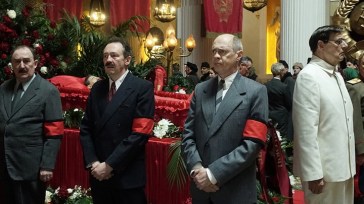 Armando Iannucci achieves new heights (lows?) of disquieting nihilism in the murderously vicious The Death of Stalin, his much-delayed follow-up to his decade-defining, Bush-era-capping In The Loop. That earlier film was a trans-national, Pond-hopping comedy of (foul)manners, both exceedingly timely and essentially timeless in 2009. (Visualizing Western politics as a dangerously out-of-control carousel, it remains the quintessential Iraq War film, and, to my mind, the sharpest commentary on the Bush era). In 2018, The Death of Stalin may be no less timely in an era of sudden Russian ascension, even if the particular brand of relatively gun-on-its-sleeve totalitarianism depicted and mocked in The Death of Stalin is less than truly applicable to either modern Russia or America’s brand of oppression which compresses classical liberalism, neoliberalism, and totalitarianism into a 21st century stew. Still, while making fun of this relatively “explicit” brand of totalitarianism is not the most cutting in 2018, The Death of Stalin is obviously a scorching, bracing, extremely obstreperous film nonetheless. And for all its gravid, ghoulish potency, Iannucci’s film is also a sage refuge for cinematic comedy, not only almost unmanageably uproarious but piquant in its observations on the depths of human selfishness and the intercommunal pandemonium of the political sphere at its foulest.
  Steven Spielberg’s The Post, furiously filmed and edited while the director’s Ready Player One was in the waiting room, lives and dies on the dialectic tension between its directors’ childlike enthusiasm for the newspaper industry and his curiosity for the realpolitik which both deflates enlivens the dream of an easy or natural democracy. Spielberg, even the liberal, is essentially defensive about democracy’s ability to surpass itself. He introduces himself into the strand of Enlightenment thought which approaches democracy’s thought-project with tempered appreciation, exposing its limits and its strengths and ultimately emphasizing the social contest and progressivism which stems from within the democratic liberal tradition rather than outside it.
 Perhaps the pop-cultural event of 2018, Marvel’s Black Panther depicts an insular African paradise that has become a moral limbo simply trying to stave off the murderous, colonialist purgatory of the world around it. Insofar as it is aware of these paradoxes, of the contradictory nation of Wakanda – indeed, the paradoxes of colonialism, the contradictions of modernity, and the ambiguities of the world – Ryan Coogler’s film is pop culture par excellence, inquisitive and exquisite in equal measure, enveloped in a brashness of spirit and mind that animates it. But Black Panther is equally enveloped in its own hubris, and finally, its own containment, its own conscription to a vision of modernity (to paraphrase David Scott) that it pretends to dismantle or, at least, disrupt. By film’s conclusion, it seems that the very paradoxes which infect Wakanda – its simultaneity of liberation and domestication, liquefying emancipation and stiffening respectability – also contaminate the film itself. The film’s elegance is both its grandest achievement and its central problematic, the encrypting idiom for a film which is hugely and depressingly invested in laundering its rebellious core in an aura of self-righteous reputability.
 In a timid act of fear for my critical faculties, I’ll begin with what I do appreciate about Peter Weir’s generally fine The Truman Show as a display of good faith, and so that the rating at the end of this review makes a touch more sense. Weir’s much-adored pop-post-modernist thing is, for a solid hour minus change, an entirely convincing character study, genially endearing if mildly anonymous, about a man, Truman Burbank (Jim Carrey), who wallows away his indifferent life in the hermetically-planned community of Seahaven without much more than passive positivism. Generally endeared to a low-humming belief that something, anything, must exist beyond his agreeably plum but criminally middle-class existence, Truman is a high-concept character at his best when he’s quietly emphasizing his humbler qualities, much like the film about his life, a life which also happens to be a planned television show Truman is unaware of but which the rest of the world is rapturously devoted to.
 With Mission Impossible: Fallout alighting the blockbuster sky with the best Hollywood action since Mad Max: Fury Road, I decided to visit the birthing pains of a franchise that began as something quite a bit different.
  Somehow both graver and more innocent than Winter’s Bone, Debra Granik’s follow-up to her career-making film (although, how it speaks to the treatment of female directors vs. actresses that we think of what that film did for Jennifer Lawrence relative to Granik) is at once more restful, compassionate even, and yet vastly more traumatic, locating major tragedy in the most minor-key of moments. Lacking that film’s bet-hedging semi-hicksploitation which feigned genuine dramatic ambiguity and equivocation while still gifting audiences the pacifying pleasures of a clearly-marked hero, Leave No Trace is a truly Herculean drama precisely because it resists any of the monolithic or totalizing compulsions the adjective “Herculean” might suggest, moral-mapping most of all. It is an extraordinarily gentle film, almost oneiric, albeit suffused with potent undertows of melancholy, like a dream-spun fable that mushrooms into a grave-like shroud.
  Ready Player One is hardly Steven Spielberg’s best feature film – heck, it isn’t even his best feature film of the past twelve months – but it might be the surest grasp of his talents, the most elegantly inelegant spiral he’s mounted in years. While his real masterpieces all work to some extent without him – Jaws boasts an astonishing full-throated and sharp-toothed screenplay, Raiders of the Lost Ark is deliriously sardonic with the question of its protagonist’s competence and narrative agency – Ready Player One, much like War of the Worlds, is good, to the extent that it is good, exclusively because of the Spielberg quotient. Boasting a screenplay which breaches questions of reality and authorship with an at-times mind-numbing obviousness, Ready Player One works as both a tornado of entertainment and a centrifuge of existential chaos only because Spielberg, seemingly singularly, knows not merely to mount this sort of production but to turn it against itself in ways which seem earned rather than cloyingly auto-critical. At its best, which is always when Spielberg exposes the inflection point between tornado of entertainment and centrifuge of chaos, between rocketing us to the apex of delirium and the abyss of purposeless, out-of-control motion, Ready Player One is not only testament to his directorial abilities, but to his thematic hunger.
  For a director who lives, or at least dreams, in dollhouses and dioramas, Wes Anderson’s Isle of Dogs fittingly, and not unproblematically, begs, and then totally decries, comparisons to Yasujiro Ozu for its cinematic fantasyland version of mid-century Japan. That plaintive master of the cinema – arguably the master of the cinema – exposed post-War tensions in Japanese life with potent undertows of generational compromise and interpersonal balance all illuminated by and exposed through his famously diorama-like aesthetic. But although Anderson’s film is also set in a facsimile of mid-century Japan and retains Anderson’s typically diorama-laden milieu as well, it is in many ways Ozu’s diametrical opposition. While Ozu cast a plaintive and empathetic eye on external society, Isle of Dogs is resolutely a vision of the internal. Or, at least, it is a resolutely internal gaze on a mindscape known as Andersonville. For better or worse, it is as personal as Ozu’s film, but it is far more hermetically the work of, and a work for, one artist.
  The Long Take