
Category Archives: Progenitors

Progenitors: Video Game Adaptations

36abcc6df20b12f080adf2652ae21a0aa1c27757a365decc65622b7a8fe8df92Warcraft is out in theaters this Friday generally doing nothing to save the video game adaptation from the cinematic crypt. In eulogy, here are reviews of four that have come and gone before.

Mortal Kombat

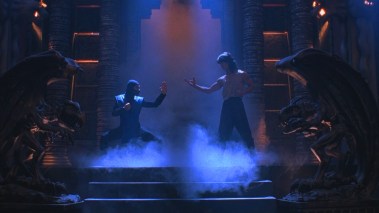
Past its twenty-year expiration deadline, 1995’s once-comatose Mortal Kombat – none other than schlock-impresario Paul W.S. Anderson’s debut criminal offense – feels oddly whimsical and innocent today. With the likes of Warcraft desperately down on one knee praying for post-Lord of the Rings grandiosity, Mortal Kombat is a refreshingly slippery, stoopid animal infused with none of that straining, sprained-ankle seriousness. No, this is arguably the proper burial, or nail in the coffin if you will, of the nebulous non-reality cotton-candy fiction video game film, epitomized by the likes of the fringe-dwelling Super Mario Bros. and radioactive Street Fighter as well as spiritual comrade The Wiz.  Unfortunately, Mortal Kombat is not as incandescently disturbed, with not nearly as much bad acid-trip imagery spray-painted all about, as those films, but it’s an admirably hemorrhaging fount of pseudo-camp that is tacitly indebted to the chop-socky mysticism and bald-faced triviality of the insubstantial kung-fu lunacy that the Mortal Kombat video game was spiritually smitten with to begin with. Continue reading
Progenitors: Alice

tumblr_n43gg3frlm1r61i6yo2_1280Another year, another ho-hum Lewis Carroll adaptation. Cutting to the chase, here’s a review of the best one. 

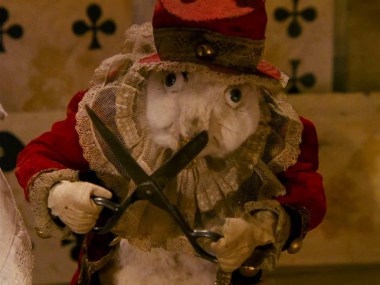
With so many adaptations of Lewis Carroll’s nonsense classic Alice’s Adventures in Wonderland neglecting the lurid insanity and unshackled insubordination of the positively criminal original and shoe-horning an incongruous, structured-encased fairy tale narrative onto a fundamentally structureless work, Jan Švankmajer’s 1988 Alice is a refreshingly fractured trance of indelible potency. With logic never driving the way – barely even riding shotgun most of the time – Švankmajer’s Alice is perhaps the only feature film adaptation of Carroll’s writing to weaponize the visual frame as a realm of gloriously disreputable possibility for expression, rather than as an excuse to rein in the bleeding entropy of Carroll’s original text. Structural integrity, by and large, is the albatross of any Alice film, and Švankmajer’s vision, teetering on stilts and just barely jumping over self-imposed chainsaws slashing at their bases, is downright volatile. Continue reading

Progenitors: Ocean’s Eleven

oceans_eleven_2001_posterCompared to “Kiss Kiss Bang Bang for The Nice Guys”, “Ocean’s Eleven for Money Monster” isn’t as clean a comparison. But I really like Soderbergh’s collaboration with George Clooney, Julia Roberts, and mindless excess, and clearly Clooney and Roberts enjoyed themselves too; Money Monster reteams them and brings a different kind of capital along for the ride.
First, a word (or 300) about Ocean’s Twelve, a consciously, elaborately superficial near-masterpiece of self-reflexively specious blockbuster filmmaking that is all but eager to endorse its own glaring incapability to follow-through with its narrative, resulting in a gloriously aggressive exercise in screwing with the audience and rigorously avoiding its own questions. Turning plotless artifice into glowing conviviality, Soderbergh’s semi-conscious sequel to his blockbuster escapade sacrifices nearly any credibility or forward-thrust for an alternate-reality vision of narrative focused on relentlessly pleasing itself with its own obliviousness and self-interested absurdity. It reworks the heist film to function as both an anti-heist film and as a commentary on cinema as an exercise in devious subterfuge. Continue reading

Progenitors: Kiss Kiss Bang Bang

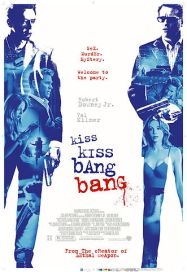
kiss_kiss_bang_bang_posterThis one just writes itself. Writer-director Shane Black is back with another buddy comedy, so let us look at his last one, a return to form after nearly two decades of wallowing in nihilism, misogyny, and eventually, oblivion.

Shane Black’s slick but not too carefully catered Kiss Kiss Bang Bang douses itself in a winking but not overly ironic reverence to not only its decades-old forebears – Raymond Chandler’s protean, Byzantine novels, most obviously – but also Black’s own earlier films, oblong buddy comedies that Kiss Kiss Bang Bang both pokes fun at and implicitly pays homage to. Ultimately, Kiss Kiss Bang Bang was meant to reintroduce him to the limelight after a decade of Hollywood exile. Although its box office numbers didn’t immediately seal the deal (they did help him nab a much loftier return to Hollywood royalty with the third, and best, Iron Man film that reteamed him with Robert Downey Jr.), Black’s tried-and-true strategy was to approach the film from solid ground: write what you know.

Thankfully, with Black’s absence from the filmmaking world post-Lethal Weapon and its follow-ups, what qualifies as solid ground for him has cracked into a more unstable, uncommon clay for the world around him. Thus, although Kiss Kiss Bang Bang’s cheeky post-modernism welcomes it into the modern world, its classical ambitions ultimately feel satisfyingly out-of-touch with the modern Hollywood landscape. Continue reading

Progenitors: Scott Pilgrim vs. the World and Tron: Legacy

scottpilgrim-posterWith four major-ish video game adaptations arriving in the cinema this year (something of a resurgence after the trend died off a half-decade ago), let us recollect our memories of two films from 2010, the inflection point of the video game adaptation as it was just entering its death throes the first time. We will eschew actual video game adaptations (they’re pretty worthless, relatively speaking) for two films that attempt to peruse the abstract idea of the video game as a jumping-off point instead.

Scott Pilgrim vs. the World

While most video game adaptations are manicured to within an inch of life and stripped of the tremulously unleavened visuals and aural absurdity that separates the “classic” video game (think the surrealist Super Mario or Pac-Man) from the more representational realm of cinema, Edgar Wright’s Scott Pilgrim vs. the World is over-flowing with a hirsute game-i-ness it exhibits no reticence about displaying on the mantelpiece. With nonsensical interludes, phonically bludgeoning inserts, and maximal visuals set to short circuit the narrative progression, Wright’s take on the Scott Pilgrim graphic novel series is not only a faithful adaptation of the comic and a cinematic tour-de-force, but a reconnaissance of the “video game” as an art form far more steeped in the tempos and cadences of gaming than any video game film yet made. Continue reading

Progenitors: Teenage Mutant Ninja Turtles (1990)

220px-tmntmovieposterWith the TMNT reboot-sequel releasing soon, reviews are out and – shock – not appealing in the slightest. Here’s a look back at, low standards for the franchise kept close to the chest in this statement, what remains the best filmic adaptation of the Teenage Mutant Ninja Turtles comic/cartoon/media empire.

A pop-culture heavyweight in its day and still lurking in the mental wings of filmgoers of a certain age, Teenage Mutant Ninja Turtles is more curio than feature film. Perhaps surprisingly though (a cringe-inducing accent or two aside) the film never threatens out-and-out embarrassment. The screenplay by Bob Herbeck and Todd Langen certainly is a wildfire spreading across the countryside, jerking around the general consensus of “four turtles battle metallic-suited abstract evil” about as abominably and arbitrarily as possible. But the insouciance of the picture allows it to slide, far more than any of the subsequent pictures in any incarnation of the franchise, into the free-wheeling, quasi-absurdist realm of animated television rather than feature-length cinema. Which, for a work called Teenage Mutant Ninja Turtles, is probably for the better compared to, say, a work like the 2014 reboot that tries to pretend it is an actual flesh-and-blood motion picture. Continue reading

Progenitors: Assault on Precinct 13

                                                                        assaultonprecinct13_390

In honor of the release of Jeremy Saulnier’s punks vs. neo-nazis closed-casket thriller, let us look back at the obvious spiritual predecessor, celebrating its fortieth anniversary this year. 

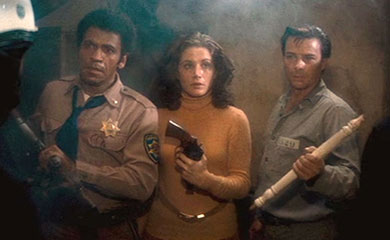
John Carpenter’s toolkit would dilate and wax over time, but he is one of the few filmmakers whose proclivities and talents pollinated most fully when he was given almost nothing to work with but his imagination and the nightmares of the public around him. His Lewtonesque management of silent wells and piercing crests of punctuating sound as well as his pliant awareness of how to transform the most elusive of visuals into a suggestible font of unmitigated horror were almost unparalleled during his heyday throughout the ‘70s and ‘80s. Although his style would be perfected in Halloween and The Thing, his apocalyptic form, less feeding frenzy of horror than icy stillwater, was already deeply entrenched with his second feature, 1976’s deliciously uncouth Assault on Precinct 13, one of the finest exploitation films ever released. Continue reading

Progenitors: Day of Wrath

day-of-wrathWith The Witch back in theaters and having a field day at the box office, let us look back at the single greatest film about witches ever to grace the screen. 

Carl Dreyer’s non-silent catalog remains one of the most fascinating mysteries in the modern cinematic landscape, precisely because its dominant stylistic mode is antithetical to the average cineaste’s mental blockade of Dreyer as an enshriner of the world in the canvas of the human face. While gestures and facial reactions do ensnare his sound era films from time to time, Dreyer’s late period style is defined in the work between characters, not the supremacy of the individuals in the frame. Although he would perfect the style with Ordet and sublimate it to a transcendental realm with his final film Gertrud, Day of Wrath evolves Dreyer into a chronicler of human connection and discrepancy, human movement and human stagnancy on both the physical and cognitive levels, as existing in similitude. While filmmakers tend to counterpose cohesion and disruption through the daily dance of tracking/panning and editing, Dreyer binds the two modes together, constructing a conscious camera that actively strives to find association in disparate existence, to discover separation in ostensible community. In doing so, not only is Day of Wrath a technical marvel but a perceptual case study in altering the consciousness of the filmgoer. Continue reading

Progenitors: Days of Heaven

days_of_heaven1Now that the release of Terrence Malick’s Knight of Cups upon us, a review of his second film is in order. 

With theme and character sublimated to the level of the gushingly sensory and a stream-of-consciousness structure that pronounces its own subjectivity, Terrence Malick’s Days of Heaven is not only one of the defining works of cinematic experience but the closest that film form has come to replicating the semiotics of William Faulkner’s literary imagination. The outline of the narrative – laborer Bill (Richard Gere) courts Abby (Brooke Adams) and stages her marriage to land owner Farmer (Sam Shepard) in a ploy to escape their workaday miasma – is suffused with forlorn Southern atmosphere. But, as with Faulkner, the texture of Malick’s work is not explaining or exploring that narrative but rendering it untenable and deferential to fluid, impermanent figments of memory, perspective, and subjectivity. In both imaginations, experience is not – as in most fiction – assured and objective, but cursory, fugitive, and ultimately perhaps inestimable. Continue reading

Progenitors: Ghostbusters

ghostbusters1_3046771bWith Ghostbusters ubiquitous in the news over the past week, a review of the original film is in order…

Thirty two years on, the most fascinating elements of Ghostbusters are its stretch marks, the product of capricious juxtapositions between gluttonous, outre blockbuster horror and laconic, taciturn, shaggy-dog comedy. It’s easy to remember the Stay Puft Marshmallow Man, a slice of gleeful, madcap absurdism wanting for graham cracker to contain it. But in Ghostbusters, bursts of special effects function as puckered-up contrasts and accoutrements rather than a skeletal framework, as is the fundamental failing of most modern blockbuster comedies. In actuality, Ghostbusters has an inveterate proclivity for jarring tonal vacillation, bumbling from gravid to gallows, from garrulous to stolid. It’s a little bit broken, as a matter of fact. But the ramshackle, barely strapped-together nature of the screenplay by stars Harold Ramis and Dan Akroyd inspires endearment rather than enmity. While so many blockbusters settle into a groove and plant their feet in the ground, Ghostbusters is always fortuitously screwing with us, largely because it’s screwing with itself. Continue reading