 If Nicolas Cages’ battered, displaced ennui in Vampire’s Kiss implied anything about Cage’s messianic ability to incarnate an entire city’s mortal fever in his very body, it’s that he really should have starred in Martin Scorsese’s After Hours instead (the previous film from the same screenwriter). Ten years after Kiss, Bringing Out the Dead fulfills the prophecy. Etching moral quandary and personal quagmire, as well as mythic grime, out of the streets of New York City, Bringing Out the Dead finds Scorsese returning to his home turf, with his home turf writer Paul Schrader, in a film that feels like an extension and perversion of their galvanic 1976 social screed Taxi Driver. Continue reading
Midnight Screening Cage-un Style: Bringing Out the Dead
Leave a reply
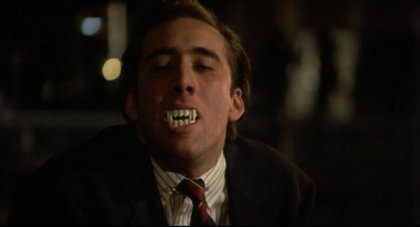 You wouldn’t know it from the film’s iron-clad second-life reputation these days as the butt-end of a joke in internet compilations of Nicolas Cage losing himself to convulsions of life-panic, but there were, in fact, other people in the room when Vampire’s Kiss was being made. At the same time, the black hole of Cage’s performance sucks in any and all vitality from the production elsewhere, energy no one else seems to have exerted in the first place. But if this is Cage’s Vegas one man show (much more than Honeymoon in Vegas, or Leaving Las Vegas even), the birthing pool of the film remains writer Joseph Minion. That’s a name you probably don’t cotton to immediately, but he’s famous in screenwriter and cult object circles for writing After Hours, a film picked almost at random by Martin Scorsese when the production of The Last Temptation of Christ screeched to a grinding halt.
 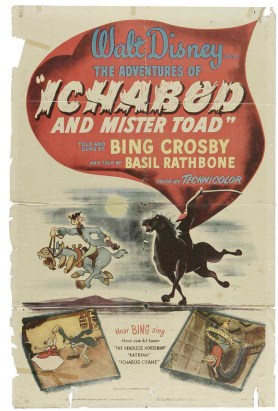 Disney Animation’s package films from the ‘40s, as a corpus, are sometimes considered the bane of the company’s existence, mercenary workaday productions inspired by a need to salvage the tatters of the company by producing anything that would make a buck, theoretically leaving their artistic inhibitions at the door. The ghetto these films have been sequestered into isn’t without purpose; compared to the brazen murderer’s row of artistic masterpieces released between 1940 and ’42 – Pinocchio, Fantasia, Dumbo, Bambi – one can see why no one is eager to pull, say, Saludos Amigos from 1942 out of the dustbin of history.
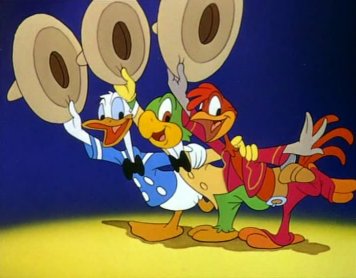 In this ostensibly superficial, altogether dazzling production about three birds in Central and South America, Disney’s near-commercial implosion arises like an avian on fire in arguably the company’s most surrealistic insurrection. Trapped in the perdition of nonexistent budgets, Disney Animation went vagabond and took a trip to, and a cue or two from, the superstars at Termite Terrace (read: Looney Tunes) with a deliberately unfussy, anarchic production for which out-of-control effusions of rhapsodic color was the only reasonable aesthetic partner. Pointless though it seems, The Three Caballeros is in fact a vanguard of the company’s continued artistic experimentation and their hunger for something a little more allegro.
 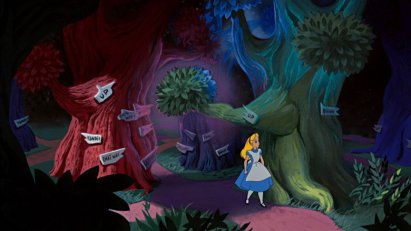 Released at the onset of Disney’s so-called Silver Age, where the money began to flow again (incrementally) in the ‘50s after the box office disasters of the early ‘40s subjected Disney to a handful of no-budget package films throughout the war and post-war years, Alice in Wonderland was a fitting rekindling spirit. None other than Walt Disney’s own childhood love and his original plan for a first feature film before things got sidetracked (as they do in animation), Alice was ironically whisked away from a fell purgatory without Uncle Walt’s own influence (perhaps he’d grown weary over trying to produce it again and again over the years), and perhaps for the better. The patchy, maniacal disarray to the look of the film and the semi-unwholesome, deliberately non-moralizing grotesquerie of the structure weren’t exactly Walt’s specialties, but one wonders what countenance his version of the tale might have born. Maybe Alice would have been a young Margaret Thatcher, and the Mad Hatter a starched-suit Joseph McCarthy and the impromptu hero. Alas, I do not suspect even Walt could have any sensible use for the bundle-of-id that is the Cheshire Cat.
 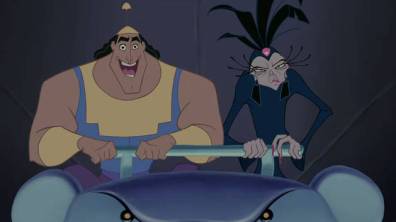 The Emperor’s New Groove
 Limned with atomic-age zest and riddled with nervous rays of icy energy, Night and the City is singular in director Jules Dassin’s oeuvre, not to mention a kind of apotheosis of the noir form, in its unmitigated diagnosis of human society as a rogues’ gallery and a murderers’ row. Scouring the self-mutilated streets of London with a spectral sense of allusion and spare poetry that stimulates a positively magnetic charge, it doesn’t take any mental gymnastics to discover how Dassin’s personal turmoil around the time of filming Night and the City inscribes itself in the singed chiaroscuro and the barbed, irregular editing mechanics of Night and City, shaking the frame into submission. This English wild cat of a film is the platonic ideal of its genre’s unremitting reconnaissance of urban scrawl, a vision of a world useful primarily, even exclusively, for nighttime, even night-terror, skulking and nothing more.
 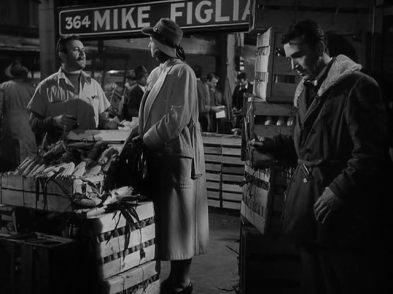 More or less, “film noir” doesn’t immediately conjure images of the fruit markets and roadside truckers adorning Thieves’ Highway, but any cognitive dissonance about the disconnect is allayed almost immediately in Jules Dassin’s wonderfully rotted-out picture, his final American film before an intercontinental exodus prompted by the dastardly House Un-American Activities Committee. Dassin’s communist sympathies inscribe themselves elegantly in the noir world where capitalist rot reigns supreme and disillusionment is the only, albeit temporary, salve against the Western lie of individual morality and pulling oneself up by one’s bootstraps. In the noir world, one person’s success is exclusively an agitated avenue for unsettling the possibilities of other humans for whom hope is an albatross and the American Dream is little more than a poisoned apple.
  The name “acid western” doesn’t quite do justice to Monte Hellman’s duo of sadly fatalistic fugues released in 1966, soon to become cult icons when their casts went on to fame and infamy, in some order. These two films have the bracing mystique of unidentified film-like objects without precedent or successor; even the most famous film in the acid sub-genre, Alejandro Jodorowsky’s four-years-later release El Topo, suggests the toxicity of these 1966 progenitors but not their distressed, cloudy desolation. If El Topo was a disobedient, hallucinatory nonsense-poem that eroded society’s expectations for the Western, The Shooting and Ride in the Whirlwind are already themselves eroded.
  A pair of surrealistic modern animations this week on Midnight Screenings.
 The Long Take