 The only thing mesmerizing about 47 Ronin is the thought experiment wherein Japanese master visualist Kenji Mizoguchi, directing a film of the same title and based on the same classic Japanese myth in 1941, imagines that 70 years of the Hollywood machine threshing at full force will result in a new version of the film fronted by actor of actors Keanu Reeves, starring opposite a rough approximation of a horse demon and a witch dragon. Proof that it’s the simple things in life that get you through, imagining how Mizoguchi might react to this film is vastly more compelling than the film in front of us.
Simple things, by the way, are not in the vocabulary of 47 Ronin, a film that makes the bewilderingly common mistake of assuming it is smarter than it is as it lays down a tale that vacillates between deep, distinct homage to Japanese myth and a more corporate utilization of Japan’s tangential relationship to dragons. In other words, we have a film that is both completely assured of its totalizing respect for Japanese culture and oblivious to the way it confronts Japan with an exclusively Orientalist bent. Being but a humble film reviewer, I can’t proclaim this with any accuracy, but presumably the original folkloric version of the tale offered fewer characters designated only as “Lovecraftian samurai”. Since, you know, Massachusetts writers from the early 1900s weren’t exactly bosom buddies with a Japan that is both, at various points in the film, “ancient” and “feudal” (which, together, is an oxymoron, but whatever). I mean, theoretically the nebulous fantasy realm of the film’s diegesis (undone only by its otherwise heavy-handed commitment to legitimizing itself historically) implies that this could actually just be Cape Cod in 1920 after all, but I like to give the film a little more credit than that. Continue reading →

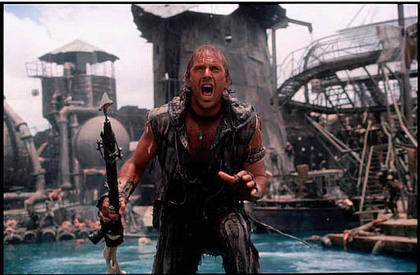 Waterworld
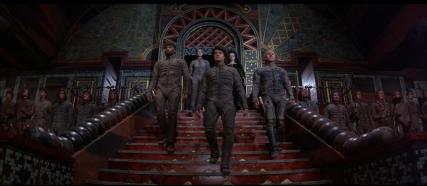 David Lynch’s Dune opens with a blissfully presentational monologue, a female face plastered onto the screen as she intones about spices like some intergalactic trade princess as her head glints in and out in a tease of a disappearing magic act that implicitly asks us whether we really care about anything she’s saying. It’s a dose of post-Star Wars and anti-Star Wars nonsense, a mocking of a genre by a director who had in 1977, the same year as that genre’s entrance into the mainstream, blasted a cavern out of the crevice in cinema left in the wake of Luis Buñuel’s quasi-retirement. Actually offered Return of the Jedi, Lynch accepted mega-producer and mega-trend-jumper Dino De Laurentiis’ offer to throw down with Frank Herbert’s story of space drugs and sand worms instead, and what came out of that unholy matrimony was one of the most famous misfires in cinema history.
  Glimpsed in light of Bob Rafelson’s youthful Head, released in the same year and theoretically covering the same territory, Otto Preminger’s gloriously screw-loose screw-up Skidoo is frankly mortifying, but it’s embarrassment with a purpose. While the former film burrows headfirst into a subterranean bebop of drug-crazed hyperbole with an editing rhythm like deranged improvisational jazz band and a mind ready to explode like the decade the film concluded, Skidoo is an improbable parade of Old Hollywood leftovers struggling on a voyage to The Way Things Are Now without a clue in the world how to chart their way. Head rushed around picking up the pieces of the world collapsing around it, while Skidoo is already in free-fall. An air of malfeasance and curiosity hovering overhead, Skidoo suggests a collection of trapped animals trying to figure out what the hell got them there. While the youths of Head are searching for an escape from an oncoming apocalypse they clearly see coming, the cadavers in Skidoo look about ready to enter a mausoleum.
  In hopes that box office failures are among the more wonderfully drugged-out and anti-social blockbusters released in the world, I’ve decided to look at a cabal of the most significant box office failures in history. I’m first going to dip my toes in with a pair of very modern films, this one ceremoniously coincidental considering that this summer’s The Legend of Tarzan is yet another Edgar Rice Burroughs adaptation that is good and bad, much like John Carter, exclusively as a function of its willingness to consider itself as pulp fiction rather than proper narrative.
 The Long Take