 We Are Still Here
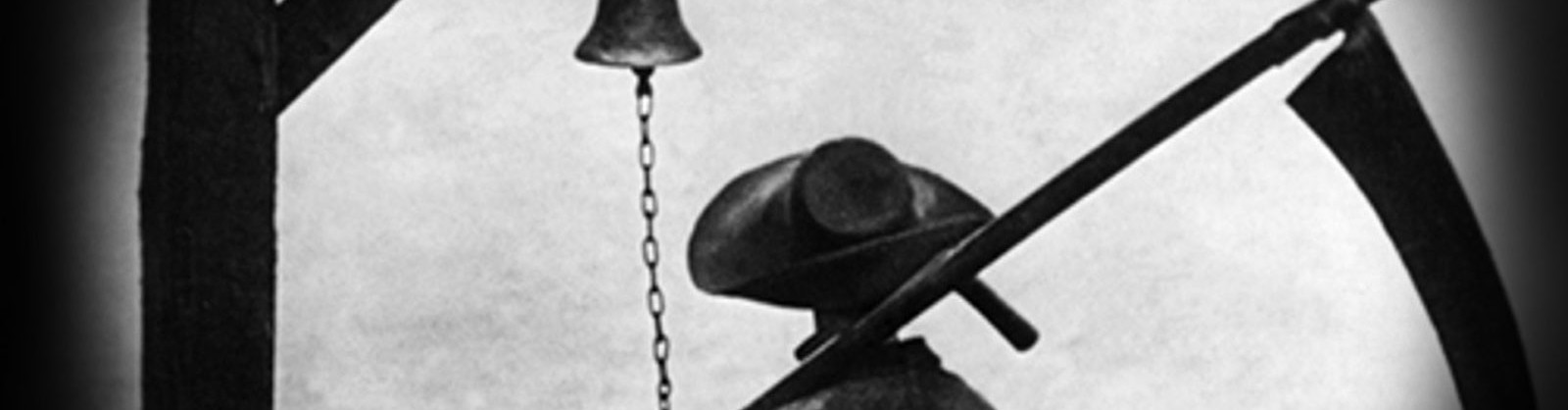
A chilling sense of isolation and post-crisis contemplation hangs over Ted Geoghegan’s We Are Still Here right from the wonderfully silent opening montage where middle-aged couple Anne and Paul (Barbara Crampton and Andrew Sensenig) acquaint themselves with their new abode. Even the finale where the satisfyingly restrained film arouses into a full-on horror erection does not quell the tragedy looming over the film, that of the death of Anne and Paul’s college-age son. Prompting their relocation from Boston to a rural New England home that feels like it’s been waiting in repose for decades to torment and consume fresh blood, the couple find that they’re trapped in a throwback horror film. Which means, naturally and expectedly, the metaphoric or emotional ghosts of past tragedy bumping around in their minds are no match for the more literal kind ready to turn the house into a haunted house tour of the town’s past sins, with Anne and Paul as the guests of honor. Continue reading
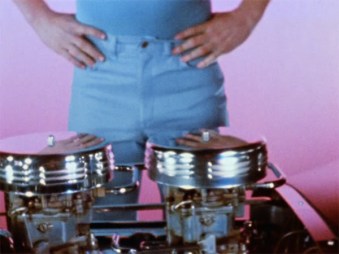 Kenneth Anger’s Kustom Kar Kommandos asks us to feel with our ears, to hear with our eyes, to taste with our bodies. Charged with a tickling eroticism and hyperbolically fetishistic aura, this lascivious work of high camp and low culture is infused with an alternately infatuated and critical attitude toward the throbbing iconography of American lore. Automobile autoeroticism at its most perverted, Anger plays around with blood(womb)red imagery to suggest the American garage as the birthing canal of masculine Americana’s dreams. More specifically, Anger locates the womb of American industry in the male heart, dressing a boy working on a car in vivid, lurid hues and equating the desire for procreation with symbiotic and parasitic ownership of metal material that bears somewhat striking implications for the notion of offspring as parental property. All of this, of course, is without even glancing at the implications of the title (or the title’s initials, more accurately, peerlessly stitching together homoerotic American masculine machinery as a sort of color-blind populist front or a vanguard for the white power movement, but that thread is hidden deeper in this film than in most of Anger’s more famous works, so we’ll leave it for someone else to find).
  Meshes of the Afternoon
 Who could think of a better near-opening for a Pedro Almodovar film than a delirious scene of a Spanish dubbing of that holiest of holy cinephiliac films Johnny Guitar? (Nicholas Ray being, with the possible exception of the more obvious Douglas Sirk, the largest costume in Almodovar’s wide-open carnival-closet of cross-national cinema). Even better, the sequence actually adds to Ray’s film rather than merely name-checking. It extends Ray’s emphatically neurotic melodrama to new cultures and across eons while teasing out its fiendish gender complications and tragicomic compulsions even more overtly than Ray, a rebel trapped in the Hollywood closet, was able to do. Almodovar’s mission statement is already clear: in the arena of melodrama, a purgative for your cynical ways.
  With anthology horror prowling all through the house throughout the ‘80s and into the early ‘90s (a byproduct of the decade’s conservative turn and ensuing ‘50s/early ‘60s fetish), 1990 was the watershed moment for when the monster mash got nasty. The A-list-courting Amazing Stories show from nostalgia-babies Steven Spielberg and friends meant to tingle your spine while it was patting your head to sleep. But when HBO latched its greasy, sleazy claws around the trend, it soured into the venomous, loud-and-proud midnight haunting hour likes of Tales from the Crypt by the decade’s end. (Robert Zemeckis, one of Spielberg’s cronies, was involved in the transition and directed three of the best, although not always the bloodiest, Tales when he decided to let his hair down and unscrew his A-list credentials for something grubbier and more robustly exploitative).
  Perched at the intersection of swinging ‘60s tilt-a-whirl and ‘70s out-of-control social carousel tilted on edge, Mike Nichols’ epochal The Graduate is largely able to plumb the depths of the liminal space where liberation over-ignited into askew, free-associative pandemonium before curdling into apocalyptic anxiety and eventually lethargy. Right from the beginning, when recent college graduate Ben Braddock (Dustin Hoffman) is traipsed around a welcoming party his parents throw him and the camera absolutely manhandles him, the film torments itself with an unshakeable apprehension about humans who interact more like daydreaming passer-bys than involved participants in life. The sequence, filmed in one-take, centers a wide-screen vista that compresses Ben’s head by lobbing off the burnt ends of his neck and hair while extending the frame laterally across the eons of bourgeois space occupied by the interlopers in his parents’ house. These visitors form a menagerie of false, inebriated camaraderie who Ben is faintly antagonistic to, all of them ensnared in the vise of upper-class moorings. Suggesting his parents as invasive, unknowable spaces by avoiding their faces in the frame when they first push Ben out into the party, the film visualizes the trenches of adulthood as quotidian spaces inscribed with recesses of existential anxiety.
  With House by the River, Fritz Lang’s forked acid-tongue was curled up into his iron-bolted mouth by Hollywood execs none too interested in some of his more provocative stylistic or thematic ideas (of really doubling-down on baroque imagery-of-the-mind or exposing oppressive gendered, racialized, and classed power dynamics in America). But, even though he was forced to neuter his mission and his mind with films like House by the River, Lang’s eyes were as sharp as ever, possibly even hungrier due to his sometimes-livid attitude toward Hollywood and the poverty-row quality of this production in particular. The once gilded director of four hour German epics, monolithic slabs of pure cinema in their day, was now a mercenary for hire. But, hey, Val Lewton and Jacques Tourneur produced the two best horror films of the 1940s with next to no budget, so why couldn’t Lang knock out a corker of a film noir?
 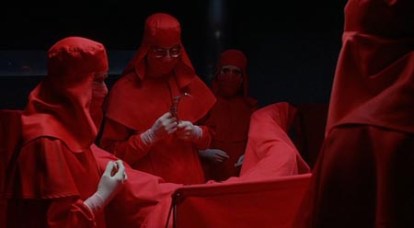 For a director long infested with and invested in deep-seated anxieties about the relationship between perturbed men and the women they feel entitled to and mortified about, Dead Ringers reflects David Cronenberg simultaneously at his most hesitant and exploratory, both empowered over his subject and emasculated by it. On “empowered”, Dead Ringers is the product of significant confidence, the director emboldened by the success of his prior film The Fly, which was the inflection point between his gutter-limned, filthy body horror films and his more intellectually-charged Hollywood productions drawing on blood veins of Shakespearean tragedy and classical literature.
 Skulking down from its natural habitat of the backwoods of the frigid North down to our prudish American confines, David Cronenberg’s early Neanderthal of a body horror film delivers a scatterbrained, deviously crude twinge right to the spinal fluid and sends the mammalian brain running wild. A premonition of icky in-your-pants terror to come, this unruly, mutilated motion picture about a sex slug that invades the inhabitants of an apartment complex somewhere in Canada doesn’t hit the deliriously otherworldly heights of Cronenberg’s latter-day triumphs. But the director already displays an almost Machiavellian skill for bodily manipulation even on a shoe-string budget (a budget he marshals for a film that is more than the sum of its parts). And his peculiar aura of marrying undisciplined/unmitigated with judicious/precise flavors ultimately colors in his hypothetically barren production with formal rigor and subtextual meat a mild wide, creating a horror that runs both fiery hot and cold like a reptile.
  In his canonical masterpiece Pan’s Labyrinth, the faint pulse of brilliance throbs in Guillermo del Toro’s luxuriant, sumptuous, affectively-charged imagery. But rather than carving out room for the kind of insouciant, mordant humor and interpersonal drama permeating through his Hellboy II, Pan’s Labyrinth is mostly content to calcify itself in a morass of symbolically-charged cues devoid of any precious room for del Toro to feel out the moment rather than smack us over the head. There’s room for such overt emotion in any filmmaker’s canon. Hell, the romantics del Toro loves (Almodovar, Douglas Sirk) practically made a career out of spinning melodramatic straw into gold that punctures the mask of subtlety and rationalism. But the sense of robust emotion as an escape from reason is too often trampelled by del Toro’s emphasis on characters as stand-ins for ideas or metaphors. The relationship between the symbols and the emotions isn’t mutualistic. Rather, the symbols parasitically enervate the characters of defiant streaks or the ability to even consider peering elsewhere beyond what the narrative has preordained for them.
  The Long Take