
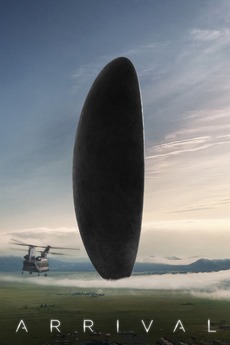
 Director Denis Villeneuve is a difficult creature. Or, rather, he isn’t, but he sure thinks he is, which is what makes his academic, stiffly formal but not actually intellectual films so difficult to respond to. He’s a formalist, but an odd mark in that category. Certainly, he prefers a bold, singular, “visionary” image – one steeped in unblinking awe and gorgeous depth of Meaning – rather than a more open-minded or iridescent style that could provoke too many reactions, too much alterity, from audience members. Villeneuve’s films have “points”, and his style is buttoned-up and sculpted to guide his audience to that end destination along the path of least resistance, not to invite contradictory perspectives. The ambiguities in his films really are just gossamer sleights of hand, faux-intellectual jargon for people who equate superficial moral complication for genuine intelligence. However, his films also – up until Arrival – bore the caliber of a work-for-hire, a journeyman’s lack of overt stylistic manipulation, as though he was directing to the material rather than massaging the material to fit his interests, basically. Because of this, his films tend to coalesce around at an odd and incomplete gap, too baroquely stylized not to insist on themselves but not stylistically inflected enough to use their images to really challenge the cinematic status quo. He’s like an apprehensive, faint-hearted Kubrick, and who wants that? Continue reading
Review: Arrival
Leave a reply
 Girl meets guy. Girl falls in love with guy. Girl is Mia, a struggling actress played by a very-much-not-struggling actress Emma Stone. Guy is Sebastian, a poetically long-suffering jazz musician played by Ryan Gosling. Guy is also writer-director Damien Chazelle, who mostly just loves himself.
 Now that we’re firmly entrenched in the perennial-Star Wars churn of the Disney machine, director Gareth Edwards’ Rogue One: A Star Wars Story bears testament to the only true artistic value of Disney’s exercise: a chance to gouge Disney’s money to spread out not vertically – along one path – but horizontally, foraging through deepest, darkest corporate storytelling for shards of tonal variance and new moods that need not commingle with the main through-line. Every film need not follow the line of best fit, which allows for a franchise to stagger and ping-pong between tones wildly rather than chart a forward path that would surely become a funeral procession, at least artistically speaking. As a first blow though, Edwards latches onto the asphyxiated, battered, worn-out world of the original film to germinate Rogue One into a supernova of bruised beauty wracked with undertows of ambivalence about its own obvious oncoming, fated conclusion. Ironically, it is by returning to the franchise’s roots – and pulling them up to expose the dirt-encrusted thorns – that Rogue One keeps the franchise from ossifying into arrested development.
  Much hullabaloo has been made about season five of Samurai Jack’s serialized nature. And why not? Serialization is the mantra of our time, the de rigueur shorthand for maturity in the televised world and the essence of respectability for a culture almost hermetically obsessed with the lexicon of long-form storytelling. The prestige TV glut of the past twenty years has almost uniformly been filtered through the quasi-hegemonic logic of the linear story, of spreading out storylines in the name of events causing events causing more events. More time means more conflict, more space to accrue information, more room to define everything and leave nothing ambiguous or uncertain. It conjures a wider cavern to fill in causes, effects, consequences, obstructions, and solutions. It feeds into a cultural desire to trace increasingly complex, labyrinthine plots and prove ourselves as viewers by untangling the thorns of a narrative.
  Freud and Superman and Fellini and sleaze-house dens all make walk-on appearances just in the introductory passages of Brian de Palma’s Hi, Mom!, a quasi-satire, or at least a loosening up of, the malevolent Hitchcockian Rear Window. A bizarre-world antecedent to Taxi Driver, this is a film with Robert De Niro obsessively subjecting New York to his viewfinder until he is himself victim to and participant in an artistic nightmare. Relentlessly aware of its own spectatorship and shot-through with neurotic ambivalences, the film always has film on the brain, and the muscles, and the loins. But De Palma refuses to rest on this tried-and-true meta-textual laurel, instead wandering off – skipping, even tumbling – in untold and untested directions. Call him a Hitch parasite all you want, but Hi, Mom! commandeers Hitch for its own sinful purposes.
  Hectoring becomes a professional endeavor, or professional filmmaking becomes a form of hectoring the audience in John Huston’s whacked-out Beat the Devil, entirely denounced when it was first released and somehow bent and mutated even further sixty four years later. Temptation begs that I reclaim the film by arguing that it was “misconstrued’ upon release, but I’m not entirely certain it exists to be construed. That might only breed domestication, curbing the film’s vigorous unruliness. With a regular goon squad of odd cartoon shapes masquerading as people waiting around in a squalid sea-port town, the whole film seems to exist to breathe in the salt water. The most exciting moment is entirely about an aging, wheezy Bogart and a pair of portly fellows schlepping after a runaway car, teasingly dramatic music massaging out the irony of their failure to exert more than a modicum of effort. It’s awkward, heinous, mismatched, and oddly brilliant in its idiom.
  Recast as a fair-weather Hollywood rebel with Terry Gilliam’s 12 Monkeys – breaking the rules only just enough to accrue a superficial glaze of strangeness – Chris Marker’s La Jetee is the real deal. It’s as aesthetically radical as any film this side of, well, Hiroshima, Mon Amour three years earlier, at least, but La Jetee was released in the most aesthetically radical period of cinema ever, so “as (blank) as any film since (blank)” has the misfortune of not really working here. Marker’s short-film is an elegy for the cohesive illusion of time as a passive process, as an unalienable fact to be perceived identically by all and regurgitated out by scores of films more or less in unison. Most films grant themselves safe passage to erase time, to treat time as a background specter to be shocked into corporeality when a film needs to increase its own stakes via a ticking clock bomb or parallel editing that expands time to increase suspense. Films escape time, essentially, and they ask us to escape with them; they whisk us away, projecting a parallel universe where the events of the world are liberated from death, from age, from vulnerability to the physical realm, to the material reality that conditions their own existence.
  Contrary to its reputation as a one-sided morass of sobriety, Ingmar Bergman’s The Seventh Seal is prismatic in its consciousness, a fitful and lithe creature that can crawl on its belly like a dark acolyte of existential Swedish woe one minute and cartwheel to celestial fields of comic (and cosmic) foolishness the next. Although accruing the dredged-in reputation of a stilted monolith afforded to only the most holier-than-thou, protected-by-the-Vatican masterpieces, Bergman’s film is a Janus-headed creature that matches its bristling dread and ability to turn terror into torpor with a spontaneous brio and elastic mood permissive to sparks that constantly disturb any tonal equilibrium. The film’s detractors conveniently fail to notice its many appetites, such as how it leverages it doleful imagery for its more amusing undercurrents, or how it teases out symbols that are as cheekily self-reflexive as they are morbidly pious. And, although Bergman’s representation of Death has been parodied too many times to count, none of them match Bergman’s Death and his statuesque, unwavering anti-charisma for sly suggestion. The film’s detractors are more-so trapped in a state of arrested development than the film.
 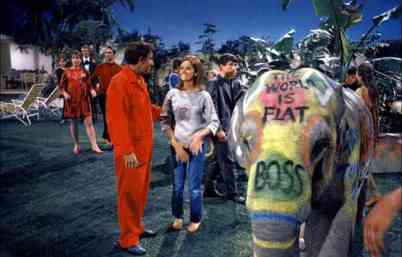 Blake Edwards does Jacques Tati in this natural evolution (or devolution, if you prefer) of the unwinding chaos of The Pink Panther and A Shot in the Dark. Toying with the perception of physical space and middle-century domesticity, The Party begins with a simple premise – an Indian actor adrift and misconstrued in a bourgeois Hollywood party – and stokes into a case for pandemonium as an ultimate liberation. If his fellow Brit Richard Lester was uniquely keyed into the beats of Beat and the menace of Mod, Edwards’ film seems to find a mantra for life in visual bedlam. Charting a path from lone Indian infection in a white person’s world to full-bore mansion pandemic, Edwards not only massages an ethnic minority’s failure to assimilate into virtue but ignites it to demolish the implicit codes, customs, rituals, and aesthetics of the Western bourgeoisie.
  Meant to review this in memoriam for Bill Paxton earlier this year, but with Powers Boothe passing as well, I had no choice but to get around to it. Both are great in this underrated horror film from arguably the worst period for the genre in film history.
 The Long Take