
 Phantom Menace naysayers aside, are you for real Attack of the Clones? Now this is how you do up a Star Wars disaster, grade-A incoherence and all. Specifically, Attack of the Clones ends up scrambling in a million directions in search of a new center after Qui-Gon Jinn’s death at the end of Phantom, a film which is itself almost a complete severance from Attack of the Clones in every way. Nothing about the earliest prequel develops any of the themes explored in Attack of the Clones, which nominally chooses to focus on the relationship between Obi-Wan and Anakin to get us on its predestined but sometimes-unfathomably rocky pathway to Revenge of the Sith. Nominally, I write, because you’d need to see Revenge of the Sith to even read any such relationship into this film. The two hardly spend any time together at all, leading to a narratively disjointed film that mostly resounds as a powerfully unnecessary display of arbitrary plot development. For the most part, Obi-Wan does things and Anakin happens to be around him, and then, for a while, Obi-Wan does things and Anakin isn’t around him, and then they’re back together again. This decision, perhaps more than any other, tends to render the whole “prequel to Star Wars” business rather dubious. All of the meaningful Anakin character creation that catalyzes the original films has been displaced onto Revenge of the Sith, whereas this film basically relegates itself to the broader geopolitical strokes of the imperial conflict, which basically means “clone army”. Continue reading
Progenitors: Star Wars: Episode II – Attack of the Clones
Leave a reply
 As opposed to an abject failure of imagination, design, or cinema more broadly, Star Wars: The Phantom Menace suffers a more equivocal, ambiguous form of misfortune, the kind of flaw that is also signally exciting and valuable in its own right: it suffers deeply from 16 years of franchise-creator George Lucas stewing on his ideas. With The Phantom Menace, the lower rungs of his imagination inflated to the point of boiling over with a desperate need to prove his mettle as an author by complicating and nuancing the concept for Star Wars without actually having a grasp on, or paying attention to, the actual execution, the very cinema, of his ideas. Everyone loves to hate on the thing, slathering it in such a smothering aura of empty incompetence that the criticism seems not only unfair but essentially arbitrary. In point of fact, the film is often anything but empty, and its surfeit of under-baked ideas – exciting to a point – are also its comeuppance. The totalizing way everyone demonizes the thing like it’s a leper unable to scrutinized up close asphyxiates not only the filigrees of glee inhabiting the film from time to time but its more legitimate offenses as well.
 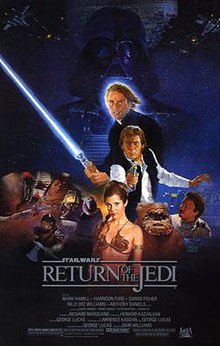 After the down-tuned-pulp pop space-opera of the original Star Wars and the astounding, apocalyptic depression of The Empire Strikes Back, what do George Lucas and his goons give us for round three? Neither fish nor fowl, but an extraordinarily and sometimes beguilingly stitched-together accident, a film loaded with and defined by peculiar tonal spasms and the kind of narratively-haphazard mess you just can’t get without a devoutly, almost feverishly passionate but mildly inept creative figure at the helm. Yes, Return of the Jedi is a travesty of writing on par with any of the prequels. But the real question is how it mobilizes its mess, whether it treats cinematic dysfunction as a liberating deliverance from acquiescence to middlebrow, mainstream cinematic perfection or as simple incompetence. Far from catastrophic but still strangely mishandled in ways both exciting and hindering, Return of the Jedi wears it fleet of script revisions and swamp of behind-the-scenes misgivings like a ball and chain. Every image, good and bad alike, are portals into the often dysfunctional production of this film as well as the obvious casualties of market success, both factors that are only barely hidden on camera.
 I consider myself someone who takes cinema very seriously. But “serious” in this sense is a question of attitude and sensibility rather than tone. I take seriously the ability of cinema to plumb its inner-depths and expand its outer-registers, to twist and turn preconceptions about existence, to interrogate its own mortal coil and material medium as well as to dialogue with social context, to refresh itself, to treat every moment as a contingency rather than a certainty. But above all, I take seriously cinema’s ability to play: with itself, with the world, and with its conception of the world. Play does not imply glib triviality or even humor but the giddy effervescence steaming off of even the most solemn and sober film as it treats its medium as an experiment in any tone whatsoever. Serious play incorporates thematic, intellectual, emotional, philosophical, visual, spatial, temporal, and aural play in all its registers, the excitement of a film that is gloriously unsettled in its always-roving, never-finished mental exploration of self. Seriousness, in this lexicon, does not entail giving a pass to so-called serious cinema, especially cinema which wraps itself up in its seriousness as a hermetic seal, as a shield from real self-interrogation, or as position of sacrosanct refuge.
 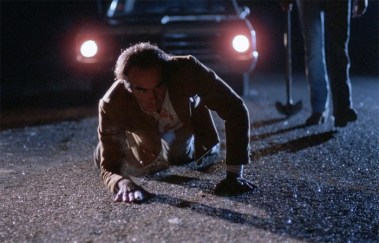 Until 2007 when they unchained No Country for Old Men on unwitting audiences, Blood Simple was the black sheep of the Coen Brothers family. Their second feature Raising Arizona is, on the surface, its diametric opposite, a harried, maniacal fracas of disheveled lunacy and Southwestern loneliness. That latter film has, more or less, paved the way for many of the Coen Brothers’ more famous features, inaugurating their reputation as the pied pipers of modern artful screwball. But Arizona shares two central components with its predecessor despite Blood Simple’s reputation as the wild card in their canon. Tones aside, both films are mordant, fiendishly cunning grasps of dour, melancholic tragedy, both comedies-of-loneliness. And both are acid-washed images of people in need of an escape hatch. The sheer surfeit of mood aside, Blood Simple frequently feels like a premonition of the Coen Brothers’ entire career. Considering Blood Simple reveals the crestfallen image of a destitute US and stunted, criminally miscommunicating people that skulks, almost subterraneanly, within the notionally-chipper heart of many of their later films.
  I’ve been away for so long … Here’s a holiday classic to re-inaugurate the site.
  Y Tu Mama Tambien is inauspicious, but like many great films, it reaches for and touches the world and humanity in everyday actions and seemingly small gestures. Here, for instance, we have teen sexuality, laid out with all its romanticism and reality, filled with the kinds of empty-but-meaningful gestures that define humanity’s desires and their foibles. Director Alfonso Cuaron is a highly personal director, but he’s always most interested in defining his characters in relation to the world they inhabit. His two protagonists here are immature and petty yet deeply human, reflections of a society that won’t admit it has given birth to them and which they, initially, want no part in. He gives us a profoundly human story, built on the eternal humanness of sex as a marker of adulthood and childishness, and given life by Cuaron’s wonderfully and contrapuntally painterly version of sloppy, slovenly reality.
 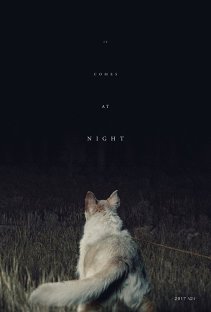 Vis-a-vis the more trimly-titled but flabbily-filmed It: now this is more like it. The second feature from Trey Edward Shults, It Comes at Night trades out the high-gloss carnival-esque of Muschietti’s film for the kind of slowly-curdling angst and stomach-rotting apprehension that not only startles the hairs on the end of your arms but rattles and disquiets the bones. It Comes at Night is not peak horror compared to some of the recent finds in the genre since 2010 – It Follows, to name another title to wield the willful ambiguity of one particular pronoun – and this new film manages the unfortunate (commendable?) feat of being both too literal and too equivocal for its own good. But compared to the lazy imprecision of It, Shults’ film is a real wilderness of human fear.
  In Andy Muschietti’s sturdy but superficial, journeyman remake of It, Bill Skarsgard’s portrayal of the title role is a too-easy thesis of the film’s successes and flaws. On one hand, when Tim Curry stepped into the fangs and red hair in 1990, he was a memorably polychromatic experience: sad, otherworldly, ethereal, campy, and bizarre. Skarsgaard only hits – or is only allowed to aim for – unadulterated fright. On the other hand, his more calculated performance less prone to tangents and instabilities capably invokes the gloomy glint of terror that animates this new film, one-note in its construction but perfectly capable of hitting the note. Curry was the standout in that earlier, now-epochal television film – it jump-started an insufferable trend of Stephen King TV mini-series that continues to this day – but the unwieldly, tone-deaf drudgery of that production was an unstable mess of arbitrarily-laid-out scenes lacking any semblance of cohesion or logic. (Nor was it, incidentally, meaningful with its mess). Intersecting feelings and emotions could be both fascinatingly tiring and pointlessly, scene-paddingly draining.
  The Long Take