
 On the surface, Mother! Is yet another example of a director aiding and abetting their own egomania with an anti-egomaniacal screed, a peculiar form of self-appreciation doled out by a director happy to explore the myriad ways in which directors are oppressive dictators at heart. This would mark Mother! as the latest bastard child of Hitchcock’s self-critiques in Rear Window and Vertigo and Hollywood’s extraordinary propensity to control the terms of anti-Hollywood filmmaking by making films which mock itself. But, to give credit where credit is due, the thoroughly undigestible Mother! erodes even that auto-critical safe harbor. Many films – far too many in the 21st century – retreat into easy mockery and adolescent self-reflexivity, the sort of trivializing reductions and post-modern hipness popular among the Tarantino-generation (although not always Tarantino himself). But, although it never stabilizes into any clear critique – perhaps not although but because it never coheres – Darren Aronofsky’s self-propagating fire of a feature film at least doesn’t treat its self-critique as an excuse to act like it really has any idea what is going on at all within its halls. Continue reading
Review: Mother!
1 Reply
 Somehow even less easily theorizable than David Lowery’s A Ghost Story and no less opaque in its horror-adjacent vernacular, Oliver Assayas’ Personal Shopper is ghost story as a polyphonous brew of constantly revivifying altered states and endless self-reconsideration. Although relentlessly frigid, it is a remarkably alive motion picture, provided that life is not a quality of camera motion or character action but a quality of stylistic vanguard-ism and restless thematic wandering, of a film with many competing selves vying for screen-time. It boasts multiple, personal tonal parallel universes, from murderous malevolence to rootless dejection to diaphanous elegance, each a viable film in its own but none enough for Assayas, who refuses to give in to the kind of stability any one mood would require. His film is astonishingly vivacious, but its life essence is not found in a candy-coated palate or schizophrenic, paid-by-the-cut edits but the chaos of modern indeterminacy. It’s found in the creeping tingle that life, like this film, thrives in constant decay and alteration, exists in perpetual erasure, is a veritable momento mori of moments that happened just before but are fundamentally different from the now and cannot be recreated.
  Writer-director Greta Gerwig’s snappish voice and self-confident-but-self-deprecating demeanor – so clearly developed after a decade of starring roles in independent features – lingers over every scene in her directorial debut, Lady Bird, even though she herself does not appear on camera at all. Certainly, Gerwig’s style clearly has antecedents in the Mumblecore movement – Lady Bird really isn’t the case of a truly new voice being cast out into the cinema, although it harbors no pretensions about being one – so perhaps I’m less singularly bowled over by her work her than some other critics. (It brings to mind the fact that few people have actually seen the many films Lady Bird owes a debt to). But with such fearless and sharply articulated characters and a jagged, spasmodic visual and tonal style, the film skitters about and casually subverts any hypotheses audiences may bear about justified or rational character responses to the world around you. Acerbic without being mean-spirited and incisive without dipping its fangs in life-sucking venom, Lady Bird isn’t meaningfully “new” – Gerwig’s perspective in the form of other beings has existed in cinema for decades waiting to be heard – but Lady Bird is a thoroughly great, quietly complicated variation on existing themes nonetheless.
 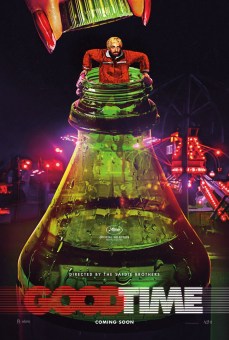 Let me rhapsodize Good Time’s achievements. Its fringe-dwelling camera and elliptical, schizophrenic editing mechanics construe cinema as visual mental collapse while somehow also suggesting that the protagonist isn’t thoughtful enough to have a collapse. All the while, it captures New York as analog-fed nightmare and white-hot horror-show, a backdrop equally viable for a demented, damaged fairy tale and traumatic study in delusional psychosis. Meanwhile, main star Robert Pattinson continues to shed actorly skin, playing a human reptile not as a lounge lizard but as hostile, unthinking, entitled, and deliberately vague 21st century American man who feels bruised by the world and thus treats people of other races as scabs to pick at. Simultaneous breakthrough and breakdown, the beauty of Josh and Bennie Safdie’s Good Time is that it exists simultaneously, and violently, in the middle of a perpetual plunge into a self-destructive stupor and as a continual deferral of realization, a displacement of the epitome or acme of that plunge so that we receive no comeuppance or catharsis, right up until the terrifyingly arbitrary conclusion. Whether or not this film is the initiation of a hopefully long-running new voice in cinema, right now, in 2017, it feels like a wonderfully tempestuous first molotov of a genuinely insurgent cinematic perspective.
 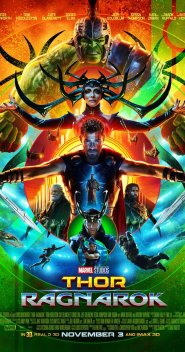 The newest Marvel movie, at its brightest, slides neatly into New Zealand director Taika Waititi’s stable of flippant, pungent comedy freak shows, and “at its brightest” is entirely a function of how cheerfully indifferent the film is to the strictures of Marvel cinema. A much more frivolous, foolhardy film than its two ambivalent predecessors, the mostly personality-stricken Thor and the Game of Thrones costume-swap Thor: The Dark World, Thor: Ragnarok’s ear for the rash and reckless, even the carnival-esque, is inimitably appealing. When his Thor film stops its tracks and stifles its narrative, choosing to hang out, loosen up, limber up, and drunkenly stagger through its paces rather than locking into place or filing in line, Ragnarok is a devilish little curio, a genuine blockbuster oddity even more bent and wicked than either of the Guardians of the Galaxy films. While Justice League was an attempt to mediate (and Marvel-ize) the abnormally pretentious and out-sized histrionics of Batman Vs. Superman: Dawn of Justice, Ragnarok is the genuine anti-Batman, an impish little sidewinder of a film that stands almost defiantly against introspection.
  At the risk of trading-in my science fiction film-going card, I present my opening gambit: Star Wars: The Force Awakens is a minor achievement in mimicry, while Revenge of the Sith is a major achievement in failure, or rather, a major achievement in failing to achieve a personal vision. Fans who despise the film tend to confine the series to a contrived standard of quality, one rooted in scene-to-scene legibility, in flows of character logic, in the film not biting off more than it can chew for fear of alienating viewers who cannot follow the missteps and mistakes of a film that seems to be actively rewriting itself before their eyes. In this framework, The Force Awakens is a definitive but ultimately banal success at what it sets out to do, a clean, precise, efficient blockbuster machine. But the costs are also a subservience to the staggering weight of the franchise and an acceptance of the solidity of obligatory satisfaction, of adherence to expectation. The film’s complementary successes ring out like injunctions to respectability, refusals to violate or reconsider or explode the mandatory vision of a franchise in favor of your personal vision for that franchise.
 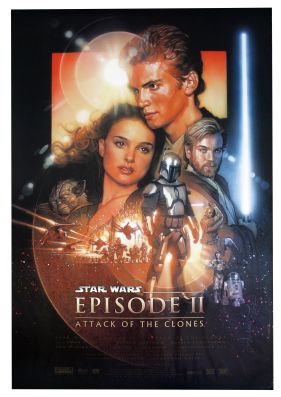 Phantom Menace naysayers aside, are you for real Attack of the Clones? Now this is how you do up a Star Wars disaster, grade-A incoherence and all. Specifically, Attack of the Clones ends up scrambling in a million directions in search of a new center after Qui-Gon Jinn’s death at the end of Phantom, a film which is itself almost a complete severance from Attack of the Clones in every way. Nothing about the earliest prequel develops any of the themes explored in Attack of the Clones, which nominally chooses to focus on the relationship between Obi-Wan and Anakin to get us on its predestined but sometimes-unfathomably rocky pathway to Revenge of the Sith. Nominally, I write, because you’d need to see Revenge of the Sith to even read any such relationship into this film. The two hardly spend any time together at all, leading to a narratively disjointed film that mostly resounds as a powerfully unnecessary display of arbitrary plot development. For the most part, Obi-Wan does things and Anakin happens to be around him, and then, for a while, Obi-Wan does things and Anakin isn’t around him, and then they’re back together again. This decision, perhaps more than any other, tends to render the whole “prequel to Star Wars” business rather dubious. All of the meaningful Anakin character creation that catalyzes the original films has been displaced onto Revenge of the Sith, whereas this film basically relegates itself to the broader geopolitical strokes of the imperial conflict, which basically means “clone army”.
  As opposed to an abject failure of imagination, design, or cinema more broadly, Star Wars: The Phantom Menace suffers a more equivocal, ambiguous form of misfortune, the kind of flaw that is also signally exciting and valuable in its own right: it suffers deeply from 16 years of franchise-creator George Lucas stewing on his ideas. With The Phantom Menace, the lower rungs of his imagination inflated to the point of boiling over with a desperate need to prove his mettle as an author by complicating and nuancing the concept for Star Wars without actually having a grasp on, or paying attention to, the actual execution, the very cinema, of his ideas. Everyone loves to hate on the thing, slathering it in such a smothering aura of empty incompetence that the criticism seems not only unfair but essentially arbitrary. In point of fact, the film is often anything but empty, and its surfeit of under-baked ideas – exciting to a point – are also its comeuppance. The totalizing way everyone demonizes the thing like it’s a leper unable to scrutinized up close asphyxiates not only the filigrees of glee inhabiting the film from time to time but its more legitimate offenses as well.
 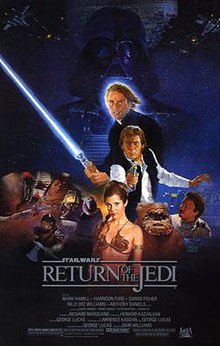 After the down-tuned-pulp pop space-opera of the original Star Wars and the astounding, apocalyptic depression of The Empire Strikes Back, what do George Lucas and his goons give us for round three? Neither fish nor fowl, but an extraordinarily and sometimes beguilingly stitched-together accident, a film loaded with and defined by peculiar tonal spasms and the kind of narratively-haphazard mess you just can’t get without a devoutly, almost feverishly passionate but mildly inept creative figure at the helm. Yes, Return of the Jedi is a travesty of writing on par with any of the prequels. But the real question is how it mobilizes its mess, whether it treats cinematic dysfunction as a liberating deliverance from acquiescence to middlebrow, mainstream cinematic perfection or as simple incompetence. Far from catastrophic but still strangely mishandled in ways both exciting and hindering, Return of the Jedi wears it fleet of script revisions and swamp of behind-the-scenes misgivings like a ball and chain. Every image, good and bad alike, are portals into the often dysfunctional production of this film as well as the obvious casualties of market success, both factors that are only barely hidden on camera.
 The Long Take