
 In honor of the half-century anniversary of the epochal years of 1968 and 1969, I meant to propose a little series of reviews commemorating the films of those years last summer, particularly with all the academic conferences and articles trying to rekindle the lost spirit of ’68 or otherwise to dissect it. I didn’t get around to it at the time, but with the era lulled to sleep last month by Quentin Tarantino’s phenomenal Once Upon a time in Hollywood, now seems as good a time as any to start! I apologize that I’m a year late to officially celebrate the 50th of some of these films, but a great film doesn’t need a deadline to be remembered.
This particular review is also in commemoration of Agnes Varda, who passed away earlier this year. RIP.
Most non-American filmmakers drawn to visualize their escapades in the US, or their fantasy projections of US life, are perhaps naturally attracted to, and unable to escape the pull of, America’s paradigmatic genre, the Western. Although heavily freighted with mythological weight, the genre doesn’t prescribe any intrinsic disposition. Initially structured around absences – of marginalized people, of violence perpetrated in the name of Manifest Destiny, etc – which various filmmakers have undertaken efforts to correct, the Western has become one of cinema’s most mutable forms for theorizing American existential uncertainty and the growth pains of a nation growing physically but not necessarily morally.
Thus, for the Italian Sergio Corbucci, the West became a burial ground. For the German Wim Wenders, contrarily, the West became a Romanticized, Emersonian portrait of exploratory selfhood, not to mention a gulf between desire and reality that threatens to dissolve the self in a deeply existential morass of uncertainty. For some, the open expanse signals space to cultivate, and for others, it signifies the untouched primacy of truth prior to civilization, and still for others it asks knottier questions about how to experiment with identity without becoming circumscribed by it, to remake the self and the land in tandem and often, to conquer and to be conquered by that desire to conquer. Continue reading
 In honor of the half-century anniversary of the epochal years of 1968 and 1969, I meant to propose a little series of reviews commemorating the films of those years last summer, particularly with all the academic conferences and articles trying to rekindle the lost spirit of ’68 or otherwise to dissect it. I didn’t get around to it at the time, but with the era lulled to sleep last month by Quentin Tarantino’s phenomenal Once Upon a time in Hollywood, now seems as good a time as any to start! I apologize that I’m a year late to officially celebrate the 50th of some of these films, but a great film doesn’t need a deadline to be remembered.
  It goes without saying that Widows is more of a crackerjack offering than we’re used to from director Steve McQueen, who typically specializes in the soul-rotting malaise of a cold-blooded world and/or the existential disfigurement of an abandoned person barely surviving in it. But Widows still bears McQueen’s ruthlessly stark, almost psychotically perfect formalist streak. There’s a little more wiggle-room in the style – more drive, more chaos, more flippancy, more immediacy, maybe even more of a desire to please – but it’s still a Steve McQueen film. Which means, although its gears run faster and it’s more soul-shredding than soul-rotting, it’s still all cold muscle, coiled nerves, and ready-to-pounce fury.
 Forgive the fact that this anniversary was last fall; I wrote this then, but didn’t publish it here until now
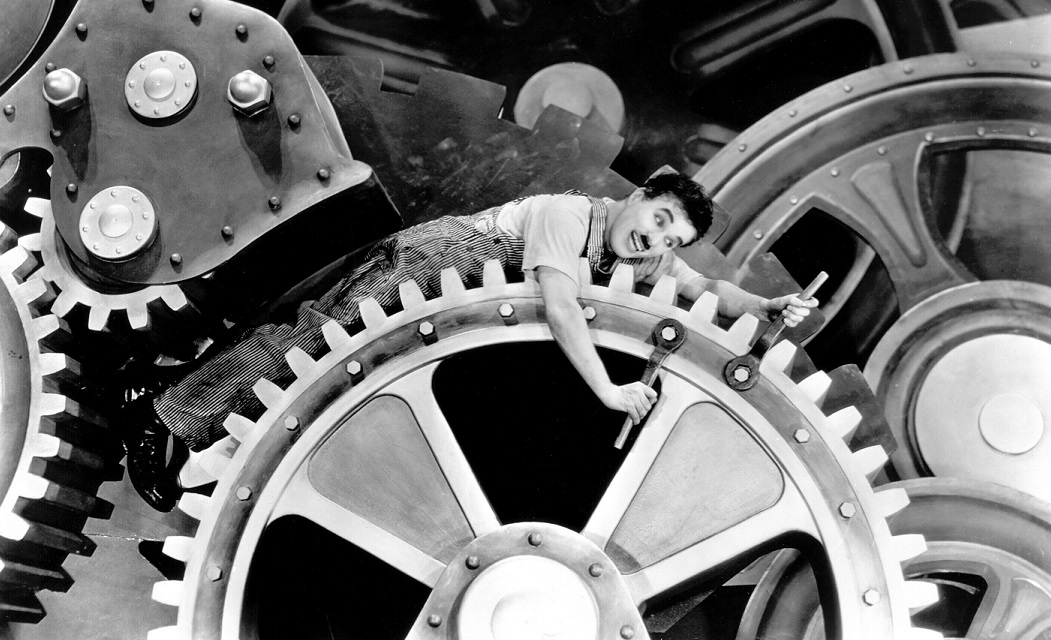 Charlie Chaplin was one of Hollywood’s earliest and largest stars, a filmmaking polymath who performed, directed, composed, produced, and wrote all of his films, a one-man brand who in Modern Times subjects himself to a possibly fatal question: whether he can escape being branded by the hot iron of capital. A British socialist who grew increasingly frustrated with American capitalism and Hollywood business practices throughout his career, he eventually left Hollywood and returned to his native England. Like many silent filmmakers, many of his earlier films explore questions of new technology and skeptically arouse the possibilities of modernization, thinking-through the relationship between new technological forms – both industrial and cinematic – and asking how one navigates modernity. Of course, many of his anxieties about industrial technology were also motivated by his own issues and frustrations with the rapidly growing Hollywood industry, exposing parallels between industry on-screen and industry in Hollywood that seem more prevalent in Modern Times than in any Chaplin film before or since. This is the film in which the personal will displayed in The Kid – where his Tramp character strategically manipulated capitalist products for new purposes with his mental ingenuity – seems to have been finally overpowered by capitalism’s singular ability to manipulate his body as the ultimate tool to its own ends.
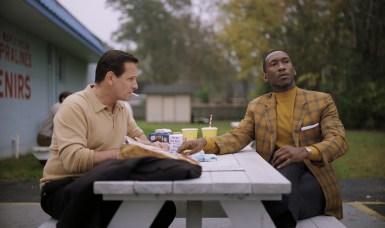 Green Book is almost refreshingly tone-deaf in its mid-century liberalism. Which, apparently, is still late 2010s liberalism, if writers Peter Farrelly, Brian Hayes Currie, and Nick Vallelonga (son of the protagonist) have anything to say about it. And, if for no other reason than to remind us that this variant of faux-egalitarian genteel liberal cinema undetained by questions of power and politics still exists this deep into the 21st century, I suppose I have to thank Green Book for taking my breath away. With Moonlight, Sorry to Bother You, and Us, I’d hoped we’d moved on. But here I am about to claim anything especially positive about late ‘10s American cinema on the subject of race, and Green Book has kindly arrived to keep me on my guard. Would that the film had any interest in exploring what its African-American deuteragonist has to do to keep himself on guard.
 Although penned by a phalanx of writers and starring Liam Neeson, the cinematically-savvy corners of the internet have been very quick to label The Commuter the work of director Jaume Collet-Sera. Perhaps grasping at straws in the wake of the death of the “action director” of the ‘80s and ‘90s, the internet has also deemed fit that Collet-Sera really is the dormant action-auteur we’ve all been silently waiting for over the past twenty or so years. And, if that wasn’t enough, he’s apparently a wrong-man thriller director whose pairings with Neeson rekindle the spirit of, if not existing on the same plane as, the famous thrillers of Hitchcock and Cary Grant! You know, the one’s where Hitchcock was playfully manipulating his audience and characters, rather than teasing us about the moral implications of how he was playfully manipulating his audiences and characters. Those films called for Jimmy Stewart in the lead.
 After the sturdy filmmaking economy of Hotel Artemis, it’s rather depressing to witness the belabored post-modernism and needlessly hip temporal machinations of Bad Times at the El Royale, not the worst kind of cinematic “cunning,” but close to it. Finally returning after directing Cabin in the Woods – and his mostly indifferent, mildly pleasurable screenplay for The Martian – Drew Goddard’s Bad Times is a vital compendium of many of the worst tendencies of mainstream “intellectual” storytelling. Goddard’s screenplay traverses an astonishingly circuitous route toward a largely banal resolution, superficially name-checking a variety of late ‘60s thematic signifiers – racism, classism, post-hippie fallout, cultish masculinity, the miasma of the oncoming ‘70s, a zeitgeist-y inability to trust in leaders – tepidly and arbitrarily. It expends all of its energy quite overtly ticking boxes on the path toward a moral parable that, at best, has little to do with any of the above, and at worst, actively avoids them to get from point A to point B, pulling themes out of a hat and getting bitten by the rabbit when the carrot at the end of the stick turns out to be a phony.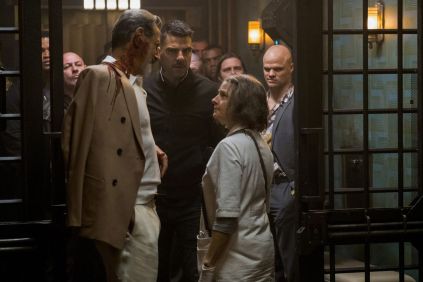
 The protagonists of the 2018 version of the oft-adapted A Star is Born may be the rugged, ragged country singer Jackson Maine (Bradley Cooper) and the younger rising pop star Ally (Lady Gaga). But the film’s voice undeniably belongs to another character, Jackson’s older half-brother, played with a typically phenomenal mixture of world-weary cynicism and weathered wit by Sam Elliot. Essentially the film’s viewpoint, Elliot’s character rebukes criticisms about its remake status by explicitly and perhaps charitably thematizing the value of playing within formulas and dusting off older routines in an early line of dialogue. As if the film is commenting on itself, this traveling soul seems to know, more than his younger brother who still believes in a more singular notion of originality, that there are limits to self-fashioning, and that all selves are cobbled together piecemeal out of influences far and wide. Elliot’s itinerant would-be cowboy reiterates what prior American wanderers Whitman and Emerson understood as the tragic possibility of realizing that you live in a world where all you can truly do is quote creatively.
 The Long Take