
 Edited
Released in the arguable peak year of a particularly turn-of-the-century form of social consumerism undercut by social discontent, Fight Club is uncommonly similar to fellow Class of 99-er The Matrix. Like the era-defining Wachowski sci-fi smorgasbord of high-flying kicks and high-falling ideas, David Fincher’s conniving would-be exercise in cinematic post-modernism is a startling technical showpiece well-versed in genre mechanics that curdles under the weight of its oppressive, over-baked interpretation of social anomie. Except, while The Matrix eventually gave in and realized it was merely an action film putting on airs, Fight Club, adapted by Jim Uhls from the book by Chuck Palahniuk, takes refuge in its pretentious vision of society until the very end. It would seem that the great, unfortunate secret of the cinematic year of 1999 is that a great many of its biggest hits are stunning visual showpieces hiding deeply incompatible or incomprehensible screenplays (it is no surprise then that the year’s best film, Kubrick’s Eyes Wide Shut, succeeds primarily because it is entirely about its visuals, rather than an attempt to marry those visuals to a needlessly over-baked narrative). Continue reading
 Formally an adaptation of what may be the greatest short film ever released, Chris Marker’s New Wave classic La Jetee, 12 Monkeys is another world entirely. This is not, as one might expect, a commercialized bastard son of Jetee’s postmodern commentary on storytelling and film as an art form. It is a more commercial beast, but not commercial Jetee. It is instead commercial Gilliam, very much retaining this particular director’s trenchant exploration of genre fiction, modern anomie, and social lies filtered through nasty dark-water corporate beasts not operating behind closed doors because there are no longer doors to close and hide behind. It’s sharp and prescient, well-directed and with a realist streak seen never before or since in Gilliam’s catalogue, but the film wisely never becomes “of realism”. 12 Monkeys is nothing breathtaking, and it lacks the elegant hellishness of some of its directors more conflicted and subversive films, but his decade and a half of ferocious commitment to personal vision, and three of the few legitimately great films of the 1980s, deserve a present. Gilliam always had trouble finding commercial success, and if conforming slightly to the norms of mainstream entertainment for the sake of a greater paycheck and commercial appeal is his present, who are we to deny him?
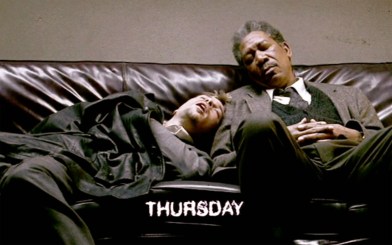 Yet 1995 was not simply a year of corporate indulgence; it was also a period where the rampant nihilist streak inherent to much of the cinema of the late ’90s and the 2000s and still running wild today came to fruition in the eyes of one music video director…
 Andrew Dominik took a good long time (five years) to release his feature-length follow-up to his magisterial The Assassination of Jesse James by the Coward Robert Ford. That he is re-teaming with his boy Brad Pitt for this film too, and maintaining the quiet despair and slow-going existentialism of his previous work, begs a mighty something indeed, a something the film can’t quite comfortably coalesce into a wholly successful finished product when all is said and done. Certainly, Dominik’s work is solid here, composed and well-formed and structured with intellect and care, but things only truly alight in a few select sequences where he decides he doesn’t need to be burdened with the weight of narrative filmmaking. It’s a good film, but a disappointingly slight one for a director of Dominik’s skill and gasping ambition. With his last film, he only re-wrote the book – or at least brought back out the re-written book after decades of being lost to dust in the attic – on impressionist, opulent Westerns and American identity… no big deal. Here, he tells a fine crime story, but one is left wanting a little by the transition.
  Edited
 Edited
 The Tree of Life isn’t easily explained through conventional filmic analysis. I don’t have the resources within me, for instance, to explain why Sean Penn is in this movie, or why director Terrence Malick felt the need to spend thousands of dollars on a CGI-heavy recreation of the forming of the world. But, for every fault to be found in the film, none can replace the eternal face that I fell – positively, undeniably fell – under the director’s spell for just about every minute of the 135 minutes I spent watching this film, in a way I never have in a movie theater before. The human story found here doesn’t recall my own childhood in the slightest, and yet watching the film, I couldn’t help but feel connected to not merely the characters but the world they inhabit in a way I didn’t quite understand at first. I felt something that, if I may, might be the foremost (and perhaps only, but that says more about me than the film) spiritual experience in my life. I wasn’t so much watching a film as accepting it and letting it wash over me. I wasn’t “analyzing” shots or dialogue, as I tend to do in order to stake my claim as a film critic worth his salt. I was just there, and also not there – in some sort of weird limbo where I existed less as a physical body and more as conception of myself. It was an experience, but perhaps, a passive one. I let the film take me and it accepted – part of me is still swimming around in there.
  The Long Take