
Terminator 3: Rise of the Machines
In 1984, The Terminator was a chilly, conniving, nihilist-humanist animal of a movie, and in 1991, T2 confronted the world as an operatic exercise in baroque fire-and-brimstone pyrotechnics. Both, in their day, were game-changers, and if the sequel’s charm has faded slightly, it still gets points for what it accomplished at the time. Even if the nebulous concept of “bigness” was the purpose for T2 – and a purpose director James Cameron has returned to time and time again to limited results – it was, when all was said and done, a purpose. Both films worked, ultimately, because they were masterminded by a man with something to prove. In 1984 it was his name as a filmmaker at all, and by 1991 merely the fact that he could humbly direct the de facto most technologically-savvy film of all time. Different hopes for different folks, as they say, but both set the man ablaze with passion to make a film. Continue reading
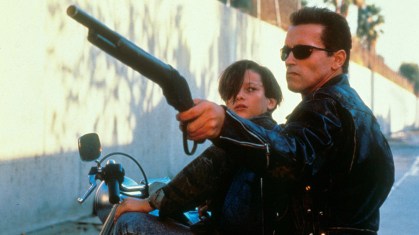 Because of that other Terminator film recently released, trying its best to soil the name of a once-mighty franchise.
 There are precious few directors that know how to wield a single scene quite like Michael Mann. His single greatest moment behind the camera belongs in Heat, a mid-film bank heist that overflows into a stuttery shootout that mashes together the rhythms of an urban jungle, the pageantry of an urban carnival, and a geometric fascination for odd, cutting edits and fascinatingly counter-intuitive visual storytelling. The shootout is one of the most perfect action scenes ever filmed, one of the most perfect scenes of 1990s cinema, and a startling showcase for a director who defines life as a collection of people (usually men) wallowing in their own danger until those men overflow onto each other and bubble till they erupt.
 With Jurassic World’s 500 million global first-weekend box office take, it is already commonplace to glorify the return of a franchise that has been some combination of long-dormant and actively awful for almost two decades now. Championing its return to quality is not a new point, although it is an incorrect one. Jurassic World is a bad film. Not only that, it is peculiar and abnormal in its badness. A great number of corporate tentpole blockbusters are soulless and mediocre – look at Age of Ultron just a month post-release – but seldom are they bad in a particular and notable way. Corporate spending on audience-testing mandates that blockbusters will be spic and span, not necessarily good, but not disconcertingly or notably bad. They may be corporately bad, or bad in a sterile way, but not specifically bad, and not especially bad. Jurassic World does a great many things that are specifically, especially bad, and that is, if not a good thing per-se, at least an accidentally worthwhile one.
  Because that other “Jurassic” movie just went and had the biggest opening release weekend in film history…
 A little late on this, but in honor of Tomorrowland, here is another, more successful, Disney attempt to turn a theme park attraction into a live-action film, a success that has haunted their follow-up attempts to this day…
 Christopher Nolan has always had a problem with his inner thoughts drowning out his ability to make compelling cinema, and the companionship of David S. Goyer in the writer’s chair has never been rectifying. Case in point: The Dark Knight Rises is a belabored mass of hang-ups, side-treks, false starts, hasty endings, and ignoble intentions. On the latter, the film’s villain Bane (Tom Hardy) – who turns Gotham’s poor against its wealthy so that he can profit in the end – is a troubling figure of social dejection and husky sooth-saying radicalism, and he is, without a doubt, a symbol for the false intentions of working class leaders, or Nolan supposes. If the superhero genre is a card-carrying caretaker for traditionalist individualism, libertarian democracy, and the American Way, The Dark Knight Rises is the flag-waving stalwart with a mouth for the status quo. It makes no bones about its fear that the working class is a raving groupthink machine defined only by its inability to restrain itself, lying around in wait for an opportunity to search and destroy and just hurting for an anarchist fight.
  Edited May 2016
 The comic book movie in 2005 was entrapped in its own split-decision bifurcation. On one hand, the likes of Elektra and Fantastic Four were omnipresent holdovers from the 1990s and markers of a genre strangling itself into childish submission. On the other, Robert Rodriguez’s Sin City sought to experiment with the comic book form as an avenue for pure cinema, and David Cronenberg’s A History of Violence was caught taking the medium of cinema to task with the violence of the human condition. Both were attempts to push the comic book medium to new depths, but both also tacitly exposed the limits of the superhero genre by eschewing the likes of Spider-Man or Superman for stories that, at their structural elements, had very little to do with the tradition of the comic book. Just as the comic book had grown up and left some of its inner core back in the minds of teenagers, so too was comic book cinema moving away from the fluff and the puff and toward something a little more brutalized and tragic.
  The Long Take