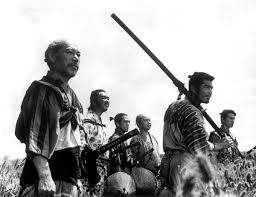
 Akira Kurosawa came to Seven Samurai at a flux, but the ripples of his magnificent cultural clash are still felt today. Birthed on a long line of films seeking a sort of safety in cultural traditionalism, he’d by 1950 established a certain formal rigidity in his films to befit this traditionalism that he extended into the stratosphere and elevated to high art. But Seven Samurai was him flexing his muscles, and his attitude toward the world, in a bid to implicitly challenge the culture he’d grown with, even as he naturally upheld that culture all the same. In its own way, Seven Samurai saw him growing, bending, and testing the limits of the Japanese samurai film. It also saw him feeling the ensuing pain and cognitive dissonance of his actions, not unlike Western films like The Searchers and High Noon for American cinema around this time. But while those films saw America grappling with its fundamental lie, that of individual freedom and fluid class boundaries, Seven Samurai saw Kurosawa tackle the mid-century Japanese focus on static class boundaries by adding a dose of new-found fluidity and freedom to his formally composed camerawork, and to his strong, silent characters. Like those films, Seven Samurai is caught in its own dissonance, radicalizing even as it remains resolutely traditional to the point of fable– but here it’s a fable of a nation coming to terms with itself.
Continue reading →

 Now, for “Film Favorites”, two of the most beautiful experiments in color ever made: Akira Kurosawa’s Ran and Michael Powell and Emeric Pressburger’s The Red Shoes.
  The Long Take