Midnight Screenings: Hangover Square

When they created Hangover Square, star Laird Creiger and director John Brahm had already collaborated on an American remake of Alfred Hitchcock’s silent classic The Lodger. That foggy cobblestone of a picture was as close as English language silent cinema ever got to the shadowy sublimity of German Expressionism, and the remake was a malevolent Hollywood horror-noir about European violence for a nation currently embroiled in the international contradictions of Western democracy. This follow-up, however, is even more capable of limning the thin line between the heavenly and the demonic, between modernity’s potential and its conundrums.

Adapted by Barré Lyndon from Patrick Hamilton’s popular 1941 novel of the same name, Hangover Square depicts progress’s gloomy underbelly in the story of a creator harboring a dark secret he isn’t even aware of, an inner shadow he cannot stabilize. For Laird Creiger, the man playing the tortured creative entity, it no doubt resonated with his desire for social acceptance, to be a hero in a world that had typecast him as a villain. By the time the film saw its release into the world, Creiger would be gone from it, dead from a self-imposed crash diet, including amphetamine use, the result of a rampant desire to be a leading man. By the end of this film, his character George Harvey Bone will likewise immolate himself in the poetry he pursued, releasing himself into a tragic uncertainty that he could not resolve in his life and which finds luminous resonance in his art.

Creiger’s sudden demise, and the shatteringly nervous performance he delivers in a character that clearly channels his inner ocean of frustration, is probably the reason why Hangover Square lingers in the shadowy recesses of the public memory. But this magnificent phantom of a film is an unquiet mind in which George’s artistic confusion doubles for Creiger’s own appetite and his socially unallowable sexuality (rumors abounded, and constructed relationships were displayed in public to present him as a heterosexual face for a movie poster). His portrayal of Bone is deeply moving and frightening, a vicious caricature of a society that produces compromised selves and displays its violence onto the souls of the unwanted and the otherized. One of his lovers warns him not to be “so far away.” Elsewhere, she asks him if he is “with me or with somebody else?” But Creiger seems to not be with himself, to be at odds with his own body, deranged by a world that quickly moved him from the fringes to the center but which didn’t, finally, have a place for him.

His Bone is an aspiring, brilliant composer in Victorian London who suffers from sudden eruptions of confusion and piercing episodes of uncertainty. When one of them leads to fugue state on the same night as a murder occurs near his flat he and his fiancé Barbara Chapmen (Faye Marlowe) confront Dr. Allan Middleton (George Sanders), who assuages him but quietly harbors suspicion. We need no suspicion because we’ve seen him commit the act in the film’s misty opening which, via the lighting of a streetlamp and a track inward from the streets to a private domicile, announces its illumination of the hidden reservoirs of brutality beneath the modern world. But he genuinely cannot remember the act, and he had no intention of doing it. This inverse Dr. Jekyll and Mr. Hyde, who is not trying to unleash his inner primordial id but who is trying very desperately to keep it at bay because he seems unable to, presents a decidedly sympathetic mirror of the early 20th century’s vision of itself. Within this violence, Bone finds a kind of dark power that is also a lapse into nothingness, a trancelike agency that is also an unmaking of self.

This is a fractured man, a huge behemoth who was also a shivering mouse. His character is a deeply ambivalent protagonist, almost frighteningly undecidable. At one point, when this towering beast of a man walks toward the screen, the camera seems to cower in fear, as though he is pushing the screen toward him and it is running away at once. A later image suggests the subtlest outline of his coat and hat in the background with his umbrella handle looking like a knife stuck through the coat’s chest, a symbol for the death of self creeping around the background of his life that he is unable to directly acknowledge and confront. When he opens a pocket-knife in front of his face, he wields a weapon of selfhood that is also figured as a schism of the soul. 

On-screen, Creiger finds an odd sort of power in harnessing his unacknowledged impulses, in unleashing his otherness onto the camera. When his other lover, singer and burlesque dancer Netta Longdon (Linda Darnell), who is transparently using him to advance her career, envelops him, the camera pulls in to the two of them, suffusing the material background in a black void. Absent the exterior world, the darkness consumes them in an absolute emptiness in the vehicle, a passage to a desire he cannot admit but which encloses him in a narcotic nonetheless. In the back-half of the film, he begins to accept himself as the beast that society made Creiger himself to be.

If this positions Creiger only as a doomed other who falls prey to his own monstrousness, Hangover Square also presents Bone’s tormented “black little moods” as cracks that open the world around him, that gouge out a vision of the social abyss pressing itself upon him. The city streets are pock-marked with ditches one might fall into, indicators of a modern London violently etching its way into the world, forcibly being made and unmade repeatedly. Fire torches, through graphic matches, become gas lamp lights, implying a modernity that is only ever a tightrope between a cavern of unmaking and a void of violent possibility. When George kills a victim off-screen, a bicyclist tragically runs over his cat, a kind of psychic tremor transported by his sensitive soul through the caverns beneath the city being dug for the subway system, as though London and everyone in it is tied together with a garrote of their own nerve endings.

This tension, not unlike the cord George wields like he’s tying his necktie, becomes truly vertiginous in the film’s harried, apocalyptic depiction of a Guy Fawkes Night party. Brahm and cinematographer Joseph LaShelle figure a celebration of national unity as a deranged homogeneity, a mountain of fake bodies all-too-easily crowned by a hidden real corpse all too easily masked as another effigy. Nationalism’s hidden brutality, here, is publicly acceptable, and yet still finally masked. Bone easily anoints himself the apex of a bonfire of collective chaos, not as its shunned outside but its repressed inner instability.

Of course, that’s being too cohesive for the film’s sensibility, and perhaps too radical. To read a film as restless and feverish as this one may be a fool’s errand, or it may suggest a text that was simply confused about what it was trying to say, or it may suggest that good art is, like Bone, tortured by its irresolution, by a drive for composure and Apollonian form entangled with an unraveling impulse to engage Dionysian force. The film is neurotic, and so were the people who made it. Creiger, of course, no doubt wouldn’t connect his own internal frustrations with this man’s murderous energy in any one-to-one way, but the point is society might have, an uncomfortable fit that allows the film to work multiple angles of social discord. Indeed, his two supposed lovers – although both relationships are notably, suggestively chaste – are clearly marked and opposed as arbiters of light and darkness, classical virtue and modernist force, yet they are often paired and echoed in various shots. This all may indicate that the film doesn’t hold up to a sophisticated and choker-tight reading, but that it prefers to run rampant, even to corrupt its own self-interpretation, and that the text is, like Bone, too uncanny and too bruised to do much other than unleash itself upon a world that has confused it.

Indeed, the film self-consciously rejects any stable reading of its drama. In one moment, we see Bone from behind, his face visible in a tiny mirror, and we sense that Bone can only see a miniaturized yet aggrandized version of himself, both smaller and bigger than he really is. The film won’t finally settle on the right way to view him, so instead it discharges him upon the world in a conflagration of a final performance in which the maddened Bone combines pieces written for both women into a swirling vortex of ravishing light and swooning darkness. His hands play fiercely and restlessly, not quite the unthinkingly violent automatons from the 1920s WWI, where the pianist’s hands were often figured in German horror as uncontrollable, runaway machines at odds with the reasonable, thinking mind. There, we get the sense that the misbehaving parts could be extracted, that inner cohesion and its capacity to produce and temper creative form could find he right balance between mechanization and human soul. Here, instead, the hands mark the artist as a savage, sublimated portal finally unloosed in an ecstatic blossoming of personal serenity and self-destructive turmoil, a man entirely in control of his own dialectical and dialogic exasperation and conjuring it in a tempestuous release of sheer energy. In this view, the artist harnesses the world’s buzzing natural chaos and complexity, scouring the shadows for signs of a dark and nebulous otherworld and hoping to stay in the penumbra, somewhere in between announcing social unrest and succumbing to complete malevolence, hovering between dark and light.

Bone, in this sense, is the tortured chronicler of a nation unsure of what composure means in the ascendant 20th century. His fits of rage are set off by loud, discordant noises, by the shocks of city life that interrupt the surface-level harmonies of the mind and of reality itself. At one point, he is disturbed by metal tubes falling of a transportation cart, by the scaffolding of technological modernity itself. They look uncannily like Luigi Russolo’s famous tube-like instruments invented to capture and channel the democratic polyphony of a frayed modern urban landscape, what at least one scholar has called the “emancipation of dissonance.” Russolo promised a new sound, a conduit for the discordant polyphony of a modern landscape, and his effervescent, corruptible vision of the 20th century would both climax in revolutionary and radical movements like the Situationists and curdle into the oppressive, reactionary currents of Italian fascism, each with their own visions of how to reconceive harmony for European cities in the 20th century.

These dueling and overlapping tendencies are uncannily embodied in Hangover Square, in its sense of a quiet instability moving equally and simultaneously toward potentially liberating disruption and that liberation’s imminent capacity to be rerouted into sheer brutality and hateful violence. This energy can only find refuge in a final symphony that, in combining different modalities of music, both traditional and modernist, cannot remain a guardian of classical composure and virtue without acknowledging the murmurs of uncertainty and otherness that already haunt it. The camera ultimately pans out and swirls around the artistic maelstrom Bone conjures and channels into blasphemous rage, taking ownership over the violence that haunts him, uniting his agony and ecstasy in a poesis consummated in a fire that portends the coming tremble of the 20th century. It dooms him as both a casualty of modernity and its purest form.

Score: 9/10

Midnight Screamings: Night Tide

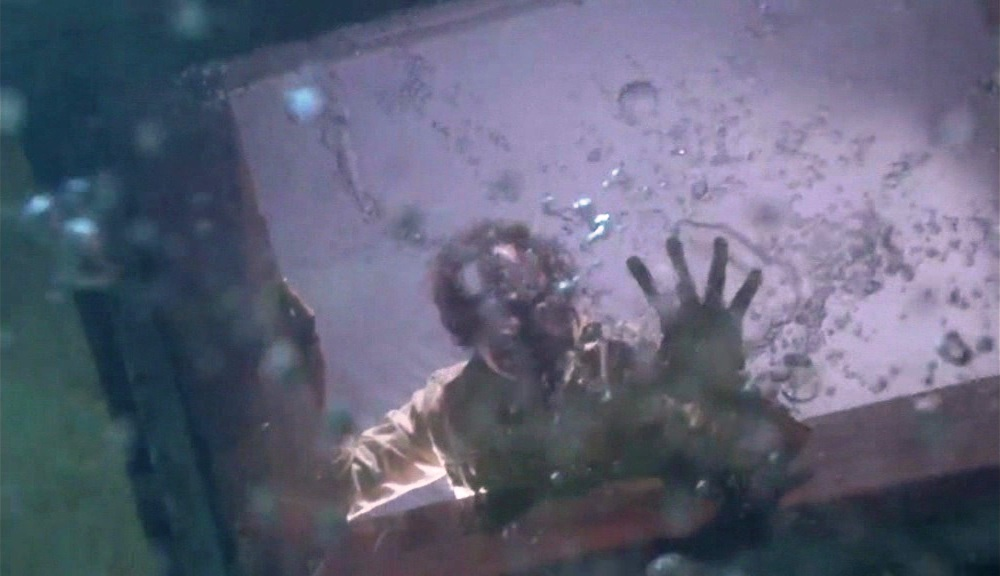
Curtis Harrington’s Night Tide feels like a strange dispatch from a cinematic mist that was and a gathering darkness that would be. It emerges out of that odd schism called the early ‘60s cinematic landscape, at once an ephemeral phantom of noir and an early tremor of the new uncertainty called the New Hollywood. It has a loose, oneiric, wandering sensibility that was a distant descendant of French poetic realism and its American poverty-row counterpart, the cinema of Val Lewton and Jacques Tourneur. At one point, the camera tracks through a forsaken coastal town bar and exposes a Night Hawks for the post-Old Hollywood generation, a community of aimless men and women in perpetual passage from one place they’ve been and another they’re going, adrift between a cinema of the past and a cinema not yet. When Dennis Hopper’s Johnny Drake walks down a flight of stairs, his journey is elongated by the camera into a passage into a new realm. He is in flight to a desire that he cannot contemplate, and a love he is both waiting for and not ready to contemplate, much as Hopper himself would become a poster child for the untold inner chaos of a psychedelic cinema that American cinema couldn’t yet formally imagine, as of this film’s release year of 1961, but which seem to haunt this text like a ghost from the future, a fate Night Tide is inevitably building toward. Like its protagonist Drake, like the doomed woman Mora (Linda Lawson) he falls for, Night Tide seems trapped between other things. It is liminal cinema par excellence.

Continue reading

Fragile Frontiers: The Searchers

While the received wisdom about the Western genre presents it as an assured space of spiritual solitude or a canvas for self-betterment through restorative strenuousness, you’d be hard-pressed to find a Western more worried about its own beliefs than John Ford’s The Searchers. The only thing really working against the film is how thoroughly its reputation precedes it. Its self-critical nervousness has paradoxically been suppressed and composed over decades into a vision of the solemn, self-assured object imperially judging its forebears. This is a supposed masterfulness that the film itself may not need, nor ask for. But, of course, that is the difficulty, and the paradox, of John Ford. The Searchers is entirely aware of the cultural baggage it carries. Far more than era-concurrent works like Anthony Mann’s Winchester ’73, it self-consciously courts, and creates, the mythopoetics of the frontier space as a moral battleground –  rather than Mann’s amoral void – on which the fate of the proverbial nation is to be staked. Its screenplay by Frank S. Nugent, based on the novel of the same name by Alan Le May, is transparently freighted with the heavenly wisdom of the noble stranger archetype, the paradigmatic American: isolated in their heroic, if tragic, dignity while being able to fluidly move into and out of various social milieus without being “of them.” This is a film that seems to have recognized how important it was before it was released, something that usually spells death for a living, breathing work of art. Yet rather than solidifying itself into a work of serene self-criticism, the interesting thing about Ford’s film is how worried it seems to be that it hasn’t actually figured out what to say about the genre laid out before it. The genre, in Ford’s vision, is not a passive resource to be either churned into self-conscious mastery nor to be dismissed or depleted into a ruse, which of course would only be another way for the film to celebrate its own assurance that the genre was morally repugnant. The West, in The Searchers, is neither a landscape to excoriate nor to celebrate. It is a vast store of uncertainty, a wellspring of consternation.

That doesn’t mean The Searchers doesn’t court the favor of its genre. The film’s interest, unlike so many heroes of the classic West, is that it transparently can’t escape its history, which means it must draw on the very mythos it can’t figure out. Wayne’s Edwards, the Western wanderer, is clearly the most capable man in the film, but he is also the most dangerous. He remains the film’s icon figure, like any good Western, but he is also the vortex around which the film distorts itself and the precipice it must confront but cannot fully peer into. While Wayne’s famous character introduction in 1939’s Stagecoach projects an imposing, all-consuming monolith overcoming a figurative landscape which he himself apexes and dwarfs, here he enters the film strolling in from a landscape that still seems to consume him, into a door that cannot fully protect him. While Stagecoach literally enacts the triumph of human over landscape in that moment of charged, almost phallic agency, The Searchers is a world in which humans seem essentially trapped in a tide of violence and vengeance that defrays the teleological, progressive structure that Manifest Destiny was predicated on. This is a not a man erected as a savior and defiler of a material, almost anthropomorphized abundance, but a lonely fellow who has come in from the cold, only to find that he imperils the very domesticity that he claims to protect.

Continue reading

Fragile Frontiers: The Lusty Men

Watching a Nicholas Ray film, it’s hard to feel good about the state of mainstream cinema in the 2020s. Ray never shows off. He doesn’t arrogate the full force of his talent to specific, privileged scenes. His films don’t explode off the screen. Instead, they achieve a kind of surface tranquility through the many febrile currents teeming within. His films superficially comply with the accepted forms of mid-century Hollywood, drawing out their inner plasticity and complexity without ever trying to make a show of exceeding them. In an early scene, aging yet apparently accepting ex-rodeo star Jeff McLoud (Robert Mitchum) returns home to his Texas birthplace after 18 years of itinerant stardom. The old man who lives there now recognizes him as the child from long ago, and they comically commiserate about the vagaries of achievement and the limits of desire.

The problem with “books on success,” the older man intones, is that they are written by “successful” people rather than “written by a failure.” In a long-shot, Ray holds on the older man on the right, shuffling around in the background with his normal routine. On the left, in the foreground, is McLoud, Mitchum letting his eyes loose on the part of the room we can’t see, seemingly taking in a vision of his past that the film does not afford us, a corner of the room that remains invisible to everyone but McLoud who, we intuit, has simply never stopped hustling for long enough to recognize that he has a past. This is a phenomenally suggestive image, Ray looking on at the two men who are sharing a story (and a mental framework) while also surviving within two entirely different registers. For one man, the house is a question of existence, and for the other it is an existential question.

Yet Ray has to insist on nothing, exposing layers of emotional reality without the characters speaking a word. This, more than anything, is what Jean-Luc Godard meant when he famously said “cinema is Nicholas Ray.” Reader, this is such a simple scene, such an apparently basic visual composition, but when do we see movies that actually even think about character blocking anymore?

The Lusty Men, in this fashion, is a quietly desolate film, the kind of piece about wayward, astray people who are so caught-up in the moment that they don’t even really understand themselves as being unanchored. In this modern-set Western, people are trapped by the vortex of the past and unfulfilled anticipations of the future, lost in a present that cannot fulfill them, or that they cannot allow to fulfill them, lest they give up on their self-imposed narratives of future, forever-deferred success. A Ray film is caught up in itself this way, aware of its energy but unable to stop it for more than a second at a time. The Lusty Men, then, is a film that knows how to kick up dust and to acknowledge the dust in its eyes, that aspires to and cowers before its own hell-raising. It thrives on the vitality of its ragged men and women, but it understands this raggedness as both a friction and a premature death. Ray was what we might call a weirdly expressionist naturalist, his cinema too hot and heightened to hold onto a reality bucking underneath it and too cold and sober to not recognize how tenuous its grasp really is. His cinema projects the fantasies his characters survive on, and it has a drink for the detritus of their being.

Continue reading

Film Favorites: Gimme Shelter

The ‘60s music movie, in its many permutations, was an attempt to diagnose the manifold mutations of a shifting sociocultural landscape. D.A. Pennebaker’s seminal Don’t Look Back figures Bob Dylan as an almost malevolent blank void courting and interrupting power, a clown prince puppeteering every inch of his relationship to the audience’s desire and his prismatic manipulation of it with Warholian ineffability and Keatonesque implacability. Richard Lester’s A Hard Day’s Night frames The Beatles as impish vagabonds harnessing the recalcitrant energies of an unreconstructed, uncontained modernity. Bob Rafelson’s Head, not to be outdone, mounts a vision of The Monkees as tortured poets of a world gone awry and unable to put itself together again. In these films, without always stating it, pop culture becomes a battleground for the fate of the future and an exploration of the limits of authenticity. In rock and folk music, the cinema of this era discovered a way of interrogating film’s very capacity to index reality itself. What, finally, did it mean to “document” truth when truth itself was a maelstrom, in which the method of inquiry itself – the visual representation of reality – confronted a subject that made visuality itself an unstable ground.

Gimme Shelter, a searingly banal documentary by direct cinema auteurs Albert and David Maysles and Charlotte Zwerin, seems, at first glance, to exhibit no such complication. Nor does the film’s subject, The Rolling Stones. Unlike Dylan, they do not thrum with calculated incalculability. They exhibit none of The Beatles’ self-aware, rakish charisma or peripatetic malice. When they are off-stage, they seem neither prey to nor predators of the forces that the Monkees found themselves wound up in. For the most part, they seem entirely unaware of the world around them, abstract ciphers approached by unknowing cameras.

The aforementioned movies and the aforementioned musicians all project a sense of interdependence and estrangement from the cultures that produce them. They are complex arrays of personal and social complexes, reflecting the ambiguities of gazes and desires that are offered, given, rescinded, and contested. Gimme Shelter, conversely, more or less depicts The Rolling Stones, who seem so happy to characterize themselves as willful collaborators with dark forces in songs like “Sympathy for the Devil” and “Paint it Black,” as entirely helpless. Gimme Shelter punctures the air out of countercultural acts of self-mythologization and optimistic social liberation not, as is usually written, by freighting these aspirations with self-inflated import and forcing them to confront a demonic ground labelled “the end of the 1960s.” What the film offers is more frightening and more thoroughly deflationary. Gimme Shelter implies that it may have meant nothing at all in the first place, that its most shining surfaces may have had much less going on underneath.

Continue reading

Film Favorites: Black Girl

In Black Girl, his 1966 cinematic debut, writer-director Ousmane Sembène casts himself as a local Senegalese schoolmaster, a figure who shares and spreads knowledge but, crucially, does not limit or control it. In his silent, accommodating, generous spirit, as a man who seems to see and explore more than know and dominate, he embodies the non-dogmatic mode of storytelling practiced by the film itself. In contrast to the typical characterization of the Hollywood director as a master-storyteller and moral jurist underlining every gesture, Sembène’s film is a cinema of non-tendentiousness, an act of poetic witness. It embodies the spirit of post-colonial “Third Cinema,” a cinema of righteous indignation that achieves moral clarity through paradoxical diffuseness, that wanders perambulates with its meaning rather than arbitrating it. Black Girl is an elliptical, exploratory text, one that slowly accumulates a deep and abiding frustration with the ghostly after-image of European colonialism but asks us to actively probe its recesses and shift with its resonances rather than passively accept a meaning that has been handed down and foreclosed for us.

When his protagonist Gomis Diouana (Mbissine Thérèse Diop) accepts employment as a childcare specialist for a white family in Senegal, eventually moving with them to France, she gives them a mask from her community as an act of compassion for the employment. Intended as a gift, a continuation of an active tradition of mutual generosity and togetherness, it has to survive becoming a mere totem. To her employer Madame (Anne-Marie Jelienk), it’s a predetermined object to fasten to her wall, an “authentic” marker of a stable and unmoving African culture. It is Madame who embodies the characteristic administrative authority of the dominating director, turning life into a symbolic abstraction, displacing the contingencies of an experientially abundant existence by congealing them into markers of assumed and unquestioned meanings. A mask that signifies so much, that refuses to be prematurely settled, for Diouana and her community becomes, for Madame, an essentialized indicator of an “authenticity” which can decorate without complicating her apartment and anoint without troubling her soul with indicators of her liberality and cultural awareness. Her desire to adorn it on her wall emblematizes her desire to pin its meaning down, to turn it from a living cultural object into an anthropological artifact.

However, the mask, which is so fecund and meaningful in Sembène’s film, always remains deliriously, deviously polysemic. It moves through the film, but it is not, and cannot be, ever summative of it or of any single meaning in particular. In one beautiful shot, Diouana stares at the mask on the wall, only to turn the top half of her body around to look at us. She becomes both the mask’s mirror, a repetition of its objectified silence, and its conduit, quietly implicating us in our own acceptance of inequality as it radiates a kind of resonant stillness. In moving her body toward it but turning back to us, she becomes its conversational partner in an intimate encounter teeming with unresolved suggestion. As a figuration of passage, the mask is a reflection of both oppression and resistance, a mute witness to violence that is also a beckoning social critic.

The mask’s constitutive ambiguity trembles throughout the entire film, especially in Christian Lacoste’s lustrous cinematography, which figures whiteness itself as a kind of luminescent longing that inspires and entraps Diouana, who early on speaks of France as an object of desire, and as the blinding, abyssal emptiness it eventually becomes to her. When she first enters the apartment in France, the shot figures Diouana’s face and the mask as two lonesome black dots on a forbidding white plane. The colonial buildings in Senegal too are viciously white slabs pricked by what we initially think of as black voids, towering edifices of colonial austerity and monolithic banality that trap the dark windows, manifold through they may be. But color remains cinematically multivalent and ambiguous throughout the film, a restless evocation of the fluctuations of identity and home. In Paris, a trapped Diouana looks outside her window and sees a pitch-black apparent nothingness pock-marked by white lights. While it emblematizes her loneliness, the reversal of color also prophecizes a potential refuge in the very darkness, the legion manifestations of a complex blackness, that she sees maneuvering throughout the world, even though whiteness seems to be in control. Like the mask, the darkness itself comes to signify not acquiescence or emptiness but the proliferating possibility of an object that remains impenetrable to the knowing or controlling eye.

Continue reading

Film Favorites: Force of Evil

Force of Evil opens on a god’s eye view of downtown New York, a promise of access to the totality of the city from a harmonious, analytical distance. Within minutes, Abraham Polonsky’s film will explore every nook and cranny of that promise as it descends into a labyrinth of ambiguous relations and inconclusive aspirations. Yet Polonsky never gives up on the ideal of his vision: to confront an amoral miasma with bracing moral clarity. Unlike many other film noirs, Force of Evil is not an equivocal descent into a swamp of unclarifiable social engagements. Polonsky’s moral point, that capitalism is a fundamentally inhuman mode of existence, is strikingly clear. The interesting thing, in fact, is how transparent it all is, how very much the on-location shooting, like the prior year’s The Naked City, presents us with a city that is all too aware of its own comings and goings, its accepted moral calculus, the quiet viciousness it has come to call home. Force of Evil, pace most noirs, is surprising for how unshadowy it all feels. It presents a city that has come to terms with its inner rot and legitimized it.

When we return to the streets much later in the film, Polonsky treats the city as an unforgiving social system but also an opaque region of the mind that might, just might, achieve transcendent clarity. In a mid-film excursion to a city park, a Church leers less as a sinister evocation of muddled ethical allegiance than a moral reminder of the limits of this way of living. When a series of birds fly away behind two characters talking, it’s as though they wish to escape the contours of this film. They float free, and the fact of their freeness implicates the characters in the illusory notion of capitalist freedom they live by. They are the only ones who escape a film about the exorbitant violence of America’s promise, a film in which everyone is trying to save everyone else via a system that kills everyone else, and almost always not knowing which is which, or how they came to become one and the same.

Continue reading

Midnight Screenings: The Hitch-Hiker

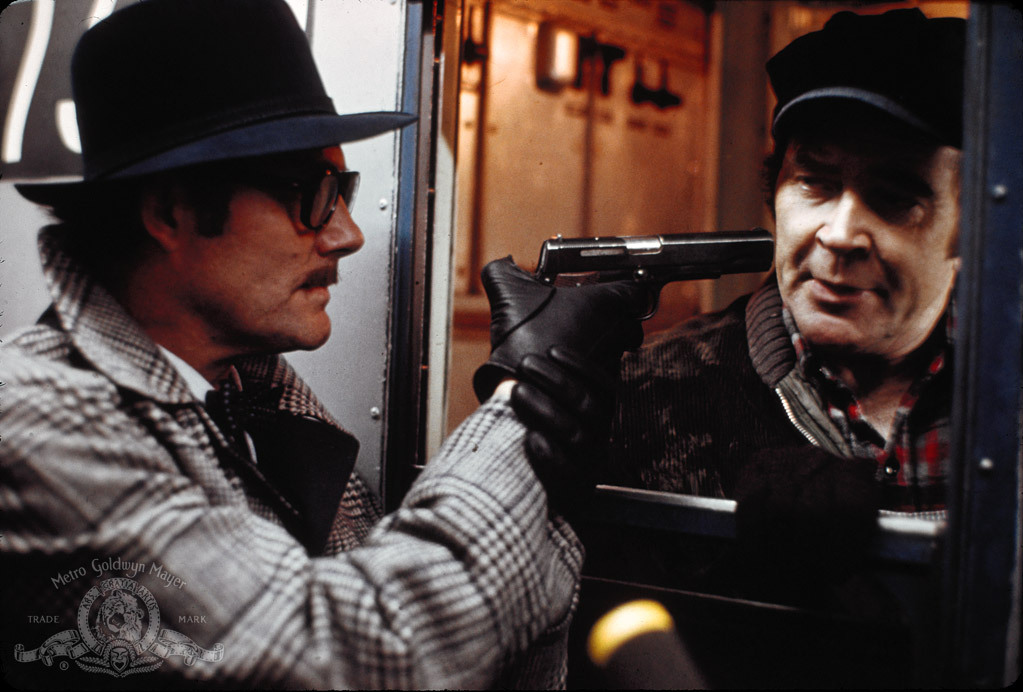
A man lurches into frame from the side, and a declamatory text card threatens us with both the immanence of a thoroughly violent stranger and the danger of a thoroughly didactic film. But while the 1953 crime drama The Hitch-Hiker loudly proclaims its message in the first minute, the film as quickly abstracts itself into a slurry of chaotic uncertainty. As if recognizing its own apparent obviousness, The Hitch-Hiker soon descends into a fog of poetic gestalts. Ambling feet wandering down the road. A scream. A flashlight on a car. Two dead bodies, their faces invisible, in a postmortem tableau. Lights like strange forces in the desert, and then a car. We’re told what and how to think and who to watch out for, but director Ida Lupino still finds ways to project the disorientation of the world on the disquiet of the screen. The title freezes over an image of a gun, with the words “the filmmakers present” over it. This is a pistol whip of a film, a raw, steel shot that festers like tetanus.

The Southwestern desert, as many scholars have claimed, lingers in the cultural imaginary as an otherworldly region of the mind, a relatively unclaimed invitation to possibility as well as a brutal crucible where the supposed iron-clad reality of the rule of law is tested and contested, exposed as a harsh, shifting ground beneath presumptuous displays of harmony. The Hitch-Hiker, fully aware of this ambiguity, is a rural noir that doesn’t submerge us in the cloistered chaos of a city but into a netherworld that once feigned as America’s frontier heaven on earth. Beware of wanderers, the film suggests, but the highway road seems to imply that we’re all wanderers in this nebulous world.

Continue reading

Midnight Screenings: Native Son (1951)

Watching the cinematic adaptation of Richard Wright’s Native Son, it’s hard not to feel the ripple of James Baldwin’s and Ralph Ellison’s critiques of the celebrated author. For Baldwin and Ellison, although they never fully shunned their forebear, they claimed that Wright was a merely “sociological author,” one who was too invested in a mechanical image of African Americans as an environmental distillate, or those of subsequent critics who emphasize the way he can only imagine unmodulated oppositions between protagonist and environment.

But Wright’s was a moral materialism, a tragicomic vision of the heroic quest to survive in a brutal and unforgiving world that weaponizes us against ourselves and metastasizes even those avenues we prepare for our liberation as new modes of oppression. Wright’s friend and fellow author and expatriate Chester Himes ambiguously and unresolvedly labelled this “the notion”: that trick which mutates the impulse toward freedom into a mechanism of control, that turns desires for agency into easily manageable fantasies of command and dominance that are alternatives to real power.

Native Son cannot escape the notion. It doesn’t offer much, really, and it is more of a curio than a fully fleshed out feature film. As a protest against society, its modes of vocalization are somewhat superficial. As an artistic statement, it is wan and limited. Its failures, however, are not those of a mute cog in a machine or a prophet of resignation, but of a film, perhaps unaware of itself, producing itself as an avatar of its own limits. Native Son cannot escape the world around it. What it can do is visualize its own entrapment.

Continue reading

Film Favorites: The Wrong Man

Largely overlooked for the films that flank it in Hitchcock’s oeuvre, 1956’s The Wrong Man is a deviously minimalist minor masterpiece, a slowly encroaching fog of existential despair in between more obviously conspicuous crests of cinematic ability. If his other, more obviously masterful films from the same era constitute apexes of formal control and metacritical acumen, The Wrong Man is striking for how thoroughly unadorned it is, how barrenly it lays itself before us. 1954’s Rear Window dissected voyeuristic masculinity. 1958’s Vertigo analyzed the desire to find patterns in a world of chaos, to bind an unwound world with illusions of control and continuity, even to shape others to fit your prefabricated mold of them. 1960’s Psycho recognized that we are all our own protagonist in our story, and that recognizing this fact might suddenly dismember someone else’s story. The Wrong Man shares imaginative territory with all these films, but it also totally evacuates them. It is not a vortex, magnetically collecting particles of cinematic skill into a violently-wound whole, but a nebula, a dispersed array of images and sounds that collectively expel our expectations for a sophisticated potboiler or a sudden shock. Unusually for this master cinematic magician, it seems to have nothing up its sleeve. It only has itself, and it lays itself bare for us.

The Wrong Man, which nominally traverses Hitch’s most thrilling, most recurrent territory of misidentified protagonists, is not a masterful thriller but a self-consciously master-less one, a film that is absolutely and finally prey to the vagaries of the world around it. Here, and only here, did Hitch suggest that the modern world itself is so chaotically unmoored and so distorted with the vagaries of chance and suspicion, that his capacity to carefully fabricate and painstakingly demarcate complex stories of control and blame can’t match up. Hitchcock’s ability to craft ingenious episodes of spellbinding confusion have nothing, he suggests, on life’s everyday ability to make us enemies of ourselves.

Continue reading