Guillermo Del Toro’s pet fascinations seem to have emerged almost fully formed in Cronos, his debut feature. Despite its less ostentatious sensibility, this is very much the work of the man who would make Pan’s Labyrinth. But it is no mere prologue. While Del Toro’s later films lather on either special effects or themes which increasingly seem like special effects, they also risk monumentalizing themselves. Despite its eminent craft, Pan’s Labyrinth feels like less than the sum of its parts nearly two decades on, as though it might collapse under the weight of the themes that signal its importance and the somewhat overworked narrative parallels that strive for conceptual relevance. Perhaps it spoke to its moment, but it also feels too strained to work as anything more than an antique to a particular flavor of Oscarbait cinema. And that’s saying nothing of his actual Oscarbait picture, the nearly somnambulant The Shape of Water.
Pan’s Labyrinth might have learned from a thing or two from Del Toro’s first film, in that regard. For all its resonance, Cronos is a decidedly spry, suggestive affair, never taking three metaphors to say what a brief glance or a hesitating pause might reveal. Indeed, the actual metaphor of the film is somewhat opaque, slowly – and without any obvious “twist” – sauntering into a slantwise vampire story rather than plunging in from the beginning. Jesus Gris (Federico Luppi), the protagonist of Cronos runs an antique shop, until he is “bitten” by one of his antiques. Suddenly, slowly afflicted with an almost-unstated craving for blood, the film plays loose with vampire mythology, but it is very much Del Toro’s exploration of the craving for infinite life that turns the body itself into a deadened machine. As one character says of his rich uncle’s desire to find the creature, “all he does is shit and piss all day and he wants to live longer?” That the wealthy uncle De La Guardia (Claudio Brook) hardly figures in the film, and that his conniving nephew Angel (Ron Perlman) who hardly cares about the metaphysics of lineage and simply wants to succeed, ends up figuring as a more central villain says something about Cronos’s general vibe, its appreciation for the deflationary and the quasi-comic, the gesture that undercuts even in the act of incanting.
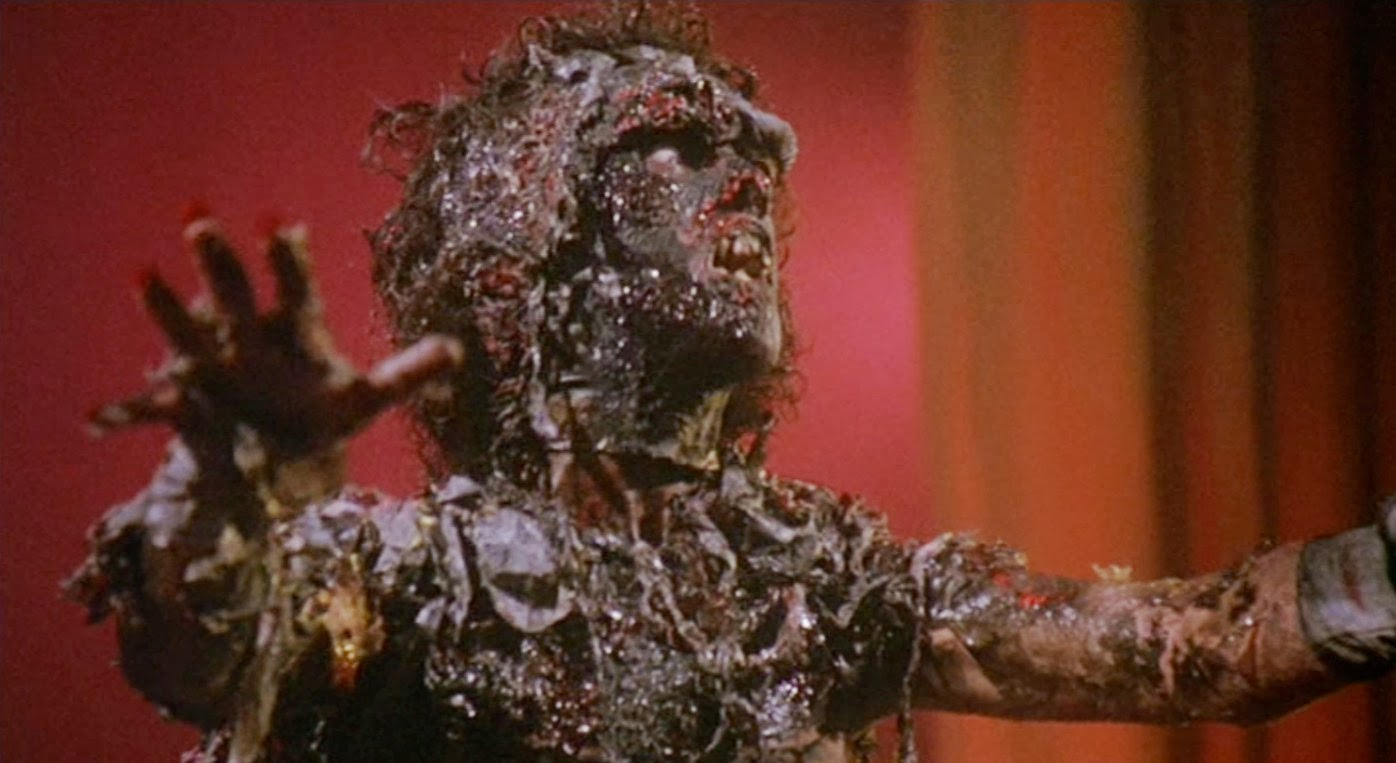
Released during the nadir of horror cinema as a popular and creative outlet, the early 1990s, when the decade was still in the midst of withdrawal from the slasher film high that quickly turned into an addiction, Cronos slips its fang into the moribund genre’s neck to reveal subliminal life.The creature itself is a clockwork insect, a vampiric inversion of the mechanical and the organic that suggests pulsing life dormant beneath objects that might be curated and controlled for display. The desire eternity is an inhumane way of absolving oneself from the complexities of existence, the film suggests. Rather than hiding death under life’s mask, as most vampire films do, Del Toro finds life dormant in an emblem of machinery, a golden antique that suggests a grotesque parody of immortal life encased in an armor of riches.One can trace the tendrils to Del Toro’s recent magisterial Pinocchio, which certainly portends his upcoming version of Frankenstein, another story of a modern Prometheus in search of transcendence who only discovers his own inability to cope.
That could also be a metaphor for the film itself. This deceptively simple story of the boundaries of life and the limits of death is all the more touching for how surreptitiously and even straightforwardly it leeches thematic resonance out of its story-world, how casually it feels attuned to everyday rhythms and, well, life. Indeed, life masking death is an unfortunately apt description for several of Del Toro’s later films, which too often seem frisky and deranged but ultimately reveal hollow cores (although his Pinocchio is a peach). Vaguely pleasing though it is to watch Del Toro given 100 or even 200 million dollars to aestheticize the lingering traces of our pasts, Cronos alone feels alive to its present. When Jesus gets his first taste of blood in the bathroom at a party, an angry partygoer wipes it up from the counter, leading an undeterred Jesus to lap up what little remains the floor, a moment that radiates even more lethargic sadness due to its casually offhanded manner. When a shoe walks past him, it briefly registers as a comment on the casually uncaring cruelty of the wealthy before it returns to the labors of the story-world. Crimson Peak, with its gothic manse literally sitting atop a field of blood-red dye, a gloriously baroque image that is also a crudely pandering, if amusingly self-amused, metaphor, ain’t got nothing on this tiny pool of blood and one man’s sudden, insatiable craving for it.
All of Cronos’s best moments are quietly insinuating like this, morbid incisions of quiet, quirky malevolence rather than meat-cleavers of meaning. After the “villain” Angel (Ron Perlman) attempts to murder Jesus without recognizing the implications of his affliction, Del Toro lovingly lingers on the work of a morgue attendant preparing the body for a funeral that never arrives. “It’s your best work yet,” he’s told, to which the attendant responds, lovingly exploring the nooks and crannies of the corpse, that there is “a technique to this. I’m giving it shape, texture, color. You have to be a fucking artist.” Del Toro gives himself the perfect metaphor for his own career, and then immediately mocks it. The widow has decided to cremate. Some people, Del Toro muses, just don’t appreciate the craft of death, and the of art of life.
Score: 8/10







 The Long Take