Something a little different I wrote for Taste of Cinema. http://www.tasteofcinema.com/2016/the-16-best-tv-series-directed-by-movie-directors/
TV Series by Film Directors
Leave a reply

Something a little different I wrote for Taste of Cinema. http://www.tasteofcinema.com/2016/the-16-best-tv-series-directed-by-movie-directors/
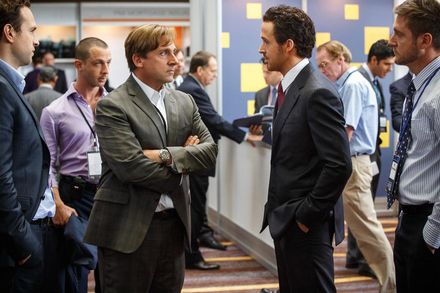 Flippant, self-consciously ingenuous, vacantly screwball-y, the caper film credentials are plastered all over The Big Short’s snazzy, flash-in-the-pan cinematography and relatively rudimentary bag of metatextual tricks. It’s a little like Great Recession fast food, although its overweening sense of “cool” calls back to the mid-’90s glut of post-Tarantino provocateurs with a camera. For the vast majority of its run-time, Adam McKay (of the Will Ferrell, internet comedy school of modern filmmaking) and co-writer Charles Randolph are not especially vexed by their total and complete disregard for the casualties and consequences of a crisis that can never fully be contained, or explained, in a single film, so for most of the run-time, they don’t even try.
Which is probably bad morality, but it doesn’t guarantee antiseptic cinema. For better or worse, Hollywood has relied on tragedy as the girders of grandly architectural cinematic entertainment for nearly a century, and if there’s a disingenuous nature to a cotton-candy approach, then a morose, ultra-serious tone doesn’t exactly wash away the failings of cinema or any art to truly capture tragedy as a lived experience either. No film can legitimately treat the tremors of life with the gravity they deserve; even when they inform us of their seriousness, bubble-wrapped films like 12 Years a Slave or Schindler’s List can’t but construct their tales around, for instance, the African-Americans and Jews who lived through unknown tragedy, rather than those who died under its wake. Films cannot raise the dead, even if they wear a necromancer’s cloak.
Although the question will likely remain forever intangible and unsolvable, a case forms for cinema that doesn’t even bother to insist on or imply its ability to truthfully expose the complexity and contradictory complication of history or experience at all; such films instead inhabit a realm of honest dishonesty, necessarily reflecting the ways in which even the most troubled and tormented “serious” films only convince us to believe that they are truly reflecting experience, rather than actually revealing it. Rephrased in the vernacular of the high school post-modernism of The Big Short, “films aren’t reality, so why bother pretending they are?”
Call it facile or amoral, but there’s a tang of truth to a film that legitimately and filmically interrogates the limits of cinema to construct experience. The trouble with The Big Short is that, while it exhibits an ounce (but no more) of this spitfire ingenuity, it is also incessantly culpable in the crime of pedantry. In other terms, a work of pop-economics is necessarily perched at the intersection of cataclysm and carnival, and The Big Short hasn’t the slightest whisp of a clue how to remove itself from the calamity that ensues at that fork in the road. Rather than pursuing one direction, it tries to ride two horses – the glib and the earnest – inconstantly, and the ramshackle, moldy-wooded wheels of its cart fall off before it gets anywhere with its own internal contradictions. The vaguely ironic oxymoron in the title is indicative of the central incertitude of the film itself; it wishes to be both grand and intimate, anthropological and personal, momentarily enthralling and fitfully educational. In the end, it only proves elusive.
Adapted from Michael Lewis’s book of the same name, The Big Short earns a point or two for perspiration, rushing from moment to moment and breaking so much sweat trying to involve its audience in material it never truly trusts we care about. In context, the self-serving swerves into sincerity (mostly near the end) feel profoundly disingenuous in light of the film’s otherwise madcap distrust of its own audience. The drama the film implicates itself in, particularly in sub-plots surrounding a mercurial, never-better Steve Carrell and a sullen Brad Pitt, is a self-aggrandizing , diaphanous layer of stuck-up moralizing ( I won’t go into too much detail about the individual characters or stories; that would be giving the film too much credit). It’s no secret that the filmmakers desperately hope the film’s sidetreks into tragedy will wash away the taste of the screenplay’s frivolousness; instead, the speechifying only reminds how contested the film really is about how to treat its material.
Part of the problem is that the film’s tricks never veer too far from the surface; the trouble with the post-Tarantino irony is that most of the filmmakers who adhere to it are mainstream welterweights whose surface-level idiosyncrasies never settle into the core of their beings. Much like suburban youths reared on Eminem and Jay-Z, these filmmakers pine for rebellion and youthful zest, but the apple never falls too far from the tree; these people are still products of mainstream institutions, and their films never sway too far from Hollywood convention after all. The Big Short is still trite Oscarbait, irony or no, and least most Oscarbait is a little more earnest about the saccharine strings being pulled in the background
One gathers that The Big Short’s most ostentatious, signature gesture – stopping itself dead in its tracks while a celebrity husk is carted out to demonstratively reduce financial jargon to human terms – is a swipe at itself. Yet in criticizing its own investment in chic celebrity couture and its shotgun-fired amelioration of fiery fallout with cool blue, easily-digestible cinematic jazz, the film also condescends vociferously and then has the nerve to sit down for story-time and teach us a message in the process. Seldom has Hollywood felt so palpably self-satisfied in its self-imposed superiority to its audience. You cannot, as the old saying I just made up goes, be a preacher and a stand-up comic at the same time.
Score: 5.5/10
 With Carol regalvanizing Todd Haynes’ career in a layer of cinematic majesty, let us take a look back upon his initial breakthrough into the mainstream.
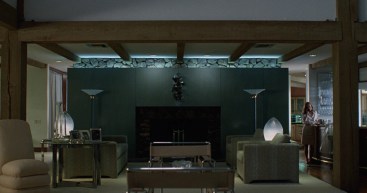
It does not require a degree in cinema studies to divine that Safe’s luxuriantly alienating mise en scene is as formidable and potent as that of any film in director Todd Haynes’ career, and arguably any film of the 1990s. Historians of the medium are no doubt aware that the 1990s were a golden age of independent cinema in the rabble-rousing, improvisational John Cassavetes milieu, but no familiarity with the decade at large is necessary, or even preferred, to bask in Haynes’ stringent, exacting evocation of social space as domineering predator and community as unstable fallacy. Continue reading
 The Good Dinosaur
Pixar’s newest film doesn’t enter a free world. Released on the back burners of best-in-class Inside Out, the company’s most sterling film in six or seven years (nothing can surpass the indomitable Wall-E), The Good Dinosaur has the misfortune of discontinuing the company’s renewed one-film “excellence” streak and sliding them back on the train to childhood cinema. The much vaunted “well they make films for children and adults” refrain doesn’t so easily apply to The Good Dinosaur, a film that does not, surprisingly, follow-up on the visualization-of-childhood-mental-breakdown and ode-to-depression themes of Inside Out. The Good Dinosaur, in contrast, is a proud cartoon, a willful and maybe even radical rejection of the need for “serious themes” in animation and a bold return to playful animation as the front-and-center first-line of any sterling animated film. It is, without apology, a Saturday morning film. Continue reading
Finally, and with a little delay, we arrive at the rest of 2015…
For the rest of the year, I’ll be breaking from my scrappy, impulsive habit of few-week review schedules and moment-to-moment small series, and finally get back to a lengthier, more extensive program of interest. Namely, I’ll be spending the rest of the year on a Cannes Film Festival project that I am incredibly excited for. It promises reviews of great films and, for me, the opportunity to see many great films I have managed to avoid until thus far.
For the particulars, there will be one review per year of the festival since its inauguration in 1946 (47, 48, 50, and 68 did not have festivals, so no reviews for those years). Usually. Who knows, as I’ll already be breaking my one-per-year habit with the first year (two reviews for 1946). We’ll see what happens for every year, but expect a general habit of one review for each year. The schedule with be intermittent but frequent. No “one film every blank days” or anything like that, but expect a regular pace to hope to finish the roughly 70 years of Cannes by the end of 2015). As for the reviews themselves, there will be a significant privilege given to the winners of the Palme d’Or for each year, but the only strict limitation is that the review for that year must be of a film that was in competition for the Palme d’Or (I’ve already reviewed a handful of the Palme d’Or’s, so broadening the rules just makes it easier). Expect most of the reviews to be of Palme d’Or winners, or at least Grand Prix (second place) winners, but again, other films will appear depending on my personal preference in some cases.
I hope you enjoy it. I’m certainly excited. Hands down, the Palme d’Or list of winners tops any other yearly award’s list of winners in terms of general quality and variety of films from nations and styles all over the world. The award has misstepped in the past sure, but the overwhelming majority of the winners are at least “very good”, and a solid plurality, if not a majority, are close to masterpiece level. Lord knows it has the Oscars (where a Best Picture winner is lucky if it is merely good) beat handily…
A chill catch-up month at The Long Take for June, before the second half of the year sees us enter into a few lengthier series spanning out the rest of 2015 (I feel like I’m still winding down from Fury Road, and especially from having to adjust to a post-Fury Road world, and I need to take the month off to rest.)
It will, of course, not actually be a month off, and I’ll continue with the weekly Midnight Screenings (I never manage to actually do them on a specific day, so let’s just say once every week at some point). I’ll also be doing a sort of final round-up of movies from the increasingly not-new “new movies” section of the blog, which covers films from now until way back in the far flung past of roughly 2008 (when I semi-started writing things about film for fun in my own time as an extremely small hobby, so a totally informal date it is). Essentially, just expect some short reviews throughout the month of movies I’ve been meaning to get up on here from the past few years, organized by category (“Oscarbait Movies”, “Superhero Films”, “Little Films That Could”, “Genre Fare”, “Animated Films” and the like) These will be more relaxed, generally shorter reviews (so, you know, only normal length reviews as opposed to my usual manifestos on the state of things as we know it).
Of course, we can’t go a month without one proper mini-series, so we’ll be taking a look back sixteen years to the de facto “Best Year For Modern Film” of 1999, a claim I do not entirely agree with, even as I respect the importance of a great many of the films from the year. The impetus for this series? I have not yet reviewed a single film from that year in the roughly 500 reviews I have thus far posted to this blog, and that just cannot do for such an important year. Expect an unspecified number of reviews (about ten) from the year over the next month. Never fear, though. July and on will be the start to lengthier endeavors.
Hey Y’all,
Check out this new list I wrote up for our friends at Taste of Cinema, taking a break from my usual horror contributions for something a little lighter but no less challenging. This is my take on the 25 Best Animated Short Films ever released.
Hello all,
It turns out I’ve produced another list for Taste of Cinema recently, on Japanese Horror this time no less. Included are short commentaries on a variety of films new and old, from Gojira to Kwaidan to Onibaba to Audition to Tetsuo to A Page of Madness. Hop on over and take a look: http://www.tasteofcinema.com/2015/the-15-best-japanese-horror-movies-of-all-time/
Hi All,
Here’s a new list I wrote for Taste of Cinema about films by directors in their twilight years, proving that talent and passion don’t necessarily fall off with age, linked below.
Some of the films included in the list: Eyes Wide Shut by Stanley Kubrick, Short Cuts by Robert Altman, Unforgiven by Clint Eastwood, The Searchers by John Ford, Fanny and Alexander by Ingmar Bergman, Grizzly Man by Werner Herzog, L’ Argent by Robert Bresson, Amour by Michael Haneke, Ran by Akira Kurosawa, The Discreet Charm of the Bourgeoisie by Luis Bunuel, Rio Bravo by Howard Hawks, and The Birds by Alfred Hitchcock, and many more!
Howdy Y’all
Just a quick catch-up here, a few sentences of your time. Due to difficulties in accessing certain films (and deciding on which to view/write-up) and rampant personal sickness, I’ll be delaying the National Cinemas feature a slight bit. November had been scheduled for Italy and December for France, with January serving to showcase China/ Hong Kong. Being half-way through the Italy month, I’ll instead continue focusing on that nation until the end of December (so expect two to three new reviews for this month). January then will tackle France and February China/Hong Kong. Then there’s that rather long last feature for Germany to be posted, which I expect will come sometime around Christmas. Perhaps then I’ll add a few more months for other nations. But we’ll see about that when the time comes, ehh?
Best,
Jake
 The Long Take