
 I meant to get this out a month ago for Halloween, but here’s a (delayed) review of one of the great, deranged, unsung horror classics of 1968, and one which by virtue of totally refusing to put its finger on the pulse of that year, seems to encapsulate it all the more so.
So many horror films from the late 1960s feel prepackaged to unpack the fluctuations and transformations of the era for us, as though hyper-conscious of and possibly imprisoned by their self-regarding ability to divulge the hidden truths of time’s passing for us. They read and tease out the machinations and contortions of the era with a self-conscious precision. Their symbolic maneuvers and eloquent gestures of barbed analysis are so clearly and elegantly primed to scrutinize and inspect, statically, what was in reality lurching around them in media res. Some of the hungriest films of the genre produced at that time, namely Night of the Living Dead, still quiver with unassuming dementedness, but many of the otherwise-sharp films from those years exert so much energy monumentalizing the time-period – arriving at the thesis that sums up the time period – that they reject the lower registers of the time period’s insanity for clear-eyed, and thus, somewhat surface-bound, inspection. They order and explain away the tumultuousness so much so that they risk missing the period-specific chaos around them, and where that chaos might take them if they were to listen to it.
That’s certainly understandable. Explanatory potency and acumen are essential features of the cinema, not to be neglected. But they don’t arrive at their conclusions without casualty, and Spider Baby is one of those casualties. Compared to, say, Rosemary’s Baby, released in the same year and a little too aware of the-already canonized importance of that year in some ways, Spider Baby feels positively anti-canonical, unadorned and unalloyed to any critical sensibility consciously informing the material. It’s not as precise as those other films, by virtue of that fact, and it so overtly dismisses the offer to comment on the era that it often seems to be doing absolutely nothing with the heritage that it’s been bequeathed with. It doesn’t feel as predetermined to mythologize any era of horror, in fact, almost as though it exists blissfully unaware of the passage of time around it. Instead, Spider Baby simply convulses, entombed in and liberated by its mania. The young directors of the New Hollywood were cineastes, as inclined to think cinema as to feel it; Spider Baby simply exudes it. It’s Old Horror passing before our eyes like a ghost rather than New Horror studiously dissecting the corpse. Continue reading
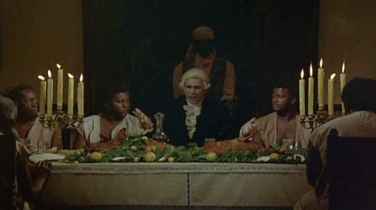 A classic of Cuban Marxist-inflected cinema, director Tomas Gutierrez Alea’s La Ultima Cena offers an intimate portrait of the paradoxes that arise when attempting to reconcile “Western” Christianity and slave life on the plantation. Focused on a slave master’s self-fashioned “benevolence”, La Ultima Cena examines how slave masters’ self-regarding visions of personal sacrifice – their collective belief that they were moral patriarchs sacrificing for their slaves in hopes of “teaching” them “civilization” – couldn’t but require them to engage their slaves in ways which sometimes invited the latter to announce their humanity through means the master wasn’t likely to want to hear. Alea’s film depicts slaves themselves debating real freedom on the sham stage of a master’s faux-freedom, pushing liberation’s meaning well beyond the pale of what their master could possibly imagine.
 No special occasion here, just a re-watch for a course, and because I haven’t updated the site in a few weeks.
  I originally wanted to write this up in reference to the release of Craig Brewer’s My Name is Dolemite next week, without even realizing the highly appropriate irony that the last (only?) great Blaxploitation film was released almost one decade ago to the day.
  Jordan Peele’s Us bears many obvious linkages to Get Out, Peele’s 2017 box-office slayer, but Us feels less like a retread or even an update or extension of Get Out than a perversion, a disruption, a chaotic disfigurement of the earlier film’s elegant simplicity. Us is both more existential and more surreal, more playful and more brutal, and, above all, more experimentally distended, exhibiting a newly ravaged and warped texture that is very much to my taste, but not necessarily to those looking for a clean like of argumentation in the film, or even a clear subject. Get Out’s comparatively streamlined metaphor for sight, sightlessness, and embodiment was tight, vicious, and tenacious – perfect for itself, and perhaps for a first film – but not nearly so troublesome as Us, which actively and conspicuously refuses the snug moral logic and trimmed-down narrative of Get Out. Us isn’t avant-garde in any overt sense, but where Get Out’s story fell into place, this new film buckles, utilizing horror for its demonic textural and thematic elasticity and indescribability rather than merely as a generic skeleton for a moral parable. It’s storytelling by way of allusion, digression, and disturbance, a film that benefits or suffers greatly (depending on your proclivity) from writer-director Jordan Peele’s obvious enthusiasm overtaking his discretion, his ensuing disdain for hedging his bets and, probably, his frustration with heeding the rules and regulations of Hollywood storytelling. It’s as if, having mastered the art of skillful middlebrow horror cinema, Peele decided to dismember it.
  Neoliberal American aimlessness is recoded as anticipatory national fantasy in Rambo: First Blood Part II, a film that both thoroughly disgraces the legacy of its progenitor and perversely fulfills the dormant desires which may have animated many viewers’ affection for the original character. That original film envisioned Stallone as a bruised dog. He was as inarticulate as any of his other characters, but his motor-mouthed struggles were construed less as a function of a screenplay disconnected from humanity (as in, say, Cobra) and more as a theme: the result of a nation and a man unable to vocalize their severe trauma and societal disaffection. The original First Blood, then, was a fairly doleful thriller about unmet expectations, a thoughtful meditation on American lapses that framed the US’ involvement in Vietnam as a national aporia that not only chewed out and spit up the soldiers but cast the whole nation adrift, leaving it to wander a moral wilderness.
 Many self-consciously “weird” motion pictures expend energy and time establishing a stable sense of cinematic self that they will only then destabilize later on, tweaking the style several notches south of sanity as the film progresses. Horrors of Malformed Men lathers the surrealistic absurdity on thick from the first shot. It introduces us immediately to a thoroughly dismembered reality, a cinematic hall of mirrors that finds us wandering into a B-movie and discovering a metaphor for Japan’s mid-century dreams of paternal control, familial destiny, and authoritarian anxiety, all (appropriately) malformed into a kaleidoscopic nightmare. The subject of the cinematic allegory? Deluded men working at any cost to recreate their lineage and preserve the fragile illusion of a linear, biologically-sanctioned family hierarchy.
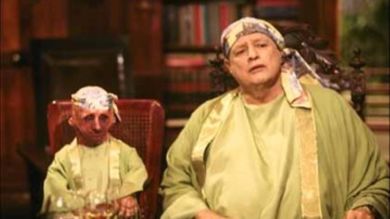 In honor of the release of Colour out of Space, the new Richard Stanley-Nicolas Cage-HP Lovecraft film (what a wonderfully demonic cinematic Cerberus that is!), I decided to look back at Stanley’s last film, a full 23 years ago. Let us hope that his new attempt at channeling the deranged spirit of century-old pulp literature and tearing open and excavating the most demented corners of the cinematic void don’t render him victim of that void, unable to find his way back, for nearly a quarter-century, like they did last time.
  The first cinematic adaptation of the writing of James Baldwin, perhaps unexpectedly and perhaps perplexingly but undeniably fittingly in light of the writers’ artistic omnivorousness, takes its most obvious cues not from Baldwin’s profession but from the profession of its main male character. If Beale Street Could Talk follows a young African-American couple Tish Rivers (Kiki Layne), nineteen, and Fonny Hunt (Stephan James), twenty-two and working as a sculptor’s apprentice who conjures visions of tragically stilled beauty that the film, if not modeling itself after, at least siphons energy from.
 Gotti asks me to put my money where my mouth is. A favorite complaint of mine when reviewing movies is to critique actors turned directors for neglecting the film of their films. That they render mere theater pieces that happened to have been filmed in lieu of genuine works of cinema. Watching actor-turned-director Kevin Connolly’s bastardization of the life of John Gotti, I realize that I’ve sinned. Most actors turned directors at least display a basic competence with the camera. They merely fail to embellish their narratives in any particularly cinematic way, dismissing the possibility that the camera might be to used to achieve anything beyond or besides perfunctory realism. They treat their camera as a window or a simple observer rather than a canvas and, in doing so, their cameras’ perspective often fails to expose its perspectival nature, feigning naturalism.
 The Long Take