
Category Archives: Progenitors

Progenitors: Scream

I am told there is a Scream TV show out now. What better opportunity to review a film I pointedly and adamantly do not like, and also to finally fill the weirdly pesky “review a film from 1996” gap in my blog that has somehow tempted me longer than any other single year.  

I am, by nature, a fan of cinematic post-modernism and deconstruction. It was just yesterday that I found myself praising the somewhat messy Pat Garrett and Billy the Kid, a film where Sam Peckinpah confronted the entire Western ideology and the revisionist “realist” Western and evoked a sense that no Western could truly coexist with a state of reality. It excavates deeper ideas, though. That Westerns are by nature so tied into the American lexicon for hope and identity, and that they are necessarily malleable and adaptable to modern American needs and desires and, on the other hand, always tangled up in the oppressive and masculine rhetoric of the past that still very much exists in the present. As a film, it addresses its own fictionality, encasing itself in a cadre of ’60s and ’70s actors and musicians who can not be disconnected from their identities as ’60s and ’70s personalities. It is a film that, by its very construction, asks us to question what a Western film is, and it does all this without ever once tipping its hand into lazy fourth-wall breaking. Continue reading
Progenitors: Terminator 3: Rise of the Machines and Terminator Salvation

Terminator 3: Rise of the Machines

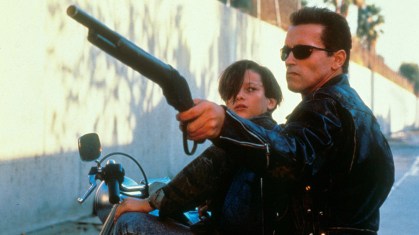
In 1984, The Terminator was a chilly, conniving, nihilist-humanist animal of a movie, and in 1991, T2 confronted the world as an operatic exercise in baroque fire-and-brimstone pyrotechnics. Both, in their day, were game-changers, and if the sequel’s charm has faded slightly, it still gets points for what it accomplished at the time. Even if the nebulous concept of “bigness” was the purpose for T2 – and a purpose director James Cameron has returned to time and time again to limited results – it was, when all was said and done, a purpose. Both films worked, ultimately, because they were masterminded by a man with something to prove. In 1984 it was his name as a filmmaker at all, and by 1991 merely the fact that he could humbly direct the de facto most technologically-savvy film of all time. Different hopes for different folks, as they say, but both set the man ablaze with passion to make a film. Continue reading

Progenitors: Terminator 2: Judgment Day


Film and TelevisionBecause of that other Terminator film recently released, trying its best to soil the name of a once-mighty franchise.

James Cameron’s Terminator 2: Judgment Day is not the film its predecessor, also directed by James Cameron, was. For largely the same reasons that James Cameron’s Aliens is not the film its predecessor, not directed by Cameron, was. 1984’s The Terminator is a more urgent film than 1979’s Alien, but they share a similar sensibility: relentless, unforgiving, nihilist, purposeless terror always lashing out at you, married to perfect filmmaking that traffics in both show-not-tell and not-showing-is-scarier-than-showing. Alien is an outright horror film masquerading as a sci-fi film, and although The Terminator is more comfortably an action film masquerading as a sci-fi film, it trades much closer to horror than you might expect. Continue reading

Progenitors: The Lost World: Jurassic Park and Jurassic Park III

Because that other “Jurassic” movie just went and had the biggest opening release weekend in film history…

The Lost World: Jurassic Park

Jurassic Park was directed by an auteur who was a kid at heart and had it in his dreams to create a new pop-fable for the modern age. Having tackled sharks, nazis, and aliens, dinosaurs were really the only foreseeable future in his career, and the rampaging success of Michael Crichton’s book Jurassic Park was as good an excuse as any to pursue that dino-dreaming. The end result was not a healthy meal, but it was a particularly fizzy soda and buttery popcorn even in its worst moments, and we critics cannot argue with Spielberg when he is using his fullest talents to commandeer the screen and throw us into our worst nightmares.

The Lost World: Jurassic Park, released just four years later, was directed by a crusty old auteur who had better things to do than make pop fluff, and it shows. Spielberg, “the man with Oscars on the mind,” was in full swing in the late 1990s. It wasn’t his best mode, but it devoured both his serious films and his blockbusters in a layer of dreary somnambulism, suffocating whatever energy and zest he had for layering fun onto the screen. The Lost World is a tired motion picture, and even in its best moments, it has a slow-going, self-serious demeanor that coats the film in an unearned sense of importance. It is Spielberg trying to make a wacky puff piece out to be a heavingly serious drama.  Continue reading

Progenitors: Pirates of the Caribbean: The Curse of the Black Pearl

A little late on this, but in honor of Tomorrowland, here is another, more successful, Disney attempt to turn a theme park attraction into a live-action film, a success that has haunted their follow-up attempts to this day…

Pirates of the Caribbean: The Curse of the Black Pearl is a little bit of lightning in a bottle. It shouldn’t work; in fact, it didn’t just ten years later – when the principal actor and director teamed up again with a similar tone and dollar signs in their eyes, only to be trounced by generally divested cinema-goers and critics. It didn’t work the half-dozen or so times that Hollywood has tried to return pirates to the mainstream since the end of their heyday ransacking Hollywood way back in the misty yesteryear of the 1930s. And it didn’t work just the same year The Curse of the Black Pearl was released, when Disney took two other Disneyland/ Disneyworld rides and made films out of them, both to negligent box office results and dismal critical failure. Continue reading

Progenitors: Poltergeist (original)

Not any sort of official series, but especially during the summer months, remakes and sequels are, if nothing else, great excuses to review the films that came before. As I am above no excuse to review a film, I must answer the call.

I would like so much to proclaim the original Poltergeist as a fascinatingly accidental volcanic meeting of disparate, jagged minds, the harsh nihilism of director Tobe Hooper jutting out into the heart of the sticky-sweet nostalgia of producer Steven Spielberg, whose nostalgia is in turn engulfing the nihilism of the director. Ideally, the two seminal figures in arguably the first AAA horror film of the early ’80s (the genre’s introduction into the big leagues of crass, craven ’80s consumerism) would have had their nails at each others’ throats like a cage match between a devil-worshiping, corpse-eating, grave-residing raven and an elegant, iconographic American eagle. Even if the two minds burnt each other out, the battle would be a bile-spewing front-row-seater if ever there was one.

At its best, Poltergeist almost gets there. Introducing us to Steven and Diane Freeling (Craig T. Nelson and JoBeth Williams) who reside in a regimented, rigid California suburb with their three children: Dana (Dominique Dunne), Robbie (Oliver Robins), and Carol Anne (Heather O’ Rourke), all of whom bear a grand-old Americana name if ever there was one. Now, most suburbs have their everyday problems…rats, tax collectors, salmon shorts, but ghosts is another story (I must concede, however, that salmon shorts may be the greater evil still). One night, Carole Anne discovers first-hand that something is up, and as time moves on, things begin to bump a little too much in the night for this family to handle.
Continue reading