A bit delayed here, but while I happened to post a review of a Roger Corman-produced film two days before his death, I couldn’t not honor the man by reviewing at least one of his self-directed works, and one of the sharpest and most prescient early ’60s films to diagnose America’s ills to boot.
In the final analysis, Roger Corman was really only interested in making a buck cheaply and quickly. He was a particularly vulgar variation of the termite artist, to use Manny Farber’s term, scratching immediately and injudiciously at any and all crevices that had opened up in society’s façade. He could make a womb, and a few dollars, in any space where the world no longer seemed comfortable. Usually, that meant selling audiences on astrological terror or cosmic instability, on the pleasures of momentarily acknowledging the diabolical awfulness lurking beneath the most domestic of exteriors. With 1962’s The Intruder, Corman did something most Hollywood directors then balked at. He looked directly at the fault lines in modern America, casting America’s favorite future explorer of the final frontier as a demonic embodiment of what historian Richard Hofstadter called the “paranoid style” in American politics and what others would go on to call “demonology”: that inimitable ability to assume and mark others, particularly racialized others, as outsiders in need of an exorcism.
On principle, Corman was willing to do almost anything to make money, but many of his films capture the same strange outsider energy of filmmakers like Herk Harvey, fugitives from cinematic corporations working right at the moment where the Classical Hollywood studio system was collapsing. In these directors, we arguably sense the democratic potential of the medium. It is perhaps deeply ironic, then, that Roger Corman’s desire to sell anything for a profit, even the evils of racism, brought us 1962’s The Intruder, a film that viciously skewers the democracy of the masses and that casts as its central character a truly vile, desperate, pathetic man whose crime is that he wants to make a buck by stoking the masses and manipulating the rifts in the world around him.
This review written in honor of Clint Eastwood’s 94th birthday.
Superficially, A Fistful of Dollars is Sergio Leone’s remake of Akira Kurosawa’s 1961 classic Yojimbo, a film that was itself influenced by the very Hollywood Westerns that Leone would make a career of commemorating and disturbing. Kurosawa’s interest in American Westerns is well-documented, and it bears testament to the family resemblances between the genres: an investment in rummaging through and investigating classic national myths, a critical appreciation for classical notions of mutual honor and camaraderie. George Lucas, obviously influenced by both genres, was onto something when he decided that the proper location for these questions to unfurl was in the mystical, speculative space-time of “a long time ago and a galaxy far, far away.”
However, Yojimbo was also an interpretation of Dashiell Hammett’s classic 1932 noir novel Red Harvest, from which it, and thus Leone’s film, draws its central narrative conceit. The noir universe marks a disturbance in the two genre’s mutual force, a moral void enervating the classical textures and moods that preoccupy both many American Westerns and Japanese Jidaigeki (“period drama”) films. What we might call the “Hammett” transfusion, a means of infusing new blood into the genres, was also a way to slit both genre’s throats, to poison them from the inside, to indulge in the noir universe’s mockery of classical order and moral harmony, to appreciate modernity’s beautiful rot.
Leone’s Italian Western follows suit. It takes a vibrant cross-cultural exchange in which the mythic types of the U.S. and Japan resonated in new contexts, and it brutally stamps that conversation down under the bitter heel of raw, un-ornamented force. Drawing on Yojimbo and Hammett and matching them every for sheer brutality, this is a vicious, mean-spirited film, one whose perspective on the universe is also its own self-justification. We didn’t need a remake of Yojimbo, but Leone’s film is both an argument and its own evidence. The world this film depicts, where those who exert an unyielding and forbidding force win, is also the world in which Leone can kidnap Yojimbo and brutalize it. Pure cinematic gristle, pure force of energy, can punish the audience into sheer appreciation. Tight, savage, and even bullying, this is Hobbesian cinema, an exercise in strength of mettle and the force of skill, one that justifies itself as a remake simply because Leone’s film is just so damn Nietzschean: if you will it strong enough, it will come.
This review in honor of Francis Ford Coppola’s Megapolis. Not it’s quality – I haven’t seen it – but just the sheer existence of the damn thing.
A famously mistreated and malformed major studio picture with a post-release to rival Orson Welles’s The Magnificent Ambersons, 1984’s The Cotton Club was, for 35 years, a deeply circumscribed experience. Viewers would be forgiven for expecting that some of that had to do with director Francis Ford Coppola himself, whose passion projects (and even his workaday productions), are – even absent any studio interference – absolutely not sturdy objects. Coppola’s best films are visual arias invested as much, if not more, in texture and tone than in plot or logical coherence. Defiantly cinematic, Coppola’s Godfather pictures are baroque operettas looking back at the gristmill of 20th century capitalism. His masterpiece TheConversation istheir grimier, tetchier, thoroughly shaken nervous wreck of a sibling. His Dracula isKabuki theater crossed with a travelling carnival.
And those are just the films that didn’t nearly bankrupt him or destroy his career. When 1979’s Apocalypse Now nearly lost its mind, it also contributed to losing New Hollywood its head. The kind of money and effort he was spending was, suddenly, only to be handed out for relatively streamlined, sure-fire projects. Personal projects were on austerity, gone the way of the Dodo. By the end of the 1970s, Coppola, like Robert Altman and others, seemed like unhinged mavericks absolutely lost in their own delirious cinematic fever dreams (and I mean that as a statement of affection). Apocalypse Now is, as he famously and self-aggrandizingly noted, an imperial project, an act of mutually assured destruction for the people behind and in front of the camera (which Coppola apparently, incorrectly, thought let him off the hook).
Distorted though his claims and films (and that narrative about the demise of the New Hollywood) could be, Coppola seemed unambiguously committed to not listening to anyone but himself when he outdid even his own ego with his fascinating one-from-the-heart picture One From the Heart drawing more from Von Sternberg than the realist textures of the New Hollywood at their grittiest. No one knew what to do with it, except put him on thin ice. It is certainly no surprise that his new film Megalopolis positions itself as a grand cinematic comeuppance, an existential statement of world-shaking import, and it will surely be no surprise when it makes no money at the box office.
God bless Walter Hill for using the commercial success of 48 Hrs. to unleash Streets of Fire upon the world. Not that it’s necessarily great, or even the best version of its central idea, but this is the sort of “one for me” we should be celebrating. Streets of Fire plays like a feature-length MTV music video, a film engaged in the sonic hysterics and labile, melted-mutant editing of a post-modern pastiche of yesteryear’s rebellions. It’s like fading in and out of sleep to catch a stray fragment of a video for The Stray Cats after watching a rerun of a classic Western. Unremittingly brazen and mostly indifferent to internal characterization, it plays like the rougher and less fully formed sibling of Francis Ford Coppola’s One From the Heart, that director’s love letter to the fantasia of history’s dreams. Hill, who would have been sixteen when, say, Rebel Without a Cause was released, imagines a fever dream version of the memories that inspired him, here brought back to furious, warped life.
Not that Hill was new to teenage carnivalesque. His 1979 film, The Warriors, a nocturnal emanation of tough youthful romanticism and dingy luminosity barely held together by leather jackets and just enough masculine charisma to smother the future with. That film, based on Xenophon’s play Anabasis, understood that minimalist aesthetics could touch the suggestive void, that in its paradoxical milieu of abstract particularity, a film could snatch a fragment of the eternal. Hill often worked in this register: grainy and low-to-the-ground like a New Hollywood greaser, but teasing out the illusive and fantastic, the penumbra of abstraction around the direct darkness, either by marking his film as an allegory, as in the turbid and tangled waters of Southern Comfort, orby turning the characters into abstractions a la The Driver or in the meta-theoretical-generational The Long Riders. A Hill film is like its title: tight, iconic, even brutally clipped, yet somehow suggestive and oneiric.
Perhaps because of his straightforwardness, Hill was largely salvaged rather than savaged by the 1980s. Rather than overinflated budgets in search of transcendent, contemplative vistas, Hill was a guerrilla filmmaker, adopting relatively tight-and-tough inclination to shoot the damn thing and go home, Samuel Fuller style. But his films also survived into the ‘80s because of their abstraction, because of the paradoxical way they extract cosmic fantasies and ambitions out of bitter realities. A film like Streets of Fire is spartan and at times not actually as stylized as it pretends to be, but it is also an expressionistic, over-feeling dream story, one in which inner states seem to take on expressive corporealization in bodies that can’t quite contain them. His films reduce complex matters to bare minimums to discover what feelings seep out of cracks.
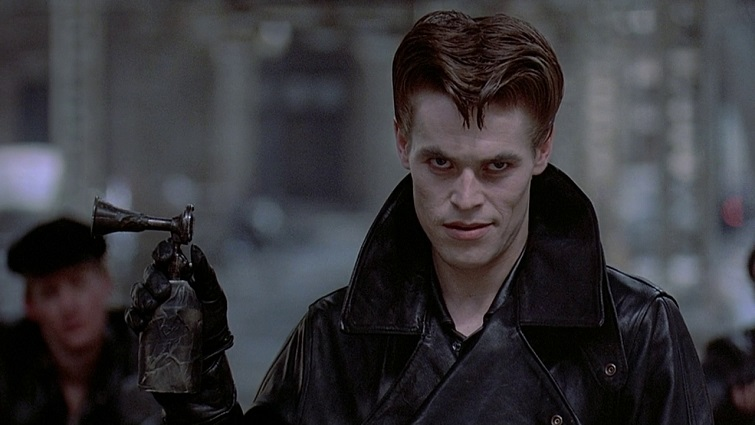
Case in point. The logline for Streets of Fire: man returns from war and assembles a ragtag crew to go to war to recover his girlfriend. Hill favors impromptu groups, often men on missions that were not their choosing, straight-to-the-numbers cinema films that mischievously emerge as cauldrons where personalities and types and teased and tested. He debases his films to elevate them, as anyone who has The Warriors well knows. The protagonists of Streets of Fire are also on a journey. When Tom Cody (Michael Paré) learns that his old flame Ellen Aim (Diane Lane) has been kidnapped by Raven (a deviously outré Willem Dafoe, who looks to be both 15 and 55, which is to say, a youthful imagination that can’t quite project itself into the clothing it wants to wear and a tired old dream clinging to youth), Tom hijacks Ellen’s new boyfriend and manager Billy Fish (Rick Moranis) and conscripts McCoy (Amy Madigan), a delicious amalgam of ‘30s tough-talking dame and Hawksian tough-women types, for the ride. The route they take is thoroughly unsurprising, nor is it intended to be anything else.
What matters, obviously, are the red-hot, hallucinatory compositions of cinematographer Andrew Laszlo and the rhythmic, off-balance editing of Freeman Davies. The ideas are simple and folkloric but vivid, and the texture is that of a film having a dream about itself. The film has an aloof, distant quality, like the characters are icon-types, or as though they’re play-acting their audition for the real deal. In switching and crossbreeding genres, Hill and co-writer Larry Gross conjure what could be called a pop-culture clusterfuck, a stray cat strut through a decade trapped in the memories of a generation before, unable to really to escape a bygone era as the end of history encroaches on them.
That’s not a unique observation of this film. Francis Ford Coppola, whose films did over-indulge their egos and their budgets and did very much play God, nonetheless excreted a truly sublime version of the same constellation of ideas just the year before in 1983’s mournful Rumble Fish. But that doesn’t stop Streets from its own strange alchemy of handed-down and exaggerated sensations. When Dafoe’s Raven walks forward in front of a fiery holocaust, he could be Christine, or The Terminator, a metal terrorist from a past’s imagined future. When he and Tom finally have their showdown, the film tries to achieve resolution via nobler means only to teasingly admit that this sort of justice doesn’t really work in the iron-clad prison of mythic-Hollywood archetypes. When they end up clashing with sledgehammers, by then fully fetishized as post-modern material extensions of a fluid sexuality, the whole world seems to stop for them, as though their mythopoetic masculine mano-a-mano conflict structures an entire world that can’t look away.
At times, one wants for more exploratory verve from Streets of Fire, which frankly remains too slim to fully commit to the bit, or to blow the bit to smithereens. Yet the film’s kineticism and channel-hopping charisma still wins. Frequently, the film indulges in a showy edit, and each feels like a toxic-waste wave we’re meant to ride into the next scene. They seem not only to move the story along or change genre but also to shudder the characters themselves, as though they’re so caught up in the molten energy of their performances that they can’t quite move between the scenes, or to stop to think how thin their characters are.
Streets of Fire feels like a ‘50s youth picture having a dream about itself, but it only clarifies its thematic priorities in the finale. Tom “gets the girl” and, like the cowboy wanderer of yesteryear, he has to leave to pave the way for the more “civilized” Billy he has allowed to exist. The film indulges in the potentially retrogressive metaphor, but then it cuts immediately to its closing music show (oh, by the way, this is a musical) for the deliriously melodramatic “Tonight is What it Means to Be So Young.” This is vintage Jim Steinman, who also wrote the opening number (“Nowhere Fast,” which could also describe the movie), a feverish, over-baked slab of clamped-down, libidinal energy. It’s really this spirit, one in which narrative corridors give way to pure-cinema explosions, that matters to the film. Tom must give way to a more liquid, more surrealistic music video medium, a (comparatively) new kid on the block, an arguably more reckless medium perhaps more receptive to the stray energies of modernity. Paré’s extremely square performance suddenly clarifies as something other than incompetence. He is an interloper on this progression doomed to move on to another story somewhere else, a wave-rider who knows when to get off, a cinematic hero propping up more interesting elements ready to have their time in the limelight. Plus, “Willem Dafoe and Lee Ving play two outcasts from a German Expressionist biker gang” is a sentence I need more of in my life.
Ride the Pink Horse is a film noir about a man who travels to a small desert town at the border of the U.S. and Mexico only to find that he is vastly in over his head. The location is in no way incidental to the film’s vision. What we might call “desert noir” – films like Billy Wilder’s Ace in the Hole (1951) Edgar Ulmer’s Detour (1945), and (admittedly stretching the “noir” claim) John Huston’s The Treasure of the Sierra Madre (1948) – turns away from the noir’s typical haunting ground of the modern city to frame the desert as a limbo for wayward souls. While Old Hollywood Westerns often centered their moral universes around pioneering egos heroically exploring unseen frontiers, bringing light to the proverbial shadows, mid-century film noirs often shadowed the visible with intimations of vaster conspiracies and relations stringing humans along while slowly sucking them dry. To combine the two genres, to infest the Western with the blood of film noir, is to offer a curdled critique of America’s pretensions of access to possibility (monetary or otherwise) stolen from the land. Rather than celebrating divine effusion, these films bear witness to modern America’s demonic extraction, taking an outward violence and turning it back inward onto the soul. They turn the West that was perceived as a hinterland of possibility into a moral quagmire, one in which fantasies of Promethean overcoming within an unfashioned expanse come home to roost.
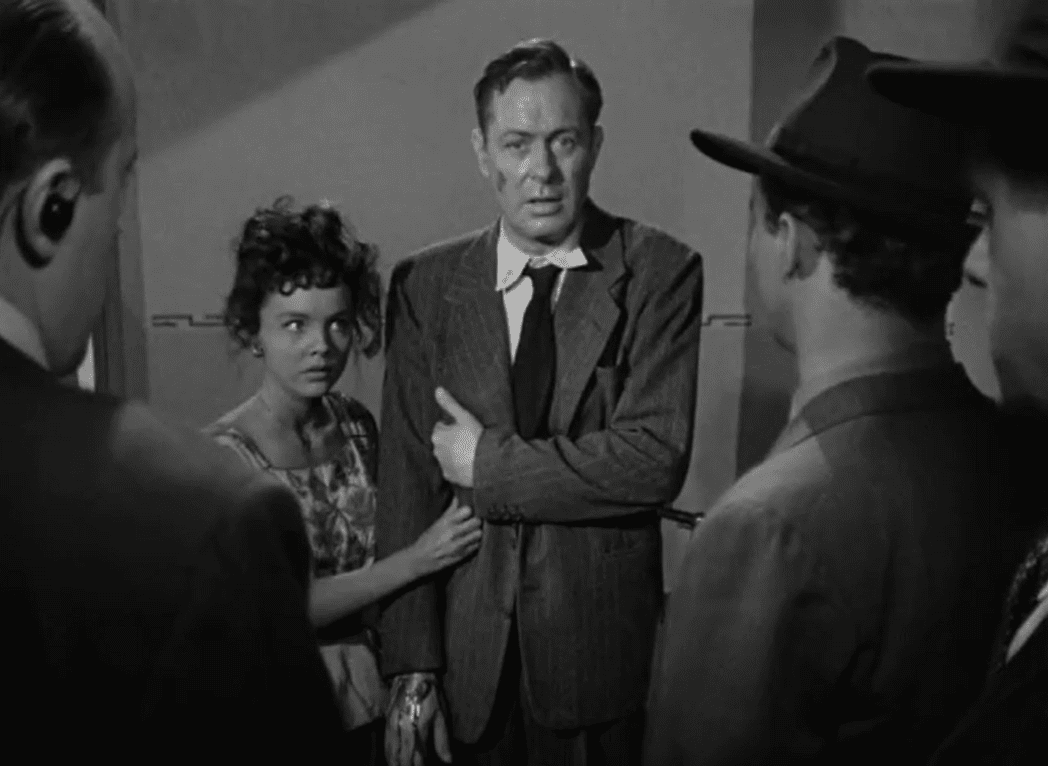
In this spirit, Robert Montgomery’s Ride the Pink Horse (1947) is a film about a man who is aspiring well beyond his means, travelling farther than he really can walk, to acquire something he doesn’t really understand. This was Montgomery’s second noir, a seeming step back from the bravura formal experimentation of his debut, a film shot entirely from the first-perspective of its protagonist that remains a watermark for the idea of the actor turned director. The protagonist of Lady in the Lake was none other than Raymond Chandler’s Philip Marlowe, the curdled noir hero par excellence, a figure evaporated but also oddly elevated and aggrandized by a camera that can’t even see him. The character is voiced by Montgomery himself, and not only are we trapped in his perspective, but he remains the film’s ultimate shadow. With Montgomery behind the director’s chair and the film directed by Marlowe’s own vision, entirely defined by where he looks, the protagonist becomes both a ghostly passenger in a narrative he can’t control and the ultimate director, a never-visible puppeteer behind the camera who can see literally everything we see.
Ride the Pink Horse isn’t as formally audacious, but it may, if anything, be more troubling, challenging, and sophisticated in the way it merges its style and its exploration of mid-century masculinity in the texture of its narrative. Montgomery again plays the protagonist here in addition to directing the film, and there’s a vestigial sense of the former film’s POV in the opaque angles Montgomery shoots himself from. Deemphasizing him in the space, the film draws us in to his limits, to his inability to center or command the frame that is supposed to legitimize his story. This is a thread that culminates in a deliriously thorny and self-debasing conclusion in which the nominal hero is rendered compliant and incapacitated before the villains. In a totally, defiantly egoless move on Montgomery’s part, he is saved at the last minute, through no skill of his own, by a man we aren’t meant to trust who talks and acts like a muppet.
By the of the 1980s, everyone who was anyone on the cult cinema scene would know the name Troma Entertainment, the brainchild of Lloyd Kaufmann, and the name would carry certain assumptions. Mother’s Day, released in 1980 when Troma was just one of (too)many upstart companies looking to get in on the exploitation cinema boon, to test the intersection of cinematic dissent and commercial success, both fulfills and disfigures those expectations. Expecting a broad, try-hard, somewhat over-baked work that announces itself repeatedly as a travesty of serious cinema, director Charles Kaufmann (Lloyd’s brother) and co-writer Warren Leight instead offer a cruel, tetchy, unsettling crypto-slasher that manages to probe quite viciously into various currents of its time-period’s psyche while technically retaining the surface texture of a silly comedy.
Mother’s Day wastes no time confusing us, trading one set of cultural signifiers for another within minutes. It opens on alien scene that eventually clarifies as refuse from an alien past that is still with us: Ernie’s Growth Opportunity, a frisky, cutting parody of a distinctly ‘70s brand of New Age individualism, a pitilessly brutal take-down of the degradation of collective resistance into individualized forms of personal “integration”. “Don’t stop to think what you feel, cause then you won’t know it,” the resident Ernie tells us, before he invites us to perform a mind-meld with each other called a hug.
One of the attendees is Beatrice Pons (billed as Rose Ross), an elderly, deeply enthusiastic woman who offers to drive two deeply twitchy, insinuating hippie types home after their capacity for collective resistance has been wrung out to dry. Kaufmann ratchets up the instability, offering two nerve bundles who seem to tangle the cinema itself. But the real culprits arrive more unceremoniously in Mother’s Day: Ike (credited as Holden McQuire, but actually Frederick Coffin) and Addley (credited as Billy Ray McQuade, but actually Michael McCleery) emerge like wildfire and decapitate one of the hippies and then proceed to abuse and rape the other, all while Pons looks on in amusement and something resembling pride. These two killers are her children, they all love each other, and unlike us suburban or urban types, they are positively dying to kill to show their love for one another. Yes, the name of the game for the evening will be that other ‘70s breed of horror, the flip side of the introduction. Rather than the over-lit atriums and strip malls of suburban America, we get the country-fried cruelty that so famously contoured the decade’s fear of that increasingly marginal space something called “civilization” was supposedly exhausting.
Update: I did not know at the time of posting this review that Roger Corman had passed the day before at the age of 98. Although any review of a positive object is always intended as a tribute to its creators, I hope that this piece provides, in however minuscule and unformed a way, a eulogy for Corman and a celebration of the spirit of wry, unadorned, knowing simplicity and disobedient innovativeness he represented. RIP
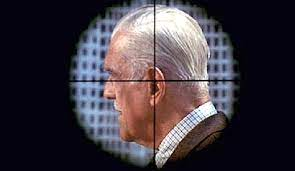
The first time we meet Bobby Thompson (Tim O’Kelly), the protagonist of Peter Bogdanovich’s debut directorial film, it’s from his own line of sight. The film takes his perspective, the camera through his gun-scope, aiming at aged movie actor Byron Orlok (Boris Karloff). The gun store owner selling Thompson the rifle comments on being in the vicinity of the faded star with the enthusiasm of a fan vaguely amused at realizing he actually exists in the same time as a dim memory of yesteryear. Thompson, though, has already clocked him, another old haunt down the scopes of a new generation of (extra)cinematic terror.
There’s no two ways about the cinematic subtext, and no way to miss it. It is thoroughly apparent that Bogdanovich studied Peeping Tom as well as the next guy, and he understood Rear Window in more or less the same way many of the young scholars of his generation did. Like those critics and scholars, Bogdanovich was reborn in the first film school generation, when an increasing fascination among young filmmakers with the history of cinema itself took hold. He also shared with the mid-century French film critics an intrigue about workaday American types and journeyman filmmakers like Anthony Mann and Howard Hawks, figures able to keep their perspectives dimly alive in the belly of the beast. This was the same spirit of personality within machinery, of adapting and allowing oneself to be adapted, which many of the new American directors would fascinatingly and beautifully lose by the end of the 1970s as their films got bigger, bolder, and more unrestrained. Like many of these fellow upstart filmmakers, all trying to figure out how to penetrate the Hollywood studios with their self-reflexive knowledge of film history, Bogdanovich also got his start in cheap, grimy independent pictures, worms feeding on and wriggling new life out of the decaying carcass of Old Hollywood. Targets, which emblematizes this meeting of high and low brow, of conceptual rigidity and corporeal immediacy, is suffused with cinema on many levels, and by the film’s end, cinema will have its way with Targets.
A bewildering comic crystal of a Western that doubles as a narrative void, My Name is Nobody is certainly one of the stranger desert dispatches you’re liable to see. If Sergio Leone’s 1968 Once Upon a Time in the West was a gorgeous bed-time story for the genre, and if the early ‘70s were filled with nightmares, My Name is Nobody is more like wetting the bed. And I’m not only referring to the truly grueling bathroom scene late in the film, an absurdist mockery of a debased high-noon standoff where one character uses a thousand-yard stare to intimidate a person while peeing. Little of this scans as uproarious, but it is certainly bracing. This is a stone-faced, brittle comedy, as cold-blooded and ironic as Mel Brooks’s Blazing Saddles from the same year was wily and hot-tempered. A bit like Robert Altman’s The Long Goodbye from the same year, it’s a playfully curdled travesty of its genre.
It certainly doesn’t take long for My Name is Nobody to announce what it is doing. It opens with an acerbic repetition of the famous waiting game from Once Upon a Time in the West, with Henry Fonda now in the hero position as Jack Beauregard. Yet even in showing all its cards in the first scene, My Name is Nobody still manages a poker face. There’s no way around recognizing this as Leone’s sillier variation on his earlier, more famous film’s sober, somber opening, but what, precisely, the joke is, and even if it really is a joke, remains fuzzy throughout the scene. All the more so when Beauregard immediately stumbles past Nobody (Terence Hill), posing and posturing with silent ruffian sangfroid in a river trying to bludgeon a tiny insect with a big stick, a screwball Teddy Roosevelt and a peculiar mixture of understatement and overkill that arguably summarizes the film as well.
With From Beyond, H.P. Lovecraft firmly joined Edgar Allen Poe in the canon of horror writers whose cosmic meditations on the limits of sight proved finally unadaptable to cinema. Or, at least, not adaptable directly. Quite amazingly, From Beyond is even less connected to its Lovecraftian source material than its immediate cinematic predecessor, 1985’s Re-Animator. With Lovecraft, at least, this is thoroughly unsurprising. The moonless prophet of the incalculable and unseeable would, presumably, struggle to find any light in cinema, one of the more naturally representational of all mediums. How, of course, does one visualize the limits of visualization?
Thankfully, writer-director Stuart Gordon and writer-producer Brian Yuzna seem to have responded by running in the opposite thematic direction. While the narrative content of From Beyond superficially explores the limits of human vision and the consequences of potentially megalomaniacal attempts to overcome those limits – “five senses weren’t enough for him,” one character remarks on the ostensible antagonist– the style of the thing is saturated with cinema’s capacity to visualize. Like many great horror films, From Beyond is essentially about the ability of humans to comprehend the totality of having been forced into a film world, which plays the role of a diviner, creating a catastrophic shadow play that doubles as, and threatens to become, a genuinely dark art. Rather than asking whether cinema can see, as many Lovecraft films would likely be inclined, Gordon’s film asks what cinema shouldn’t see but will anyway, and what the consequences of its vision might be for the souls trapped in it.
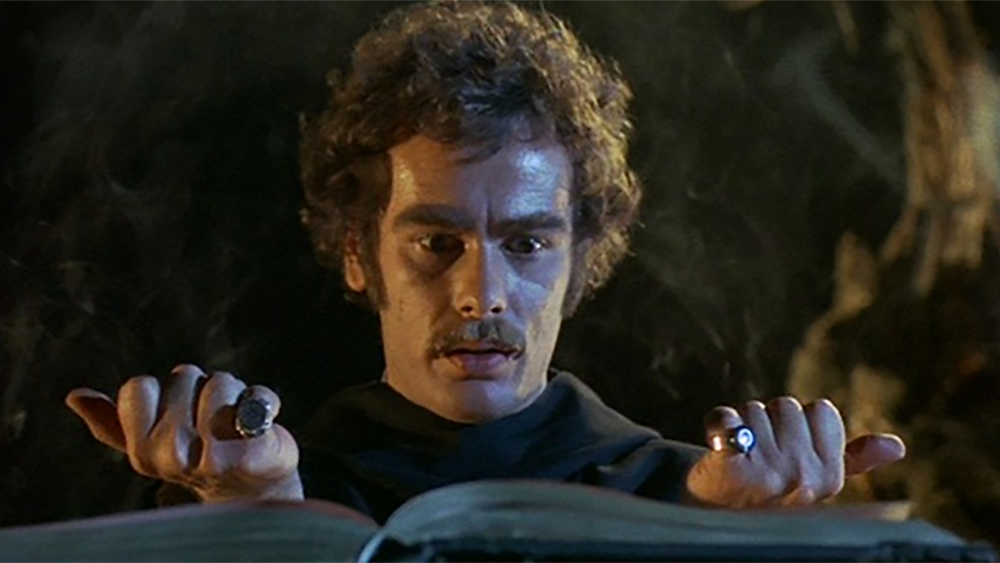
After spending the better part of a decade running riot with the works of Edgar Allen Poe, H.P. Lovecraft’s chthonic short stories seemed like the obvious next step for American International Pictures, another textual canvas to scrawl on and fascinatingly deface. Unsurprisingly for any connoisseur of low-brow, high-aspiration mid-century horror, this is a decidedly untethered adaptation of Lovecraft (which befits AIP’s extremely loose orientation toward Poe as well). Rather than a paean to celebrate or altar to worship, Daniel Haller’s The Dunwich Horror appropriately figures the author as a portal to channel or an opening to explore, a cosmic constellation of images and suggestions to tease out rather than submit to.
Haller’s film opens with a kind of precis for the texture of the whole film: a tableau of static figures locked in time, a fully ordered, barely moving presence, that is nonetheless cut up and disfigured by the editing, never fully clarifying into a clear vision or a pierceable image, something at once obvious and misleading, manifest yet ephemeral. The scene seems to give us everything and nothing: a woman seems about to give birth to a demonic entity, marking this as a Rosemary’s Baby pastiche, but the bit ends before we can fully grasp it. In this tension, The Dunwich Horror disorients itself but also finds a mode of expressing its theme, a battle between order and chaos in which the delineation between the two may not be so easy to divine, and the forces of societal control may not be what they seem.





 The Long Take