
 Actor Robert Mitchum’s bedraggled visage in The Friends of Eddie Coyle lays bare the crippling exhaustion of nearly two decades slugging it out to remain relevant after his early run of alternately lusty and haunted film noirs cast him as the de facto face of wounded mid-century existence. Back in the day, his slightly slurred baritone was the perfect mouthpiece for the archest of masculine men revealing the hesitancies and anxieties behind their robustly manly confrontations. But by 1973, Mitchum was no longer a white-hot emblem of a vision of American questioning itself. Decades of both personal and national tension remade him as the hoarse, dog-tired poster child for an America that was now not only struggling but seemingly disqualified, and The Friends of Eddie Coyle takes full advantage of every crack adorning his face. With an uncertain humor and paranoid visual style, director Peter Yates’ film is a return, and an extension, of that very spirit of wounded noir cinema. Not only a work of darting eyes more than the classical steely glares that punctured many classical film noirs, it is also a return to the forefront for Mitchum that paradoxically revitalizes his screen life by casting him in a faded, funereal gloom that drives him right back into the grave. Eddie Coyle’s skeletal framework, with an emphasis on absence rather than presence, suggests a world of unassimilable people splayed across a suffocatingly finite space, lost in a dulled, silenced universe. Continue reading
Films for Class: The Friends of Eddie Coyle
Leave a reply
 While so many of his kindred company directed films so busy getting high-strung, coked-out, and animated with a life on the edge, reveling in the tension of their own deathless drive teetering on the edge of demise, Hal Ashby’s unhurried The Last Detail may actually be mistaken for druggy, hazed-out ‘70s relaxation. However, peering beyond the tempo of the film, or reading it more accurately, reveals that Ashby’s looseness is less relaxation than resignation. The Last Detail, like many of his films, is a sighing and reflexive awareness of the essential anonymity of energetic wild-man rebellion against a system designed to truck on against you until it flattens you to the pavement of a hopelessly square, domesticated existence. Wounded and shot-through with a brittle awareness of the ephemeral nature of the hippie dream, the film embodies the weary, wounded trajectory of time. It replaces Scorsese’s or Coppola’s nervous alacrity, a fear aimed at a coming insurrection, with a post-destruction elan, a strained sense of giving in to the amiable pleasures of fooling around as the only leftover joy during the decade-long amble that was the American ‘70s.
  Dimensions of Dialogue
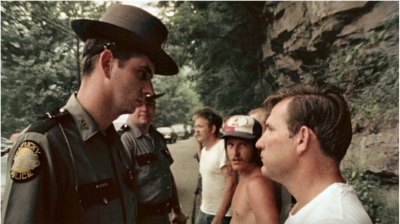 Humanistic agitprop at its finest, Barbara Kopple’s documentary is the rare cinematic work that is both a ferocious vanguard for humanity and a glimpse into the heart of a depleted American identity. Adopting the verite mantra as a way of life and exploring the months-long United Mine Workers strike in Harlan County Kentucky, Kopple’s film rings out with both the dust-caked haziness of human exhaustion and the fevered perception of dissent against all odds. One can feel how the miners had spent months incubating in harsh conditions without losing sight of the hard sear they bring to strife and soldiering on. Kopple’s film, although entirely humble, takes them out of the crawlspace of American memory and uses the currency of the camera to explore the potholes of American existence with venom and frailty in equal measure. The experience of the strike was no doubt fatiguing, and Harlan County, USA is a dispiriting film that nonetheless energizes itself with cinematic gusto in a bold attempt to fight against the dying of the light, mimicking the miners who no doubt had to invent an excuse for continued passion at any cost.
  Quixotic and paranoid in equal measure, Grey Gardens’ protagonists Big and Little Edie Bouvier outstrip a legion of Rocky Horror vamps for moxie and general disarray. They live in a perpetual fugue state that also doubles as filmmaker Albert and David Maysles’ vision of the American Mishap. If the 1970s carried a stench of permeating, askew discombobulation for the American public, Big and Little Edie serve as reflections that perverse economic conditions don’t always heed seemingly iron-clad class boundaries and notions of cultural capital. Beyond that, their connection to the Kennedy family not only enhances the admittedly trashy, voyeuristic pleasure of the film. It also transforms the film into an off-kilter work of near-speculative fiction, like some demented teenagers’ cultural pile-up of inverted Americana iconography and nastied-up sitcom routines. The infested, post-hurricane manse at the center of Grey Gardens is like some parallel universe missing link between Munsters’-level suburban middle-class cultural airs and Addams Family-caliber aristocratic eccentricity. How fitting is it that the film’s central gruesome twosome boasts both the populist twinge of desire to belong and the need to assert difference from the rapidly homogenizing American public, a central dialectic of American culture’s existence post-WWII. These two blue-bloods act like reptiles and yet, in their own way, they reflect an equally mordant and morose breakfast nook of the wayward American dream.
 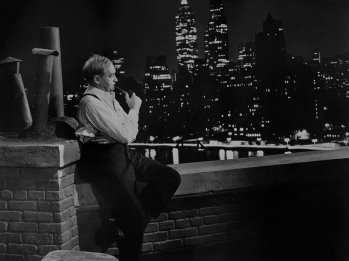 Excuse anyone expecting a grizzled true crime story from this early work from Jules Dassin, arguably the missing link between American noir and those malarial European art-house crime pictures of the ’50s and ’60s, films that in their own way paved early ground for the spatially-focused art-cinema likes of Antonioni. For those filmmakers, narratives were but loose constellations of events to hang questions of human modernity and architectural geometry on. And while those filmmakers would truly reorient cinema, Dassin’s films peek open the door that someone like Jean-Pierre Melville (not to mention the French New Wave) would eventually dynamite, laying brick work for a cabal of hungry young American film school students with a voracious appetite for anything radical and foreign. So the name Jules Dassin is, if nothing else, a name you, the consummate cinephile and obscure film blog reader, ought to know.
 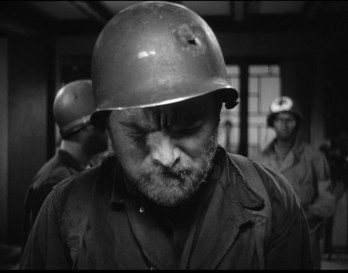 The first Korean War film, Steel Helmet was released mere months after the war formally began, and it benefits from the kind of irrevocable, in-the-moment anxiety that all of director Sam Fuller’s films do. Frankly, the master narrative about the war was still a bundle of unconnected nerves with no central focus yet, so Fuller did what a good Fuller was accustomed to doing: he grabbed the nerves by the claw and jostled them even further. Steel Helmet is infused with a ramshackle vitality and a sense of vicious, viscous dirt seeping into every crack that Fuller so astoundingly tightens up with garrote wire. This is catgut filmmaking, muscular and taciturn and brutish in the manner of a war of attrition mixed with a combustible blitzkrieg, and more importantly, its expediency ensures that the film cannot bother with the tangled geopolitical board-room ideologies of war in a broad sense. Because the war had no overarching narrative (yet), the film only had one choice, the Fuller special: to leave the board rooms behind and make things deeply, uncomfortably intimate, as in camera-too-close-to-the-character-sweat intimate.
 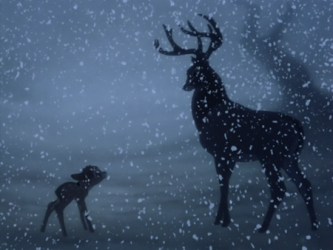 This review published, belatedly, in memoriam of the death of animator Tyrus Wong at the ripe old age of 106.
 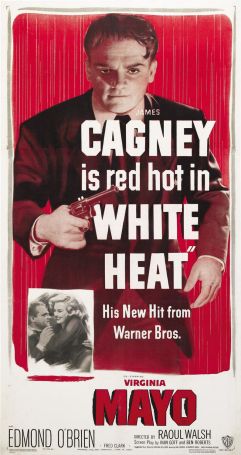 Raoul Walsh’s cold-blooded reptile of a late-period gangster picture finally stills itself only when the genre reaches its apocalyptic acme in the death-scented denouement, the fumes permeating outward off the screen. Even when the credits crawl, the film refuses to be dismissed. The title doesn’t lie – shards and splinters of visual and sonic phosphorous sparkle right into your eyes with infectious charisma – but the punch and gusto are also counterpointed by chills of loneliness and murmurs of exhaustion. Released in 1949, White Heat evokes a genre’s last gasp, a style ready for a nervous breakdown, bracketing staccato bursts of violence to harried melancholia to disheveled, droll comedy. Gone is the wiry little slugger of star James Cagney’s youth found in the likes of The Public Enemy, replaced instead with a self-worrying work that examines its own rat-in-a-cage tempestuousness and ultimately embodies a missing link between Hawks’ Scarface and the downright pernicious onslaught to come in Bonnie and Clyde.
 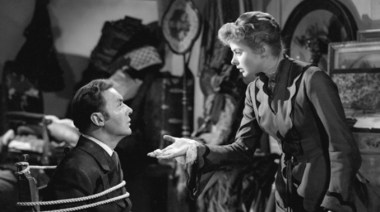 George Cukor’s slightly creaky but undeniably spirited psychological thriller is quite a bit more “potboiler” than it is willing to admit until the Guignol denouement where the old fuss-and-stuff middle-of-the-road “please Knight me now” respectability of the diction and mise-en-scene pounces right into the ditch where it belongs. A B-picture in A-picture threads, it’s only when it unstitches its chest-caving corset that Gaslight finally has room to breathe. Which is to say: Gaslight is a little over-determined and too dignified in its prestige-pic wax to embrace the deliriously illicit trashiness at its core. (De Palma has essentially remade the film three dozen times, and while that statement may be hyperbole, how does one tackle De Palma without exaggeration?). Old Hollywood smut can be oh-so-gallant in its strewn-from-the-gutter and out-on-the-edge charisma when it just smacks some of that musty old regal upbringing right out of its properly-dictioned self. Yet Gaslight, while often killer, spent a little too much time in finishing school, dotting its I’s and crossing its T’s, and not enough time out on the streets learning how to play in the dirt where its heart truly lies.
  The Long Take