
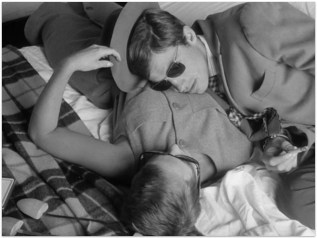
 Reviewing Goodbye to Language made me realize how criminal it was that I had never, in almost two years of blogging, reviewed a film from perhaps the most important director of the past sixty years. What was I doing with my life?
“If cinema if truth at 24 frames a second”, as Jean-Luc Godard famously said, then Breathless, the director’s estimable debut feature film and the breaking of the dawn for the French New Wave, absconds with that truth via Godard’s forgotten, demonic second-half riposte to the phrase: “and every cut is a lie”. With Breathless, Godard brought new meaning to the word “cut”, injecting his film with risky, tempestuous crackles, excising material, jumping between otherwise nominally cohesive sequences with jump cuts that turn the cinema into a seizure-filled parade of jumbled motion. Godard transformed the cinema by denouncing the claim that it was meaningfully realist altogether, implicitly connecting the dots between the cinematic hucksters of the world from Bunuel to Welles to even William Castle. In doing so, he skyrocketed the art-form to a higher plane of truth hop-scotching around its own limits by reveling in its own artifice. Continue reading
 Billy Wilder was on the hottest streak of his career in 1961, bucking the end of the studio era with two masterpieces of vigorous, and vigorously perfect, cinematic scab-scratching, 1959’s Some Like it Hot and 1960’s The Apartment. Both were films rooted in the classical Hollywood traditions of vertiginous pithy screwball comedy and intricately calibrated deep-focus drama, and yet both sneaked in their own silently naughty slices of screw-the-censors panther-wit, be it the deliciously filthy physical gestures lying dormant in Some Like it Hot or the venomous wordplay of The Apartment, a film that also managed to smuggle a visual ejaculation reference past the censors in 1960 (as diabolical in its own way as what master of the macabre Hitch managed to do with Psycho the same year).
  7 Women
 Billy Wilder was the Hollywood cynic. We all know this. It wasn’t necessarily always the case (Some Like it Hot is one of the most delightfully buoyant screen comedies ever made, despite a dark edge). But he had it in him from the very beginning, and he kept it in him until the very end. If you want scabs though, and I mean pus-filled, oozing, inventing-colors-so-they-don’t-have-to-be-just-black-and-blue scabs, you have to stick with mid-period Wilder, who, with Sunset Boulevard, turned Hollywood against itself like a rabid dog unsure of its target and found that even this wasn’t enough. One year later, unfulfilled and still in need of making the nastiest Hollywood film yet made, he unleashed Ace in the Hole upon the world, and his vengeful edge, his sickly grotesque demeanor and love of exposing the least well-lit regions of human activity, absconded down the churlish rabbit hole.
  Edited
 Another little temporary series here. Nothing too fancy – mostly an excuse for me to catch up on some films I haven’t seen or haven’t seen in a while. We’ll be looking at three classical Hollywood filmmakers over time: Howard Hawks, John Ford, and Billy Wilder, visiting each once in the annus mirabilis of classical cinema, 1939, when they were all still (relatively) young, again in the late ’40s and early ’50s at the middle of their careers (and the middle of classical Hollywood’s career), and finally when things were waning for each director and for classical Hollywood in general in the early ’60s, before the new school American New Wave would wreck up the joint.
  Another little temporary series here. Nothing too fancy – mostly an excuse for me to catch up on some films I haven’t seen or haven’t seen in a while. We’ll be looking at three classical Hollywood filmmakers over time: Howard Hawks, John Ford, and Billy Wilder, visiting each once in the annus mirabilis of classical cinema, 1939, when they were all still (relatively) young, again in the late ’40s and early ’50s at the middle of their careers (and the middle of classical Hollywood’s career), and finally when things were waning for each director and for classical Hollywood in general in the early ’60s, before the new school American New Wave would wreck up the joint.
  It isn’t difficult to find issue with Beyond Thunderdome, nor is it difficult to pinpoint the root cause of the problems: Hollywood money, and the desire to go big or go home. Both things that Miller used like a sledgehammer in Fury Road 30 years later to wonderful effectiveness, but which here see him step up and trip over the need to focus on a plot that doesn’t much go anywhere. The pure cinema appeal of the series is certainly lost (with Fury Road, Miller managed to go big without inducing a case of the talkies), but it doesn’t do well to overly criticize something for simply having a more elaborate story. Still, admittedly, the focus on “plot” for Beyond Thunderdome sacrifices the queasy, nihilistic immediacy of the original Max and the off-kilter humor and the implacable malaise hanging over The Road Warrior, a malaise brought on precisely by the fact that the film never much “went” anywhere plot wise and established, instead, a feeling of stagnancy.
 When we last left him, former police office Max Rockatansky (Mel Gibson) lost his family and his best friend, and had fulfilled a most unfulfilling form of revenge on the now lawless highways of the Australian outback. He had lost and repaid the loss only to realize that there was nothing to be won back. When we last left him, there was nothing left for him but the empty road.
 Thirty six years later, with the release of the grandly, boisterously cinematic carnival opera of Mad Max: Fury Road, it is difficult to peer back through the looking glass and glimpse the humble origins of the Mad Max fiction. It is difficult to remember that, for all its commercial and critical success, the 1979 release of Mad Max was nothing more than a budget of 400,000 dollars (a paltry sum then and now) and one of the great modern cinematic visualists doing everything they could together to disturb, provoke, and ultimately, to entertain and thrill. It is difficult to remember how intimately inhuman the original Mad Max is, how nonchalantly brutal and matter-of-factly nihilistic it is in its almost impressionist depiction of apocalypse and social malaise propped up by stunning, startling car chases of unquenchable viciousness. It is also difficult, in lieu of the great majesty of the second film in the series, Mad Max 2:the Road Warrior, to remember how effective the original grinding house classic of action entertainment is to this day.
  The Long Take