Author Archives: jakewalters98

Fragile Frontiers: The Life and Times of Judge Roy Bean

A camera saunters into a lonely bar on the edge, and in the middle, of nowhere. It confronts its own face on a wanted poster, and then it rips the poster off the wall before solidifying as a shadow before it steps inside. This is a man, presumably, defacing his codified image, asserting himself as the real deal above and beyond the law’s version of him. But it also could be the wanted image – the weird, antagonistic mixture of legislated object and mythic subject, contained image and resistant force – enfleshing itself, giving itself the body of a human, enacting itself as a becoming. Here is a figure who knows he is a wanted thing and wants to both defile and endorse that wanted-ness in his act of defilement. The shadow seems to corporealize out of a mixture of nothing and everything, to make itself in the act of disregarding the law and embodying the law. The shadow becomes Judge Roy Bean by recognizing that its resistance to the law, in a nation that worships dissidence and rebellion if framed in terms that can be enfolded into the national narrative, is its way of becoming the law.  

How could this film’s titular character sustain such a contradiction? We might instead ask: how has America? How have Americans lived within this contradiction for nearly a quarter millennium? The film’s opening is a vision of America’s founding writ large: a nation that wants to act as though it has always been there, always enshrined within some kind of law, and yet always incipient, always making itself new, always entangled in the act of defiling itself and critiquing itself. In disregarding the law, in ravaging it, America becomes the law. It founds itself on an act of anti-foundational behavior. It consecrates itself through a profaning gesture. It aggrandizes itself in the act of defiling itself. In escaping itself, in dismissing the rules by which it is supposed to live, it embodies its truest essence, returning to the primordial act of poetic imagination that has inspired and tortured, enrobed and denied, so many American writers and thinkers.

In this film, the figure is named, or rather names itself, Judge Roy Bean (enfleshed as Paul Newman), a man who becomes an allegory of American self-contradiction. Distilling a nation’s ability to overwrite its internal chaos with celebratory myths of inaugural innocence, he has no problem bequeathing himself with vagabond legitimacy wherein his sheer act of will becomes divine justification for violence. “I never killed a man before,” “I shot at some” but “I never hit anyone,” he remarks after a particularly unlikely showdown in which he vanquishes everyone. God himself must have left him off the hook before this – must have kept him pure – only to bestow him now with the gift of sacrosanct justice. He also, he claims, understands the law “since I live in flagrant disregard for it.” This is the ruffian as a dynasty, a vision of outsider frontiersmanship as Manifest Destiny. He is, in other words, an out-law, a man who will turn his perpetual errantry into a vision of redemptive self-authoring, who by being outside the law can be the law. Judge Roy Bean is like America, a self-legitimizing and finally self-insulating force that arrogates for itself the right to arbitrate justice, to lay down the rule of law, while also implying that it is simply enacting a higher one through its refusal of any other earthly tribunal. The Life and Times is nothing less than a travesty of America’s creation myth, a fire-and-brimstone desecration of the abiding faith that whatever the nation means can be traced back through to an initial act of originality.

Continue reading
Fragile Frontiers: Buffalo Bill and the Indians, or Sitting Bull’s History Lesson

Directors today almost entirely mobilize the wide-screen canvas to insist on the weight, purpose, and “big-ness” of their films (c.f. Christopher Nolan) or because it connotes cinematic acumen and anoints them as a filmmaker of legitimacy (c.f., most recently, Ryan Coogler). Rare is the Hollywood film that mobilizes wide-screen to articulate just how little it knows, and just how entangled its own relationship with American “big-ness” is. Robert Altman – maybe only Robert Altman  – treats the elephantine canvas as a termite colony and a void, a busy, buzzing confusion of event and a supreme nothingness. His widest canvases are sloppy and wayward, fashioning confused, quasi-structureless saunters through the limits of American mythology, sideways ambles through America’s pretensions about itself. He fashions a frame that is both a critique of American egotism and a mode of diffusing it.

At the beginning of Buffalo Bill and the Indians, or Sitting Bull’s History Lesson, a narrator informs us that the Wild West was a celebration of  “the anonymous,” promising a democratic affair of “these brave souls” and their unclaimed, but undaunted, effort to survive a harsh wasteland.  As the frame lights up to view the outskirts of wild-man performer Buffalo Bill Cody’s traveling circus show,  the narrator promises that Altman’s open canvas would be a democratic frame: one that incorporates the many, the liminal, the rogues, the outsiders, and allows them a moment to be counted, to be claimed in an image that doesn’t treat any of them as any more worthwhile than anyone else. This is America’s promise, and Altman’s most generous films ask what it would look like to fulfill that aspiration. Like an old-school Hollywood epic, Altman luxuriates in performative showmanship and grandiosity, yet he also smuggles in a neo-realist sense of multiplicity and ambivalence. His camera seems as though it could go anywhere, discover something new, as though it hasn’t figured itself out yet. His frame itself is a metaphor for America’s Phoenix-like belief in self-revising openness, in the capacity to find, in the margins of the frame, an undiscovered potential just begging to be catalyzed into kinesis.

Altman’s frame is also an expression of the nation’s delusory subscription to ideas about itself that doom that promise from the start, that mutate even openness and freedom into most pernicious modes of control. Yes, Altman’s camera looks and searches. It also seems like it might topple over at a moment’s notice, exploring the inner workings of a Wild West performance show that it neither understands nor celebrates. Paul Lohmann’s cinematography is sickly, jaundiced, and uncertain. The narration is spoken by a man who sounds like he’s about to drop dead. This is not an authentic America, but an incestuous tangle of ideas and iconographies, history and mythology, gazed at in a film that exposes inauthenticity as America’s core potential, and its final failing. In a nation where everyone is a momentary performer of the possible, where “the legend” is more important than the “fact,” as a famous man who made famous Westerns once famously said, Buffalo Bill (Paul Newman) is as American as apple pie with razor blades in it. He is like Andy Warhol, another American prophet of secular mysticism, who hides within the gap between freedom and oppression and exposes play itself as a particularly brutal mode of control.

Continue reading

Film Favorites: The Taking of Pelham 123

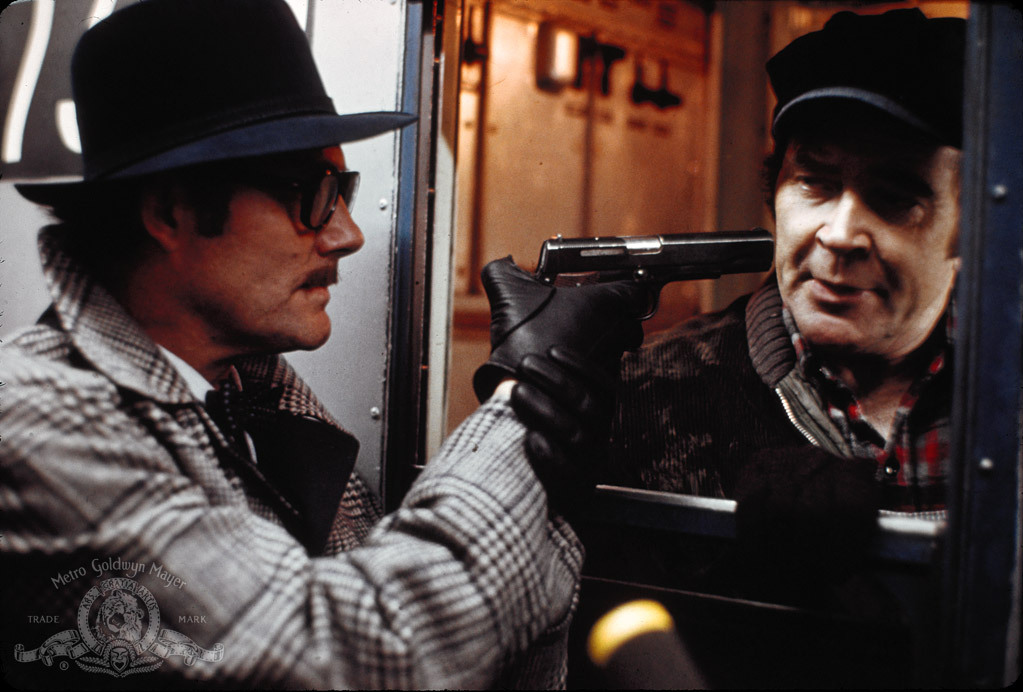
We begin in motion, a man in a self-consciously unconscious suit running into a subway station, as though late for work. He is late for work. He’s about to hold a subway car hostage, but he walks like a recently divorced dentist. He seems less like a man worried he will get caught for robbing several million than a guy concerned about whether his coworker will waste fifteen minutes of his time at the watercooler.  The Taking of Pelham 123 is a remarkably workaday vision of New York City, a schlub’s paradise. It feels trapped in a post-‘60s hangover, but what it sees isn’t a nihilistic failure but a run-of-the-mill existence. New York City, here, is a machine that hasn’t defaulted on a foregone promise but that was too busy to even recognize it when it was there. When the conductor first recognizes that his train is being stolen, he can only respond “you’re taking my train?,” and it’s more like he’s confused why anyone would want to bother with such a thing, or how it could be an interesting plot for a movie. When the police get involved, you half expect the hostage takers to respond “hey, I’m stealing here!”

Yet this is a hell of a movie, mostly because it doesn’t really treat any of this as a hell of thing. Nothing in Taking of Pelham 123 insists on its self-importance. It treats commandeering a subway train as another feature of the day, an incident roughly as interesting or as improbable as the nonchalant tour that Walter Mattheau’s Lt. Zachary Garber gives for Japanese businessmen at the beginning of the film. Everyone is a worker, and the film poeticizes what it means to be workmanlike. Director Joseph Sargent was avowedly not a great director, but his journeyman sensibility is amazingly appropriate in this context, a banal, quotidian vision for a monotonous world.

Sargent’s somewhat flat style thoroughly, elegantly deflates the entire film. He brings the kind of vulgar poetry that Don Siegel or Robert Aldrich would have brought to the proceedings, etching a semi-naturalist vision of crude, ragged world but distinctly not an expressionistic one. This is the city not as a crestfallen hellscape or a byzantine labyrinth of bureaucratic overreach or a carnivalesque playhouse but a simple fact, one that keeps you moving through it so expediently that you don’t bother to notice how it is limiting your consciousness. This is not a camera that accesses an inner life beneath the surface but one that observes how depleted inner life has become. When the pivotal moment comes and the strains of the story come together, Sargent frames the crisis not as an interruption but a continuum. In an exquisite panorama of a weathered transit station, Mattheau is giving his tour, mockingly bullshitting his temporary hostage audience, before he learns about the other, more severe hostage crisis perpetrated by the other, equally disgruntled, disaffected men. What, the film quietly posits, does it mean that these two things are less different than we want them to be, or that we no longer want them to be that different in the first place?

Continue reading

Film Favorites: Night Moves

Arthur Penn’s name doesn’t linger in the cinematic imaginary like many of his New Hollywood co-conspirators. Like Robert Altman, he was an older man when the movement kicked into high-gear, which meant that he was not a product of the film school generation. Unlike Altman, however, he did have a background in commercial cinema and television. In other words, he didn’t cut his analytic teeth examining every nook and cranny of the ‘60s European interpretations of the American cinematic mavericks of the ‘40s and ‘50s. He developed his eye and hand by making those sturdy, silently subversive, culturally neurotic mid-century American films in the first place, which places him on a continuum with, say, Anthony Mann, Don Siegel, and Robert Aldrich rather than Martin Scorsese and Francis Ford Coppola. He was less a student of the cinema of American waywardness than a traveler of American waywardness himself.

Befitting his journeyman sensibility, Penn’s films offered a more subliminal, less self-consciously auteurist perspective of what directing might mean. His sensibility was rooted in looking at reality through an odd angle in a mirror rather than, as his younger New Hollywood contemporaries would, shattering the mirror and holding up a serrated shard to reality’s throat. This scrappy, less avowedly personal stamp wasn’t necessarily a moral vision per-se, but the quiet compassion with which Penn contoured the emotional universes of his down-on-their-luck renegades reflected a serious empathy with the mundane nonetheless. One can think of him more as an extractor perceiving momentary realities than an artificer wholesale reconstructing that reality and conjuring meaning out of cinema’s defamiliarizing smoke and mirror show. His was a cinema of the silent tremor, not the sudden eruption.

Continue reading

Film Favorites: Winter Light

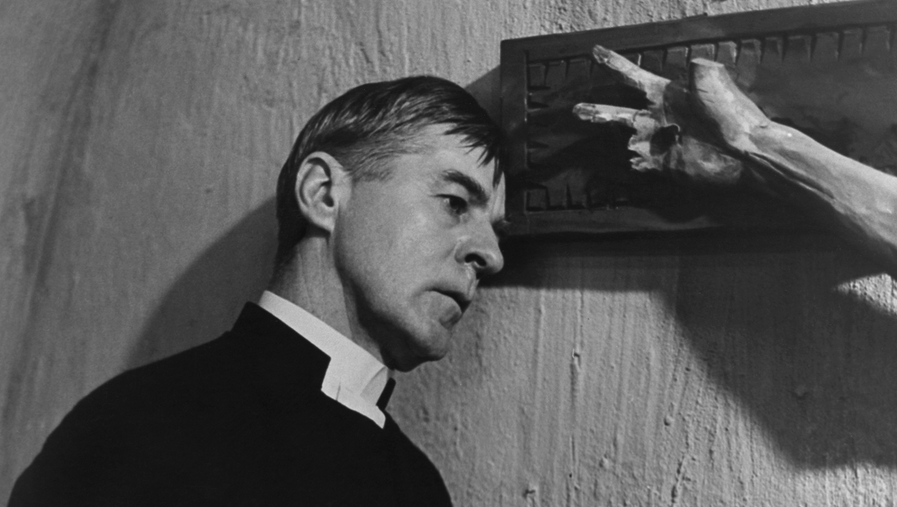
Early in Winter Light, Max von Sydow’s Jonas Persoon gives voices to one of the major throughlines of director Ingmar Bergman’s career, a subcutaneous current that unites many otherwise ostensibly disparate films. When Jonas’s wife Karin (Gunnel Lindblom)asks to meet with pastor Tomas Ericsson (Gunnar Bjornstrand) to discuss her husband’s crippling depression, a neurotic aftershock of the nuclear armaments he is obsessed with, the couple – her ability to voice to terror and his ability to bespeak it through his reticence to speak  –  bring to life many of the abiding conundrums of Bergman’s cinema. What does it mean to speak for another person, and how are our capacities to find life emboldened and sabotaged by our entanglement with others and with the world? And what does this mean when we as a species have decided that the capacity to wipe ourselves out with nuclear weapons is the only way to pacify our existential uncertainty at having created them? How can we, knowing this, go on speaking in the first place?

The Persoons are only the most manifest evocation of Winter Light’s vision of the mid-century as an ambivalent netherworld salvaged from its slow, inexorable decline into the abyss only by those moments of human connection that ultimately come back to mock the idea that we believed they could save us. The largely disinterested way Tomas moves through his daily rituals suggests a weary soul who has become a wayward traveler of life. Real fatigue seeps through every inch of Bergman’s frame, and in his unshakable dread, Persoon only makes Bergman’s lingering spiritual disquiet manifest. His was a trepidatious cinema, one that, as Susan Sontag famously claimed, may be genuinely uninterpretable. That’s perhaps more poetic than, well, interpretive, but the man definitely made movies that beg the question of whether interpretation can do anything in the modern world, and why it would be worthwhile to even bother interpreting in the first place. Bergman’s anxiety about the certainty of meaning in a world where mutually assured destruction dwarfs any other kind of certainty suggests that terror has become its own sublime, seemingly worshipful God (as scholars of nuclear destruction have long argued), something that frightens and disturbs the search for truth, that induces an apprehension beyond the capacity to intellectualize. The austere severity of Bergman’s film seems to state its case so bluntly only because it is trembling with disquiet, with an unease that shudders so much, at such a low frequency, that it actually stills the film, and grants it a capacity to rend the soul.

Continue reading

Film Favorites: La Strada

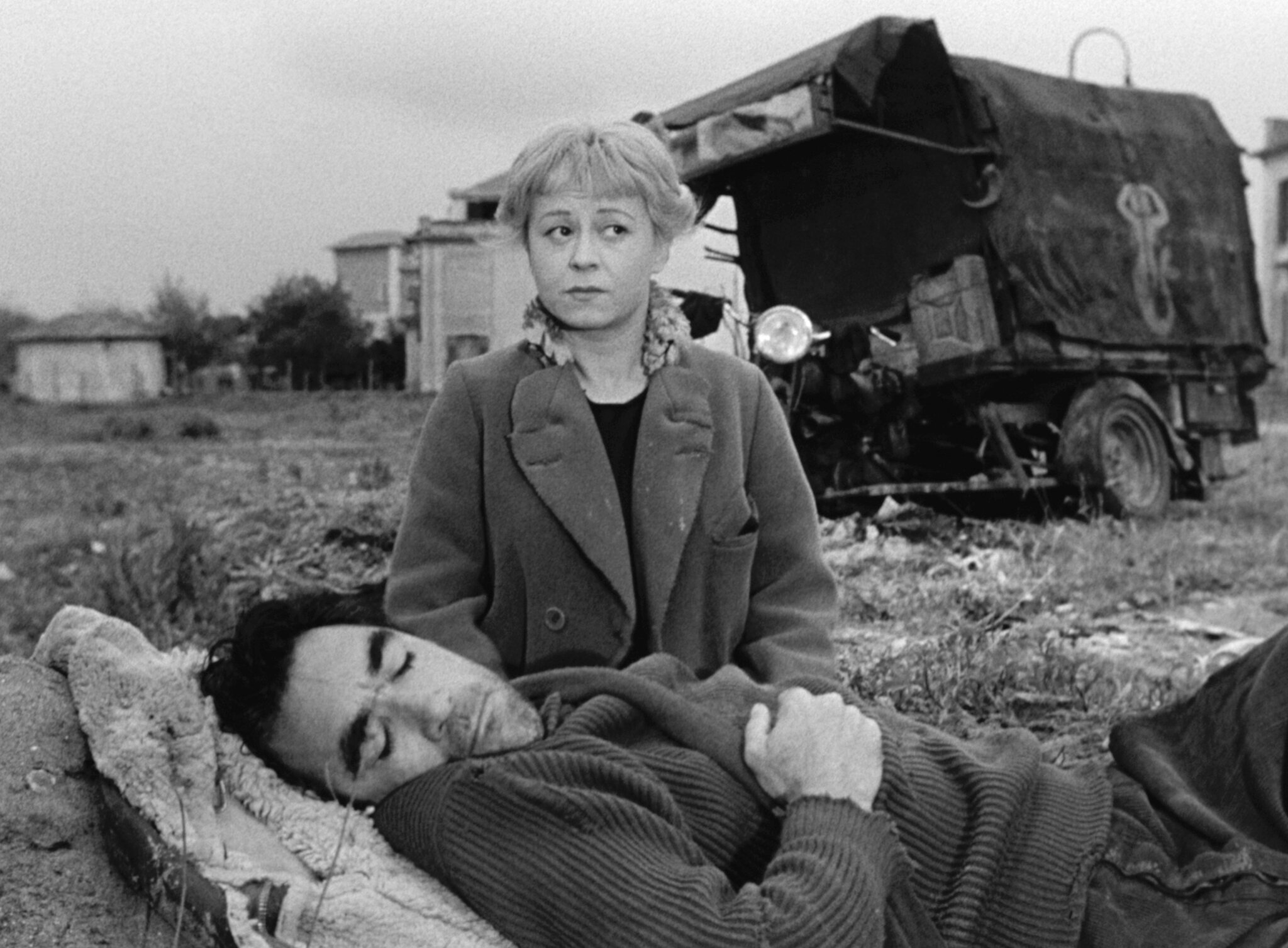
Few faces linger in cinema history like Giulietta Masina’s. As Gelsomina, a woman sold to brutal, confused strongman Zampanò (Anthony Quinn) to serve more as his assistant than his companion, Masina is an open void, a vision of sheer openness to the cosmos as vibrant, animated, complicated, and embattled as Renée Falconetti’s in The Passion of Joan of Arc. Gelsomina is unimaginably receptive to the world. She achieves a kind of pre-cognitive grace, the self as a pure canvas on which the world is written, and which, in her planetary vibrancy, rewrites the world. While she echoes Charlie Chaplin’s worldly attentiveness to flux, his need to follow the often confusing motions of an ungovernable world, as many have pointed out, her carnivalesque sensitivity to the mutable rhythms of the earth, the sheer multiplicity of life, is uniquely  guileless. Chaplin seems to wrestle with the world. Gelsomina becomes it, existing as a microcosm of its flows. She has no ulterior motive, not even a need to survive. She simply experiences. While she never quite finds a home in the world, it is only because she seems singularly able to find momentary homes in passing notes, in itinerant images, in local joys, and in temporary sadnesses. She is a performer of everyday life, capable of potentializing any moment, a completely versional person who becomes whatever she needs to be. Each moment she encounters is entirely itself, a murmur of radical otherness she finds, and accepts as part of her, as she vibrates to the lyrical indeterminacy of the world itself.

It is simply unimaginable how much trust Giuliata  and her husband, director Federico Fellini, must have put in one another to approach this character, to conjure a being who  exists in such a primordially open, childlike state. For him to invest so much, or to allow her to return so much to him, both resonates with and embodies the film’s sense of celestial synchrony, its appreciation of a world where the wondrous and the awful are warp and weave of one another. Within the contours of this film, this also marks Gelsomina as irremediably ajar, prey to a world which she has no faculties to respond to, which she does not erect psychological boundaries to avoid. Compared to nearly every other film protagonist, she reads as inextricably passive and essentially pre-liberal in her identity, not a self-contained and self-authorizing individual but an animate point in the world, a ward of the universe.

La Strada asks us to appreciate this openness with an attitude of diffuse directionlessness and supersensory epicureanism. The world is brutal and unforgiving, it says, and any honest reckoning with it requires a sense of beauty that is contingent and localized, that finds joy in the everyday, not in a final eternity or an ultimate meaning. While Gelsomina echoes Falconetti’s Joan in a shared attempt to breach the limits of our everyday modes of viewing and perceiving, her version of transcendence does not look beyond the world into a transcendental ether called God, as Falconetti did. Gelsomina discovers grace in the world, marking her as a pure immanence that is spiritually inflected and yet entirely un-transcendent. She seems essentially untouched by the accumulated cultural signifiers on the world around other, but she also does not turn the world into a mere surface hiding a deeper, truer, essential divinity. Rather, she accepts the world’s all-ness in its manifold multiplicity and ravenous uncertainty.

Continue reading

Midnight Screenings: Reign of Terror

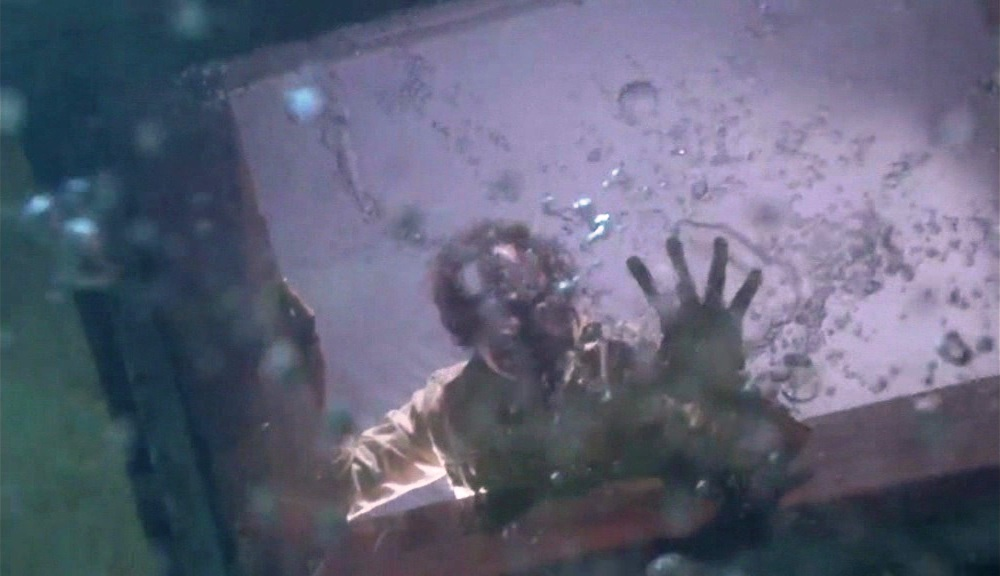
Early in Anthony Mann’s seriously neurotic and starkly severe Reign of Terror, a sinister hand excretes from the border of the frame and reaches up to choke the man we have thus far assumed to be our protagonist. The camera suggestively observes who we take to be our hero in a mirror’s gaze while an unknown assailant stabs the man in the back. Within a minute, this film not only reintroduces the man wielding this phantasmic appendage as our real hero but shatters the accepted vision of historical cinema that would believe in clear gazes and untroubled viewpoints to begin with. Both Orwellian and Wellesian, this is a historical anti-epic that entirely disfigures historical cinema’s own panoptic “epic-ness.”  It erects an edifice of cramped people who can barely see where they’re going down the cloistered, blinkered hallway of history. If cinema often promise to reflect the past to us, Reign of Terror offers an ever-cracking mirror.

Poetically, this marks Reign of Terror as a hell of a text, not a milquetoast, straight-laced historical suit-and-tie but a full-on expressionist straight-jacket.  Politically, it means that the film has little use for historical grandstanding, and that its politics can verge on drowning revolutionary potential – the hope of a genuinely better world – in a swamp of what passes for “complexity” but may simply be confusion. Released in 1949, Reign of Terror is a transparently fearful text. It is a Cold War casualty fully in line with the politics of the time. Its opinion is that revolution is often more foolhardy than not. It resonates with what Lionel Trilling would call the liberal imagination’s fear of dogma and its metaphysics of calibrated uncertainty, Isaiah Berlin’s appreciation of “negative liberty” as a bulwark against what he perceived to be the excesses of totalitarian solidity, and Hannah Arendt’s belief that the Soviet revolution was merely an extension of the French Revolution’s inevitable slide into dictatorial control. The film’s portrait of Maximilien Robespierre is as a self-important monomaniac exercising autocratic dominion, a God-like puppet-mater who calmly intones things like “I made the mob. They are my children, they won’t kill their own father.”

Yet Reign of Terror evidences a deliriously morbid, at-times nearly erotic fascination with death regardless. It is conservative, in the small-c sense, but Reign of Terror is also troubled and tormented in a way that is never less than fully fascinating. While the “history film,” in 1949 as it does now, promises an unceasing access, a panoptic gaze, Reign of Terror turns the limits of its micro-budget production into a boon to its imagination, warping conspiratorial gloom into noirish modernism. This is a history with precious little stable ground, and whatever it lacks in moral clarity, it recovers in aestheticizing the experience of having your sense of historical meaning – of history as a divine arc – swept out from under you. Heroes who seem like dark angels partitioning the frame later feel like shadowy wraiths ready to do away with us.

Continue reading

Fragile Frontiers: The Naked Spur

Anthony Mann was one of the great chroniclers of American violence. His classic Winchester ’73 expresses that violence in an unholy object: a doomed gun that sidewinds through the hands of weary travelers of American life as it indexes a brutal cycle none of the men trapped in it could break from. Three years later, in The Naked Spur, he shifts from an object to a place, a cragged expanse that is a space of ostensible but illusory freedom that becomes an unexpected forum for the affectations of rugged masculine types and the afflictions of American society. The very raggedness that made the frontier a living thing was also a product of genocide and mass death and often spelled existential demise. The West in The Naked Spur is a fully three-dimensional hellscape, a place whose forbiddingly omnipresent physical nooks and crannies mirror the impossible ethical convolutions characters make within it. William C. Mellor’s cinematography is vivid but oddly neutered, intimating a vibrant geography concealing a festering moral sickness. It’s as though the spirit of the West no longer needs a corporeal object to attach to in order to unleash itself upon the world. When one character remarks that “it’s getting so I don’t know which way to point this thing anymore,” he’s talking about his gun, obviously, but he might as well be talking about the shared worldview its characters inhabit, one which invites them to join guns for a common cause just as easily as it coaxes them into turning their guns on one another.

In its cavalier, casual brutality, The Naked Spur feels like a definitive statement on the Wild West, but only because Mann’s film is so self-consciously un-definitive. That’s because everything is so double-sided. Take lead man Jimmy Stewart,  the consummate Janus-faced  Old Hollywood protagonist. There’s a reason Hitchcock famously quipped that he cast Stewart when he made movies about who he (Hitchcock) really was, a fundamentally ambivalent man capable of extreme nastiness when he summoned his darkest reserves of psychological frustration. In Stewart, Mann found a would-be scion of a moral American universe who was actually a cruelly  domineering figure harboring  unexpectedly violent urges. His character Howard Kemp begins the film an apparently noble man, but it isn’t long before we see how capable of using others he is, abusing their potential desires for his own momentary needs in a way that stops short of overt malevolence but certainly constitutes a kind of cruelty.

Continue reading

Fragile Frontiers: Bisbee ’17

Robert Greene’s Bisbee ‘17 is obviously indebted, at least in part, to Joshua Oppenheimer’s generation-defining The Act of Killing. Yet it is far from a delayed echo of a masterpiece. In The Act of Killing, artistic generation signals a deeply ambivalent, forever-incomplete form of moral reckoning, one that offers no reprieve from past wrongdoings and only tenuously implies anything like real acknowledgement of complicity. But the film is absolutely about the desire to atone, or at least one’s desire to believe one has a desire to atone. In one of the film’s most memorable scenes, artistic self-fashioning – one’s capacity to relive one’s most horrible acts – becomes a grotesque purgation of one’s past. The evacuation of self, the spilling of the soul, suggests a need to believe in indemnity if not a genuine willingness to engage with and confront the consequences of one’s actions. The characters at the center of The Act of Killing want to believe they can escape their past, even as they seek it, and celebrate themselves through a past they vaguely seem to despise themselves for.

Bisbee’ 17’s literal and figurative fault-lines are much more diffuse and, in some ways, more complex. The effects of a reprehensible incident and a moral failure seep through the cracks of a town over a full century, and they trickle into every crevice of its being, but it is much harder to get a bead on what any one in the film wants to think about it, let alone whether they should be affected by it at all. This is not an account of individuals believing they are coming to terms with something who are, in turn, coming to terms with the dubiousness of their coming to terms. Bisbee asks us a perhaps harder question: are these people responsible for anything at all? With the sense of blame unmoored from typical Enlightenment-derived notions of individual culpability, we are forced to question how we are supposed to feel toward any of these people, and, indeed, whether we even want to care about a form of reckoning that, the film suggests, may merely just be cashing-in on a legend.

Still, while culpability is displaced through the generations in Bisbee ’17, both films ask similarly prickly questions about the value of historical confrontation and the limits of artistic witness. Each film examines the ghostly after-image of a horrific incident as it metastasizes in the mind of its perpetrators, or their lineage, and as it evaporates into the sheer raggedness of history. In both cases, cinema is tasked with saving the present from its unacknowledged past and recovering the past from the present’s refusal to acknowledge it.

Most of all, though, both films task cinema with meditating on its own capabilities. When we leave either film, we are hardly sure that anything has been achieved, or that any past has truly been acknowledged. What film itself can do, in the face of abject horror, is a serious question mark in both texts, one that each film recognizes will gnaw down those who ask too hard. For The Act of Killing, the question was national, genocidal, and deeply historical, an awful grandness that warps an entire country’s history – the entire world’s history – by insisting on humanity’s capacity for brutality, and humanity’s ability to seek forgiveness for that brutality in the eyes of others without actually wanting to fully wrestle with it. For Bisbee ’17, the question seems much smaller. The event in question was more localized, and there’s little sense that anyone outside its direct descendants ever heard of it. But for the people who come and go in this film, it has the capacity to become everything. Like an underwater whirlpool, it’s both invisible and gravitational, a century-old violence that is both a chthonic tragedy to confront and a taxidermied memory to curate and ornament. The people of Bisbee seem all too willing, in a manner less overtly reprehensible but no less troubling than the mass murderers of The Act of Killing, to remember the violence only insofar as it suits them.

Continue reading

Midnight Screamings: Psycho II

A special holiday addition of midnight screenings, for mother.

In one of cinema’s more fortuitous twists of fate, Psycho II is essentially a re-adaptation of 1964’s Straight-Jacket, William Castle’s Psycho rip-off that, itself, only relied on the concept of Psycho to drastically reconfigure its thematic texture and imaginative logic. Like that film, Psycho II ruminates on the tortured pull of past, on whether cycles of violence inextricably perpetuate themselves or whether they diffuse and eventually decay, whether they emanate from individual souls or via cycles of society, as the unfortunate tragedy of vicious circumstances, or as the unknown endpoint of some sort of cosmic gravitational pull. Like Castle’s film, Psycho II can only play silly for long before revealing its secret: it genuinely cares about the soul of Norman Bates (Anthony Perkins), the troubled man who, twenty-five years before, murdered a few trespassers and cleaved linear cinematic storytelling in half along with them. Under the sway of Norman’s own psychological self-splitting, Hitchcock proposed that the medium itself could not stand stable anymore.

Psycho II bristles with the consequences of that history. It trembles with disquiet not at the murderous power of a seemingly self-composed man but at what it would mean to put himself back together again, to recompose the soul of a broken man. In the original film, Bates was essentially a cipher for a fragmented world. This film posits that the society unleashed by that world does not want him to find a home in it, that it would rather ossify its instabilities in him than acknowledge them as distinctly social distortions. This film’s portrait of Norman is not a malevolent individual force. He is a lost soul tormented by unseen energies he cannot name in a film trapped by a history it does not want to claim.

Continue reading