
Burn, Witch, Burn, directed by Sidney Hayers and based loosely on Fritz Leiber’s novel Conjure Wife, follows Norman Taylor, a newly appointed psychology professor at a quaint British school whose professional identity rests entirely on self-confidently deconstructing irrational beliefs. An arbiter of post-enlightenment skepticism, he, and his subject position, necessitates that superstition be seen as a relic of primitive, pagan thinking. Taylor’s position reflects a characteristically mid-20th-century confidence in scientific rationalism, a worldview the film subtly interrogates as it evokes the early 1960s – a moment poised between postwar solidity and the creeping resurgence of countercultural forces. To those invested in the sanctified stability of mainstream forms, these new energies seemed to rekindle an occult past that had been only apparently foreclosed by the hegemony of rationalism.
In this film, however, these energies were only superficially dormant, less absent than silently constitutive of the very reason that Taylor grounds his identity in. An identity the film finally destabilizes, disfiguring Taylor’s self-enclosure by slowly exposing the protective influence of his wife Tansy. Her charms, written off by Taylor as trivial superstitions, ultimately prove entirely essential for maintaining the subterranean order beneath the internecine rivalries and bristling anxieties of the modern academic world, which claims that it thrives on order but can clearly not sustain itself without tensions and complexities it must superficially disavow.
When Taylor discovers these threats – in the form of his wife’s protective superstitious charms hidden throughout the house – he destroys them. His sense of self depends on this destruction, but this very act begins to scrap away the veneer of rational stability that had granted this practical man of mid-century academic affairs, and the social structures he represents, legitimacy. These seemingly irrational currents which he must deny are ultimately exposed as the hidden backbone of the system that must excise them to the margins in order to preserve its identity, revealing a science that is more vulnerable, and ultimately more fragmented, than it is willing to admit.
Academia, rather than emerging as a smooth of inquiry and intellectual curiosity, becomes a deeply unstable space in this film. While it celebrates modern order, the film excavates its entrails to reveal a decidedly irrational domain of repressed tensions only kept in check by the forces it has to disavow. This is a fragile world, a simmering cauldron of envy concealed beneath a patina of civility. In this light, witchcraft – the enchanting of charms – is presented as a balm, a metaphor for the invisible domestic labor women perform to sustain and stabilize the lives of the men who occupy the public sphere. Magic becomes less an aberration than the subterranean core – and the forgotten other – of the world of patriarchal reason itself. Without Tansy’s interventions, Norman’s career begins to falter. Revelations expose themselves. Tensions boil over. His world cannot sustain itself, revealing rationalism as an exposed, vulnerable, precarious framework dependent on that which it must relegate to the background, and which it must frame according to its needs. When Taylor chases Tansy down to stop her from leaving on a bus, he confronts a succession of similar looking blond short-haired women, interchangeable housewives, each framed in their own bus window, copy-paste images who have molded themselves to their husbands’ framework for success.
Although I can only claim viewership of this one film, Sidney Hayers seems like a forgotten master of the medium. Here, he crafts a slowly, sinuously distorted world, shivering with uncanny presentiments of future disquiet and present paranoia. When Taylor runs up to a house, Hayers shoots his approach from within the house, his face trapped on the other side of the window bars, locked out of – and locked out by – the tranquil domesticity that can no longer be palliative for him. Hayers turns even the safest of refuges into a tempest through blocking and camera movement, emphasizing subtle shifts of whose perspective is privileged in the frame. Witchcraft in the film is, finally, neither insurgent nor essentially destructive but, rather, the underbelly of a normality that seems, even before anything has gone awry, ready to tilt on its axis. The supernatural slowly emerges, certainly, but with an existence this subtly askew from the beginning, the film begs the question of whether the revelation of that which exists beyond reason is destructive or, conversely, restorative? The uncanniness of the text is not the emergence of the strange into the normal but the revelation that the normal was, in fact, only functioning due to the submergence of the strange beneath it.
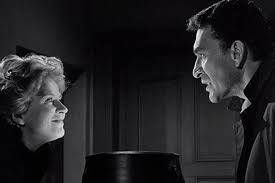
Finally, it is revealed that the ultimate force at play is Flora Carr (Margaret Johnston), the school’s secretary and wife of stalled professor Lindsay Carr (Colin Gordon). They call her a “middle aged medusa,” and she is one: she stops Taylor’s masculine heroism cold. This is at least a decade before Helene Ciroux’s foundational feminist reading of the Medusa story, and Burn With Burn can’t quite commit to such a playful inversion of the myth, let alone a refusal of it. What it suggests, instead, is the myth trembling at its own incompleteness, its own inability to foreclose itself. Flora’s final weapon is a stone eagle atop the school animated into a living wraith either by the force of her unreason or the disturbing resonances she sends into Taylor’s mind. In a film that is very much about background violence, the custodial work women perform to stitch the idea of reason together is brought to the foreground, and its unstitching, the film suggests, brings life to the still and stagnates that which is usually alive. The secret headmistress of a kind of academic coven, Flora opens up fissures that the film feels an impossible amount of pressure to close again. To leave reason unabated, she must be finally crushed by the stone eagle she animated, and thereby figuratively petrified by the history of unreason at the core of reason that she had exposed and let loose.
Score: 8/10
 The Long Take