
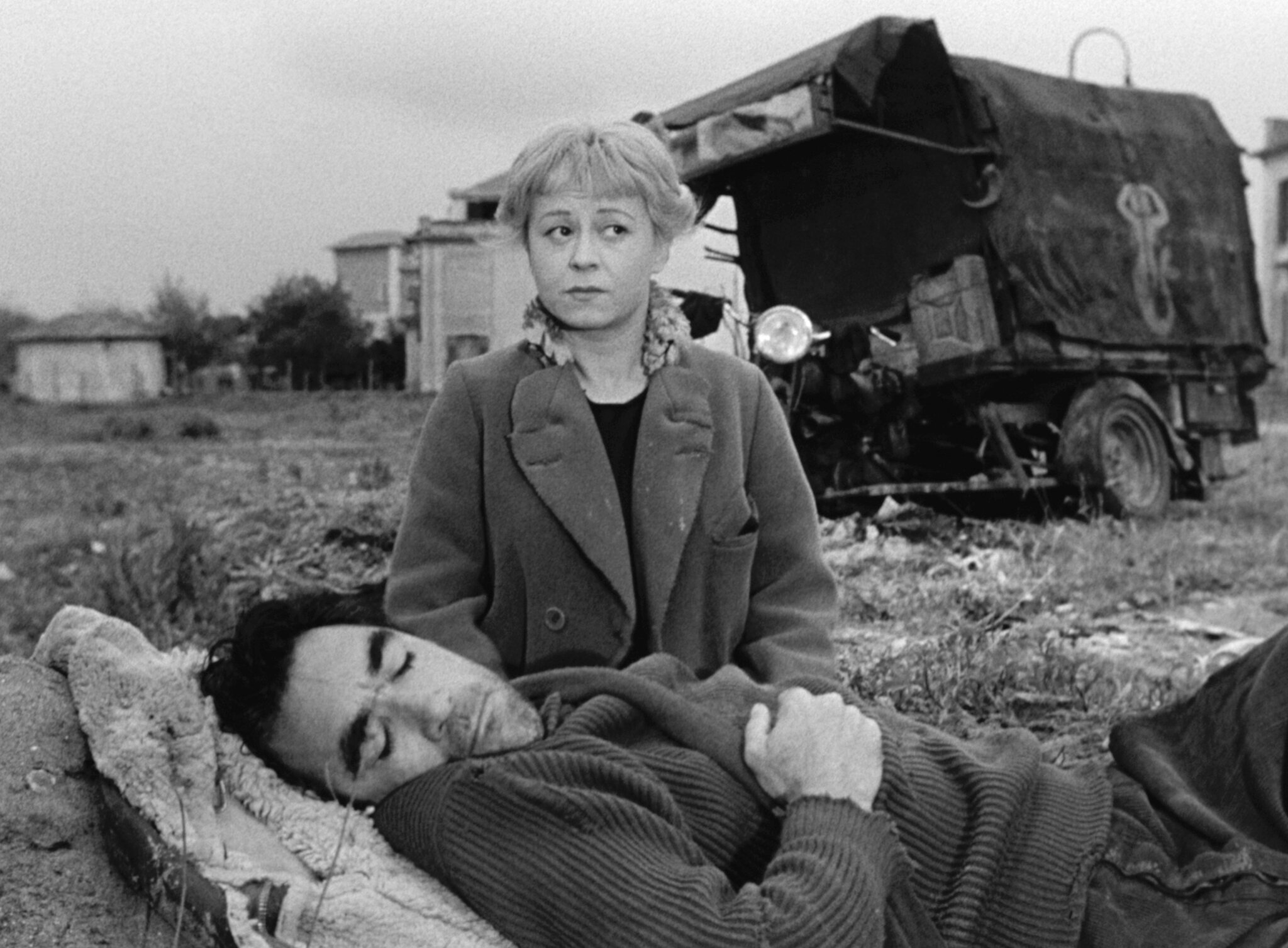
Few faces linger in cinema history like Giulietta Masina’s. As Gelsomina, a woman sold to brutal, confused strongman Zampanò (Anthony Quinn) to serve more as his assistant than his companion, Masina is an open void, a vision of sheer openness to the cosmos as vibrant, animated, complicated, and embattled as Renée Falconetti’s in The Passion of Joan of Arc. Gelsomina is unimaginably receptive to the world. She achieves a kind of pre-cognitive grace, the self as a pure canvas on which the world is written, and which, in her planetary vibrancy, rewrites the world. While she echoes Charlie Chaplin’s worldly attentiveness to flux, his need to follow the often confusing motions of an ungovernable world, as many have pointed out, her carnivalesque sensitivity to the mutable rhythms of the earth, the sheer multiplicity of life, is uniquely guileless. Chaplin seems to wrestle with the world. Gelsomina becomes it, existing as a microcosm of its flows. She has no ulterior motive, not even a need to survive. She simply experiences. While she never quite finds a home in the world, it is only because she seems singularly able to find momentary homes in passing notes, in itinerant images, in local joys, and in temporary sadnesses. She is a performer of everyday life, capable of potentializing any moment, a completely versional person who becomes whatever she needs to be. Each moment she encounters is entirely itself, a murmur of radical otherness she finds, and accepts as part of her, as she vibrates to the lyrical indeterminacy of the world itself.
It is simply unimaginable how much trust Giuliata and her husband, director Federico Fellini, must have put in one another to approach this character, to conjure a being who exists in such a primordially open, childlike state. For him to invest so much, or to allow her to return so much to him, both resonates with and embodies the film’s sense of celestial synchrony, its appreciation of a world where the wondrous and the awful are warp and weave of one another. Within the contours of this film, this also marks Gelsomina as irremediably ajar, prey to a world which she has no faculties to respond to, which she does not erect psychological boundaries to avoid. Compared to nearly every other film protagonist, she reads as inextricably passive and essentially pre-liberal in her identity, not a self-contained and self-authorizing individual but an animate point in the world, a ward of the universe.
La Strada asks us to appreciate this openness with an attitude of diffuse directionlessness and supersensory epicureanism. The world is brutal and unforgiving, it says, and any honest reckoning with it requires a sense of beauty that is contingent and localized, that finds joy in the everyday, not in a final eternity or an ultimate meaning. While Gelsomina echoes Falconetti’s Joan in a shared attempt to breach the limits of our everyday modes of viewing and perceiving, her version of transcendence does not look beyond the world into a transcendental ether called God, as Falconetti did. Gelsomina discovers grace in the world, marking her as a pure immanence that is spiritually inflected and yet entirely un-transcendent. She seems essentially untouched by the accumulated cultural signifiers on the world around other, but she also does not turn the world into a mere surface hiding a deeper, truer, essential divinity. Rather, she accepts the world’s all-ness in its manifold multiplicity and ravenous uncertainty.
Generally, this orientation transmutes us beyond causation, and away from our conventional markers of narrative significance. Throughout the narrative, our strongman frequently jests and fights with another performer, The Fool (Richard Basehart), whose cunning, cutting distortions of Zampanò’s masculinity echo Chaplin’s Tramp. Yet when the Fool is tragically stricken dead, the film’s perspective isn’t so much that Zampanò’s brutishness lead to a singularly abyssal, abysmal event as that this was his lot in life. This, too, happens, the film implies. Even the Fool freely admits that the conflict between him and of Zampanò was just as much The Fool’s fault, and when asked about his desire to marry Gelsomina – as the presumably more compassionate, superior man – or whether he might settle down, he rebukes his own capacity to change too. It’s as though he is weary for his cosmic fate, or simply uninterested in the kind of narrative in which he would save her, or she him, or in which he would save himself. His imaginative calculus simply is not ours, the one we use to negotiate our faith in a governable world. This isn’t a vision of heroic becoming, or self-actualization, or a story of personal self-authoring. The carnival’s omnipresent circle, to which the film often returns, is a poetics of repetition and continuance, of eternal return, a democratic space in which anyone might rise or fall, and in which any status is necessarily temporary and in passage to another one.
Fellini’s film shares this sense with the amused sensuousness of Bergman’s Seventh Seal from a few years later, and which Fellini himself would expand in the years to come. To live in this world is to bear an unimaginable violence, and to learn to accept that the vagaries of existence that generate happiness and meaning are not antithetical to those that cause us to despair, and to produce misery. Most of the characters in La Strada are singularly attentive to this maddening ambivalence, but precious few can really potentialize it. When the Fool asks Gelsomina to play a comic trombone behind his weeping violin, she returns the favor, and exceeds it, by learning his excruciatingly mournful melody on the horn. This is an act of sublime malleability and ductility, of the reconciliation of opposites, a sound that reflects, and perhaps redeems, the world’s difficulty by securing an artfully achieved harmony through difference.
La Strada doesn’t always hide Gelsomina’s celestial status. When a group of nuns explicitly mark her relationship with Zampanò as an echo of the way they serve a seemingly confused, often confusing God, they seem, like Gelsomina, not so much to put their faith in a superior creator as subsume themselves to the possibility that he, God himself, might be saved by their devotion to him. Gelsomina, like the nuns, is the more moral figure, the one who tries to save the bitter, astringent, forlorn beast of a man, and thereby to save humanity in the process. In a reflection of the film’s cosmic continuum, it really is Gelsomina who seems to have achieved the sacrificial, empathetic quality of a religious icon, and Zampanò, in his own way, who seems more indicative of our failings and frustrations as adrift humans whose capacity to hurt and wound one another is simply unmatched.
Yet it is not her doomed subservience that turns her into a martyr. The origin of the word “martyr” ties it to the act of “witness,” to glimpse and bear testament to a truth and refuse to lie about it even at great cost to oneself.What saves Gelsomina is her mode of what we might call earthly transcendence, her capacity to witness the instability of the world and refuse none of it, to dedicate herself to playing a tune that evokes and channels the world’s ambivalence. When we finally learn that Gelsomina will eventually dedicate her life to playing the Fool’s tune for other people, she embodies a form of witness that can’t quite be called resistance, but that does expose the world’s frustration and turn it into a sublime song, giving it a name without being able to put it into words. She has engaged with a world that doesn’t really seem to deserve our faith in it, and yet she has continued to act as though that world might be worthy of producing art. We sense something like ethereal serenity, a nurtured affection for our nebulous attachment to one other, our shared capacity for momentary creativity. Her resistance carries shades of Melville’s Bartleby, who can’t escape the world, who dies a lonely death even though he connects us all. Bartleby’s famous phrase “I would prefer not to” constituted an act of sublime rejection, what the philosopher Gilles Deleuze called a “ritornello at the limit of language,” one that “produces only when it takes to the open road (or to the open sea) with its body, when it leads its life without seeking salvation, when it embarks upon its incarnate voyage, without any particular aim, and then encounters other voyagers, whom it recognizes by their sound.” Deleuze is talking about American writing here, but Gelsomina’s musical refrain constitutes such a “ritornello” – tellingly an Italian term – one that finds another, chthonic rhythm of possibility and hope within the plaintive melancholy of Nino Rota’s wonderfully mournful music. Zampanò glimpses only one fragment of this confused beauty when he finally leaves Gelsomina, releasing her to the world, to a vagabond existence that also saves her from merely being an image of redemptive suffering, that allows her to reroute the world’s tragedy into a tragicomic reckoning. It is only because she allows herself to be so afflicted by the world that she channels its consternation into an act of genuine philosophical outrage that seems to whistle with eternity itself.
In her capacity to salvage the world through sheer expressiveness, she is also an embodiment of Fellini’s own acts of luminescent transformation. When she finally transforms from a corporeal hope to a more phantasmagorical saint, she herself models the flow of Fellini’s cinema from ethical witness of reality to poetic conjurer with reality. While he began his career as a post-war navigator of collective frustration and social inertia, he eventually came to explore the layers behind and beyond what we perceive to be reality, to channel those blocked energies as a prophet of internal desires. Like Gelsomina, he retained his early, neorealist ruggedness, a sensibility forged in harsh observance of the peripatetic violence of the world and the inconclusive, almost ineffable beauty of attempting, in a process La Strada understands to be conflictual but absolutely genuine, to survive it. His universe, and La Strada, like a carnivalesque parable, is a world thrumming with transportive, delirious energy if we let it affect us. La Strada’s rough-shorn humanism not only marks it as an inflection point in this passage to the director’s – and Italian cinema’s – more uninhibited later sensibilities, this also means that La Strada is one of the key films ever made, a plea for a conception of empathy with the all-ness of humanity and a celebration of the world in all its lonely resplendence.
Score: 10/10
 The Long Take