
Force of Evil opens on a god’s eye view of downtown New York, a promise of access to the totality of the city from a harmonious, analytical distance. Within minutes, Abraham Polonsky’s film will explore every nook and cranny of that promise as it descends into a labyrinth of ambiguous relations and inconclusive aspirations. Yet Polonsky never gives up on the ideal of his vision: to confront an amoral miasma with bracing moral clarity. Unlike many other film noirs, Force of Evil is not an equivocal descent into a swamp of unclarifiable social engagements. Polonsky’s moral point, that capitalism is a fundamentally inhuman mode of existence, is strikingly clear. The interesting thing, in fact, is how transparent it all is, how very much the on-location shooting, like the prior year’s The Naked City, presents us with a city that is all too aware of its own comings and goings, its accepted moral calculus, the quiet viciousness it has come to call home. Force of Evil, pace most noirs, is surprising for how unshadowy it all feels. It presents a city that has come to terms with its inner rot and legitimized it.
When we return to the streets much later in the film, Polonsky treats the city as an unforgiving social system but also an opaque region of the mind that might, just might, achieve transcendent clarity. In a mid-film excursion to a city park, a Church leers less as a sinister evocation of muddled ethical allegiance than a moral reminder of the limits of this way of living. When a series of birds fly away behind two characters talking, it’s as though they wish to escape the contours of this film. They float free, and the fact of their freeness implicates the characters in the illusory notion of capitalist freedom they live by. They are the only ones who escape a film about the exorbitant violence of America’s promise, a film in which everyone is trying to save everyone else via a system that kills everyone else, and almost always not knowing which is which, or how they came to become one and the same.
Polonsky’s film has a deliciously morbid hook: a rigged number’s game orchestrated by the crooked employer of corrupt lawyer Joe Morse (John Garfield) that plans to weaponize their knowledge that everyone can’t resist betting on “776,” America’s number, on the fourth of July. America bets on capitalism, in other words, and against itself. People combine faith and chance in American identity, which is itself a concatenation of divinity and risk, and this belief is ironically manipulated by those who are smart enough to weaponize it but not thoughtful enough to challenge it. One character asks, in the poetic and pungent prose of Polonsky’s script, “how does it feel to be a wrong number?” Everyone in the film, more or less, is trying to bet that they can turn their wrongness into a rightness, that their perennial inability to succeed within the system can, through a self-fulfilling prophetic bet on the modes of risk that system affords for them, become a facsimile of proof of their worthiness. This, the film suggests is capitalism’s myth of self-actualization. “I don’t believe in an employer who makes people do things because they’ve got to,” one character remarks, “but in employees who do things because they want to.”
Joe is willing to play along, but his soul is tormented by the knowledge that his brother Leo Morse (Thomas Gomez), will almost certainly be among those to lose out in the bet. He runs a small-time numbers racket that is more honest than Joe’s, but also more deluded in that it assumes it is above the system they both participate in. Leo cares for his employee Doris Lowry (Beatrice Pearson), who Leo treats as a sort of daughter and who is another stray tumbleweed in modernity’s storm. “Don’t make a book out of it,” one character informs another, yet Polonsky’s script, co-written with Ira Wolfert and adapted from Wolfert’s novel Tucker’s People, is a lyrical, lucid manifesto that takes real pleasure in the lengthy, repetitive rhythms of literary speech. It treats these people and their moral searching as though the fate of modernity itself lies in their hands, figuring them as abstractions of us, iconographic conduits of our failures.
But Force of Evil also knows that we can be had. Within all the talking, the film reminds us, we must listen for “a little click,” the tell-tale sign of “the man who listens” on the other end of our conversations, the stowaway in our interactions who, in fact, actually controls those interactions. We cannot lose the forest for the trees. We must see the big picture, the way that forces far beyond our empirical view shape the world available to us. Joe will turn this realization on its head when he weaponizes a tapped phone, discretely, to his advantage in the climax of the film. But even this is a risk, and it may not signal real escape. “Was my phone talking too?,” Joe worries, the film offering a premonition of The Conversation’s tarnished cynicism, and a hallucinatory vision of capitalism’s ability to turn objects, commodities, into “speaking” things we treat as humans.
In a melancholic late-film conversation, in which the exquisitely conflicted Gomez manages to be both self-hating and self-congratulatory, Leo lets us know that he is “dying all the time” “ever since I was born.” When he claims “I die almost everyday myself, that’s the way I live. It’s a silly habit,” he diagnoses the modern American condition and then implies that there is no way to survive it other than undermining and ironizing it, even if it means lying to yourself. “You’re dying while you’re breathing” is as sober a statement as film noir, a genre that epitomized the deflationary instability of mid-century American society, ever produced. This is a vision of a world in which to live is to “be guilty” and to make peace with it.
Unless, that is, we look elsewhere. Thrumming with a palpable urgency the film itself understands as a distraction, a way in which our need to survive is turned into a means of keeping us only, or barely, surviving, Force of Evil’s finale looks not to the moral purity of a promontory world above us, as the opening shot did, but to the renewed definition of understanding the ground on which we walk. Finally, Joe descends to the “bottom of the world,” perhaps in hope of uncovering the base of this silent cataclysm, of getting to the bottom of the proverbial and literal tangle of a system designed to obfuscate guilt and make innocence a sheer impossibility.
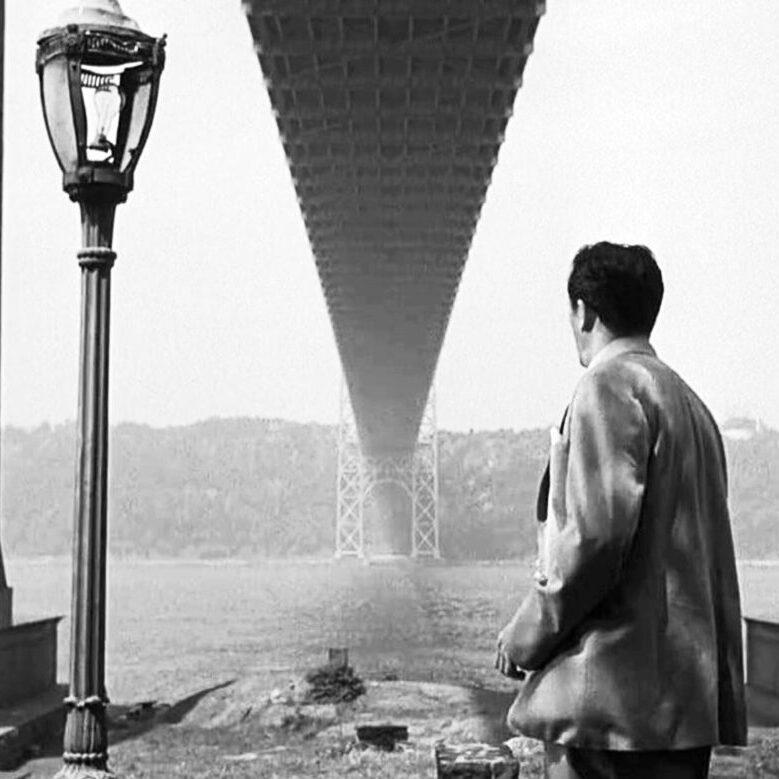
Throughout the film, George Barnes’s chiaroscuro cinematography has been stitched together, like Polonsky’s sentences, by editor Art Seid as a mosaic of moral contortions. On his way to the film’s conclusion, he walks under the shadow of a bridge, a dark arrow on top of the frame flanked on either side by blinding white light. In the proto-Antonionian white void Joe finally descends into, he finds the body he’s looking for, a sudden epiphany of the consequences of acquiescence in a world in which everyone is “not strong enough to resist corruption but strong enough to fight for a piece of it.” Still, the film worries that whatever Joe might do may not be enough. His moral action is meaningful, but the terms on which he contributes remain ambiguous. He can only recognize that “something was horrible and had to be ended one way or another, and I decided to help.” He still cannot name that which subjects him, a force created by us that seems to be beyond any of us, that wants to be left mysterious and uncoagulated, that has diffused around us and corrupted our modes of mutuality. The whiteness of the void in the film’s finale is an invitation to name what ails us while also expelling the inherited weight of our historical assumptions. It is also, finally, ephemeral, a deeply transient vision of itinerant hope. Joe still has to walk back up the known city, toward a poorly written first draft of the modern world that the film hopes can still be rewritten.
Score: 10/10
 The Long Take