
William Castle wasn’t a natural artist, but he was certainly an organic showman of the P.T. Barnum tradition, a skillful and wily craftsman with a populist’s canny sensibility for manipulating without upsetting the status quo to his liking and a magician’s eye for how to do more with less and play in the realm between appearance and reality. Case in point, Strait-Jacket, a self-evident Alfred Hitchcock knock-off with no new ideas, and which doesn’t even try to pretend like it has any actual ideas, but whose successes still, through some magical sleight-of-cinematic-hand, somehow feel entirely its own.
Strait-Jacket is certainly a copy-cat, but then, the writer Robert Bloch did write the story upon which Psycho was based, so it’s hard to criticize him for that. Plus, while Strait-Jacket shares Psycho’s lurid morbidity and fascination with the darker regions of America lurking beneath the facades of normality, Castle’s film mostly wants to play with us rather than to play us, as Hitch always essentially did. This is an essentially democratic film. Rather than exercise a cruel, conniving, beautiful mastery, it invites us in to a strange corner of America for a little while and then lets us leave. Straight-Jacket’s raison d’etre, certainly, is the sudden success of Psycho, which sent a dark chord down the spine of an already decaying Hollywood and threatened America with the sudden fragility of notions like “protagonist.” But Castle’s soul was that of a playful huckster just delighted to show us how he can, technically, show several heads being lobbed off in 1962 because they look cartoon-y enough to get by the censors, who don’t really seem to care when the film is this off-brand. That may be a gross reduction, even a debasement, of Hitchcock’s seminal masterpiece, but it isn’t exactly a rip-off.
Strait-Jacket does announce itself as a different beast almost immediately with a decidedly Castle-esque casually comic cruelty when Lucy Harbin (Joan Crawford) quickly and undramatically executes a double-murder in the film’s prologue after she catches her husband in bed with another woman. Staging a late-night double decapitation with the pragmatic efficiency of a midnight snack, it’s an exquisitely loopy pre-credits sequence, punctured by a few close-ups on Lucy’s young daughter Carol meant to maximize our awareness that she is obviously not going to survive this act of witness unchanged.
When Lucy is released from her psychiatrist institute twenty years later, however, the now adult Carol Cutler (Diane Baker) seems basically fine, working as a sculptor and ready to wed a much wealthier man Michael (John Anthony Hayes), who she seems to genuinely love. Meanwhile, the forces of fate seem to conspire to keep Lucy from ever fully reconstructing herself, especially when she is given the grand tour of her daughter’s farm and is introduced to a chicken killing room practically begging to be utilized for more than killing chickens. While it seems somewhat obvious that Lucy is doing less well than she lets on, those childhood close-ups couldn’t be there for nothing. Or (in my best William Castle voice) could they?
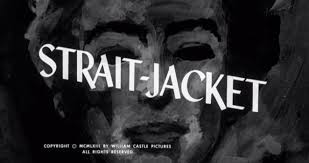
Meanwhile, from the black-and-white striped hell-scape of a cell Lucy finds herself in to the shadowy void of the kill room to the simply exquisite opening credits sequence where the names of the cast and crew appear above some truly sinister oil paintings, William Castle emerges as a genuinely capable, if only intermittent, stylist. Strait-Jacket is a self-evidently well-crafted film, even in the midst of the slippery suddenness of the several heads that lob off with teasingly cartoonish texture. Even the setting, a rural California hellscape near but not of anything that resembles civilization, feels like a perfect mirror for this distinctly off-brand, out-of-the-way Hollywood film. It’s a sun-scorched hell shot in a bleached-out style that feels simultaneously drained-out and hot-blooded.
But the beating heart of the film is, undeniably, Joan Crawford, giving a legitimately astonishing performance as a lost animal that is also a pit viper, able to shift on a dime from passively wounded to violently capable to pleading to terrifying. It helps that she’s given quite a surprisingly wide range of emotions to play, including that of a woman trying to live like she not only hasn’t spent twenty years in an institute but hasn’t aged twenty years at all, more like her daughter’s slightly unwound, slightly jealous, and slightly over-protective best friend than her mother. Crawford was effectively semi-retired at the time of filming, and the desire to turn back time and explore a younger version of herself lends a bitter meta-text to a performance that already radiates expressive intensity.
Score: 7/10
 The Long Take