Monthly Archives: October 2024

Midnight Screamings: Night Train to Terror

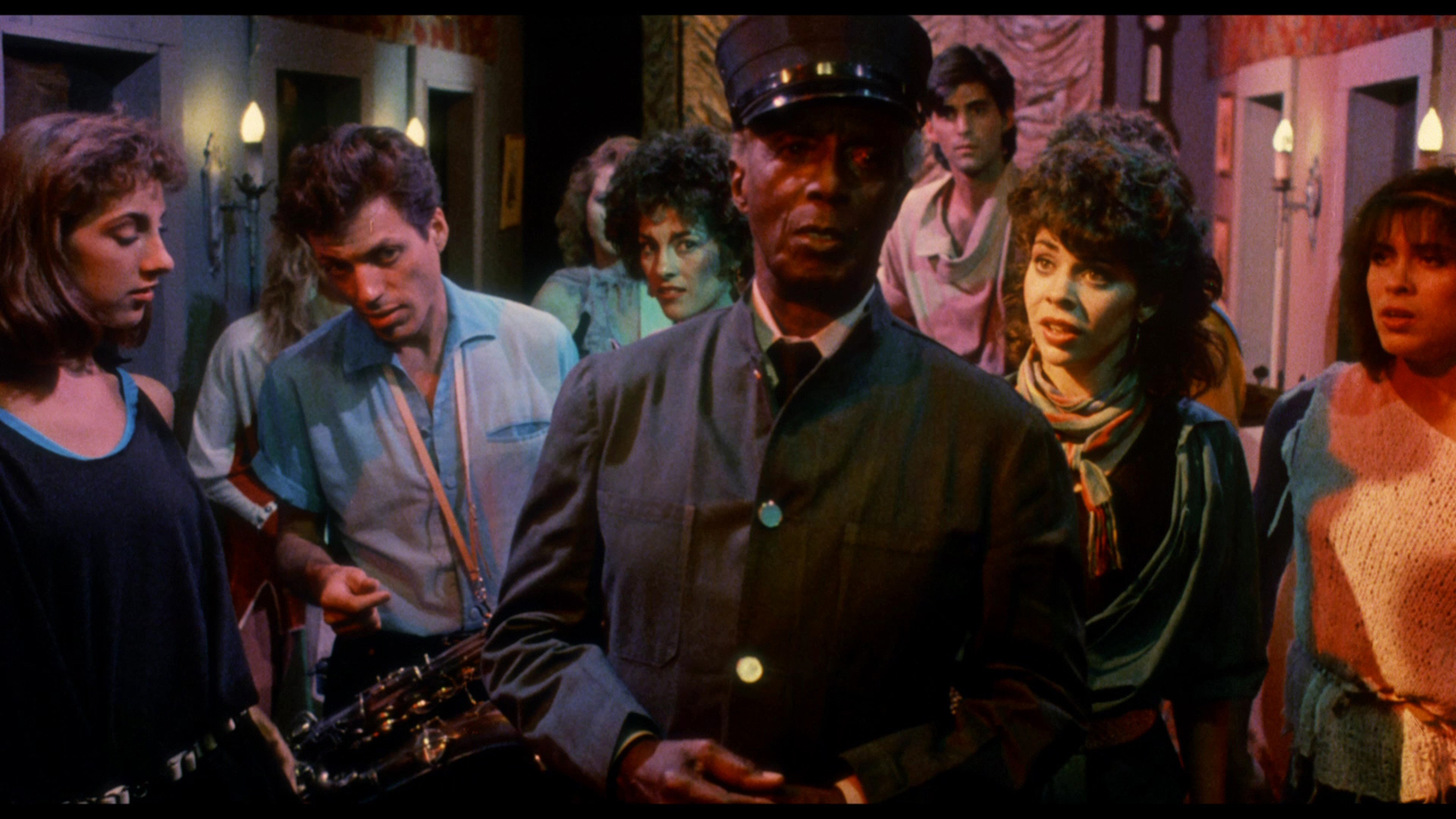
Night Train to Terror is undeniably trash, but its pleasures, paradoxically, are entirely intellectual. In its own unintentional, mercenary way, it severs the tension cord linking high and low art. It is, finally, only really valuable as a theoretical exercise, a strange cinematic mad science experiment (a connection that runs deep in cinematic history) in which several unfinished older films have been sliced and diced to pieces and reassembled into walking corpses of their ostensibly living selves. Born out of the forgotten remainders of unfinished horror pictures, this is an avowedly monstrous exercise in revivifying films that, as Frankenstein’s Monster himself once said, “belong dead.” That the film itself admits that this undertaking may itself be an immoral act – “bodies for money,” one character remarks in the first short film – is simply part of the fun. Night Train to Terror is a strange kind of cinematic meta-archive that salvages films while also working as proof for both the argument that this very salvaging is a heroic act and, conversely, that the films should have never been salvaged in the first place. It is, in the most literal possible sense, hack work.

All of this is to say: Night Train is probably an un-reviewable cinematic object. It feels like outsider art, so anything like a conventional standard of textual coherence or roundness seems essentially meaningless for parsing it or accessing its soul. Make no mistake, though: this is no labor of love. Its only investment is ensuring that scraps of lost and found footage might make a few dollars when unleashed on the unsuspecting, or on those who have deluded themselves into thinking this is a real movie, or on people like me who, apparently, hate themselves. For director Jay Schlossberg-Cohen, this is self-evidently an attempt to salvage a collection of films that couldn’t, or wouldn’t, cohere the first time around, footage that, as if by some demonic force, simply would not coagulate into a stable form.

Continue reading
Review: Once Upon a Time … in Hollywood

Once Upon a Time … in Hollywood opens with consecutive images of its two villains. Neither are Charles Manson, despite what the marketing claimed. The first is wanted poster of a Wild West outlaw. The second, in a whip zoom back, is Jake Cahill, Wild West lawman extraordinaire, a nasty renegade backed by Manifest Destiny who knowingly nods at the camera and who dishes out justice with an unforgiving grimace and little interest in the formalities of legality or the niceties of compassion. A marker of a time in the American imagination when retribution required little justification and morality was Manichean and measurable rather than mysterious and muddy, it is no wonder, we’re soon told, that Rick Dalton, the actor who once played Cahill in the early ‘60s TV boon as an unbending arbiter of goodness, has been reduced to momentary turns as a weekly walk-on heavy on budget Westerns and other TV shows dedicated to newer, younger, more ambiguous stars worthy of the murky waters of the late 1960s. The kind of justice he represents, a mixture of unbridled individualism and cosmic force, casts a dubious presence in a world where pretensions of moral purity backed by national predestination are increasingly threatened by recalcitrant forces of social unrest laying bare previously concealed realities and shrouded conflicts.

Two villains I wrote, but although Dalton is now reduced to playing villains on television, Quentin Tarantino’s Once Upon a Time … in Hollywood interrogates the possibility of giving him the fantasy of hero-dom he so desperately craves. When we cut back to a scene from Bounty Law, the show on which Dalton made his career playing Cahill, it’s to the shadow of a man, who falls dead into the frame, before Cahill covers him in the shot with his own image on a bounty poster. The shadow becomes flesh becomes print, illusion into reality into the legend. By the end of Once Upon a Time, Tarantino’s film will have helped Dalton fill out his shadow by giving him the chance of becoming a real-life Cahill, to embody a cowboy in the flesh. But the cost for turning dream into reality is a reminder that reality is a game of smoke and mirrors. Whatever else it is, Once Upon a Time … in Hollywood is a love letter to a time that, the film acknowledges, never really existed on the terms Tarantino wanted it to. Tarantino’s most recent film is a critical paean, and a wistful eulogy, for a hope that the film seems to recognize, but cannot fully admit, is a delusion. Which is to say: in aspiring to salvage the late 1960s, Tarantino also realizes he can only really be a pallbearer at its funeral.

Continue reading

Review: John Wick: Chapter 3 – Parabellum

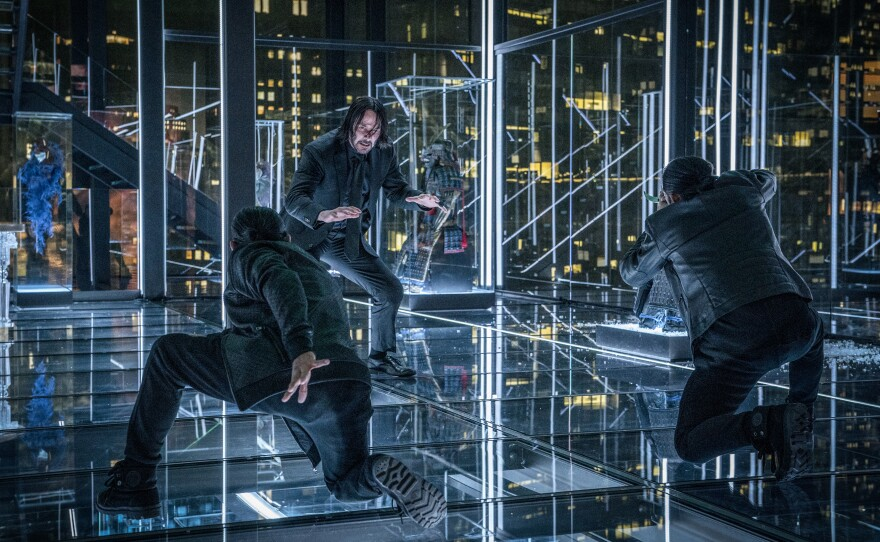
Just as we previously left him, at the end of John Wick: Chapter 2, our man Wick was hurtling down the suspicious streets of Manhattan, fearing for his life after having been recently excommunicated from the worldwide assassin community for (deservedly, in the film’s view) killing a person on hallowed ground. That ground was New York’s Continental Hotel, one of the many hubs of official assassin activity in, as we learn, an increasingly wide and complicated network and economy of murder. Its owner is Winston (Ian McShane), and he has used his power to delay the ensuing hit on Wick by one hour. We open John Wick: Chapter 3 – Parabellum mere minutes before that hit is to be sent out to, seemingly, every hit-person on earth. Parabellum’s Latin subtitle suggests – promises, really – no shortage of ego on the part of the film. And the dense and forbidding aura of its world, and the controlling and manhandling showmanship of this behemoth of a film, do not disappoint. This is a work that will summon swarms of extended forces, out of nowhere, to bear on one man who has to call forth an equally forceful reserve of will to survive, a celebration of one man’s capacity to survive a sheer, overbearing, unending onslaught of raw, leviathan-like cinema.

Wick 3 was the most highly stylized, most ornate of the series up to that point – the most continental of the Wick features, if you will, a kindred spirit of the aesthetic sensibilities more commonly associated with Continental Europe. That the one ostensible refuge in the film’s world suggests a hyper-controlled aesthetic sensibility seems to imply that the film’s aesthetic proclivities are ways of evacuating the ungovernable traces of real-world human spontaneity and uncertainty. This is a film that has been painstakingly manicured for us, to our liking, to do our bidding, to exert supreme effort and control in punishing one man and to take pleasure in his ability to survive that punishment. It asks that we revel in controlled chaos and the possibility of coming out the other side undaunted. It is pristine in the force of its construction, the single-minded brutality of its monomaniacal and thoroughly, violently uncomplicated imagination.

And revel we do. John Wick: Chapter 3 – Parabellum makes a pretty immaculate, almost indefensible, case for itself. The obvious criticism of the film is that its sound and fury signifies nothing, and that this film is so well-mounted and anointed that it can’t really register any suspense. That’s all true: we watch hundreds of people try to kill John Wick, and we delight as he kills them. In a sense, though, Wick’s over-modulated hollowness isn’t really so much a decrement as a sheer fact. While the film may seem empty on first blush, it might rather be that Wick refuses the injunction to make meaning out of its cornucopia of senses and perceptions. John Wick does not unearth some divine essence beneath all the madness, nor does it pluck any manna from heaven that unlocks the film’s mysteries for us. It just is.

Continue reading

Midnight Screamings: Strait-Jacket

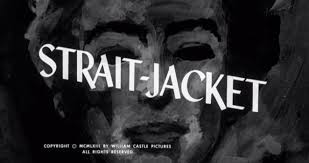
William Castle wasn’t a natural artist, but he was certainly an organic showman of the P.T. Barnum tradition, a skillful and wily craftsman with a populist’s canny sensibility for manipulating without upsetting the status quo to his liking and a magician’s eye for how to do more with less and play in the realm between appearance and reality. Case in point, Strait-Jacket, a self-evident Alfred Hitchcock knock-off with no new ideas, and which doesn’t even try to pretend like it has any actual ideas, but whose successes still, through some magical sleight-of-cinematic-hand, somehow feel entirely its own.

Strait-Jacket is certainly a copy-cat, but then, the writer Robert Bloch did write the story upon which Psycho was based, so it’s hard to criticize him for that. Plus, while Strait-Jacket shares Psycho’s lurid morbidity and fascination with the darker regions of America lurking beneath the facades of normality, Castle’s film mostly wants to play with us rather than to play us, as Hitch always essentially did. This is an essentially democratic film. Rather than exercise a cruel, conniving, beautiful mastery, it invites us in to a strange corner of America for a little while and then lets us leave. Straight-Jacket’s raison d’etre, certainly, is the sudden success of Psycho, which sent a dark chord down the spine of an already decaying Hollywood and threatened America with the sudden fragility of notions like “protagonist.” But Castle’s soul was that of a playful huckster just delighted to show us how he can, technically, show several heads being lobbed off in 1962 because they look cartoon-y enough to get by the censors, who don’t really seem to care when the film is this off-brand. That may be a gross reduction, even a debasement, of Hitchcock’s seminal masterpiece, but it isn’t exactly a rip-off.

Continue reading

Midnight Screamings: The Visitor

First things first: a film that begins with a thank you to the mayor of Atlanta and the governor of Georgia, immediately propositioning the audience with a fantasy of verisimilitude and access, and then immediately cuts to a totally opaque, ethereal non-space while an elderly John Huston, fresh off of voicing Gandalf in the animated Rankin & Bass The Hobbit,  appears as an unknown prophet on an alien planet that looks like Mos Eisley, isn’t ever going to lose me completely. We seem not to be in Kansas anymore, and this high up in the sublime tornado of chaotic-evil cinema, we’re probably doomed to fall.

Yet, amazingly, The Visitor holds up its end of the bargain. It is only when we cut to a basketball game that the real mystery of the film reveals itself: how is it that essentially unknown director Giulio Paradisi never made another horror film, and his subsequent two films were apparently easy-going Italian comedies, before he unceremoniously never directed again?  The Visitor’s opening basketball game is a beautifully opaque textual object, a killer opening to a film that is a bricolage of genres and textures and uncanny thematic and technical juxtapositions revealing a director of real mettle and a vision of extraordinary curiosity. This is a stupendously unsettling game of hoops, a cut-up event in which the camera floats around with haunting observational acuity, like a deconstruction of a sporting event from a ghost’s alienated perspective.

Perhaps even more interesting: a latter combination gymnastics event/bullet-removal surgery sequence (you know, one of those type-deals) clarifies that much of The Visitor is an experiment in mobilizing giallo-style filmmaking for primarily non-kill sequences. While some of the set-pieces do technically result in dead bodies, as in a phenomenal bird-in-a-car dive bomb, even they are far-removed from the giallo’s usual stalking ground. Instead, we explore everything from public sporting events to overcrowded hospitals to an abandoned apartment building to the innards of machinery scaffolding, each of which the film turns into a genuinely ethereal cinematic experiment in sheer observation.

Continue reading