North by Northwest lacks Vertigo’s deliriously unhinged inner excavations, or Psycho’s id, or The Birds’ nihilistic opacity, or Rear Window’s playful self-contemplation, but it may be as wry and wiry as Alfred Hitchcock ever got. In inching toward the sleek, aloof, maximalist delights of high-gloss, haute-couture 1960s pictures, North by Northwest isn’t necessarily nervier than it otherwise would be, but it certainly does provide an impish new spin on Hitchcock’s wickedly self-amused sense of self. It’s superficially glossy feel somehow makes its observations all the thornier, like a razor wrapped in cotton candy. That Hitchcock’s most overtly pleasurable film so smoothly and surreptitiously smuggles in so many minuscule wrinkles and devious intimations that all is not right with America may even be a surer display of his astringent talents. Figured as a grand confidence act at the end of the 1950s, it feels like the last time Hitch could celebrate the delirious excesses of modernity, and pungently dissect his own complicity in it, before Psycho and The Birds took him into the cloacal core of terror and abjection respectively. It’s far from Hitchcock’s cruelest film, but something about its chipper demeanor feels uniquely nasty nonetheless.
For North by Northwest is very much a sly deconstruction of America, one that practically announces itself with its famous final set piece, a suggestion that America’s national monument, and its pretensions of greatness, is really just a home base for conniving and cheating one another. Climaxing atop Mt. Rushmore, Hitchcock’s hilarious planned Lincoln-nose sneezing gag never came to fruition, but there is something amusing about the censors only allowing advertisement executive Roger O. Thornhill (Cary Grant) to slide around between the faces rather than on them, as though the film is playing around in the crevices and shadows of American monumentality but never quite getting to the core of the matter, either because America is too dense to really know or too shallow to be worthy of exploration. Atop an edifice of stone, a monument of national lies and hubris, we find only a slippery conspiracy of ne’er do wells that runs on battery acid. North by Northwest is the ur-film, the apotheosis of Classical Hollywood, a cinematic snake oil salesman that sells us on itself even as it tells us what kind of poison we’re about to drink.
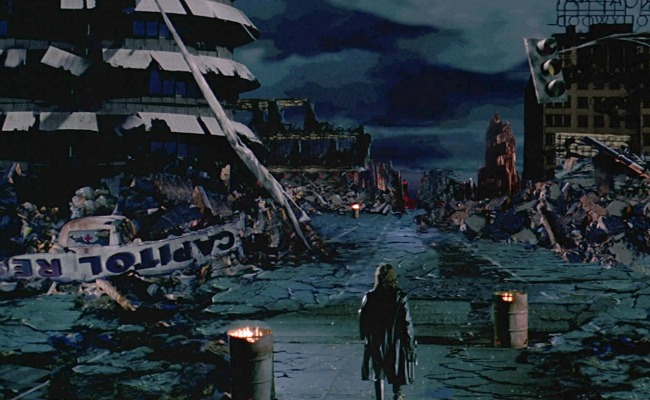
I won’t say that Escape from L.A. wasn’t working for me from the get-go – the first diegetic image is pretty stellar shot of the Sam Fuller school, a quick-fire slug of Nazi-adjacent American soldiers lined up against the camera, as though blockading it from access to some dark secret behind them – but the moment where John Carpenter’s fifteen-years-later sequel clicked for me is the one where it seems to completely collapse. When our resident eye-patched libertarian outlaw Snake Plissken (Kurt Russell) is tasked with rescuing a black box containing US satellite codes from post-apocalyptic prison-colony Los Angeles, he takes a one-man submersible into L.A., which is now separated from the rest of the U.S. and only accessible via air and water. We, however, take a roughly 60 second slalom through some of the roughest mid-‘90s CG you can imagine, Snake’s comically sleek submarine hurtling through an abstract void that is meant to connote “water”, passing by a toxic garbage plate of pixels registering ever-so-briefly as a “shark”. Finally, in a split-second, we rush past the drowned Universal Studios sign, now a lost relic from a forgotten age. The shark suddenly clarifies as a CG travesty of Universal’s great hit Jaws, itself a famously iffy effect thoughtfully used in only privileged moments, and Escape from L.A. clarifies its own status as one of the great Hollywood piss-takes, a mockery that is also a howl of frustration aimed at what Hollywood had done to Carpenter’s medium of choice. The title is not a not a statement of fact but a genuine wish, not a declarative claim but a plea for help.
Judging from the rest of the film, its deeply caustic ambivalence and jovial nihilism, its playful absurdity and nasty cruelty, it is impossible to read this as anything other than a vicious take-down of the idea of a CG action sequence, a curdled critique of the limits of Hollywood, even the idea of making a sequel to 1981’s Escape from New York. The consequence of this ferocious, even callous brazenness is that the film’s vision of redemption is reduced to apocalypse, and that Carpenter’s vision of anything like politics essentially consists of an empty void, but the beauty of the film is that it registers the sadness of a director reduced to that position. If Escape from New York was a caustic scalpel, Escape from L.A. is a libertarian broadside aimed at society writ-large. Gone is the sense of impromptu, even thorny, community in New York, or Carpenter’s The Thing, with its paranoid ruminations on humanity’s capacity for self-destruction, or Big Trouble in Little China, with its comparatively convivial reflections on the inadequacy of Hollywood male archetypes, or Prince of Darkness’s mercurial meditations on the potential for science and religion to work together. The possibility for human salvation through collectivity has no place in Carpenter’s mature brand of nihilism. While his deeply underrated Christine implicitly assaulted Hollywood’s acts of cinematic necromancy, its inability to fashion anything new and need to feed off the corpses of earlier visions of youth and coolness, Escape from L.A. is his most full-throated bite of the hand that feeds.
In that sense, the cosmic uncertainty of Carpenter’s wonderfully underrated 1994 film In the Mouth of Madness was a pivot point. With its harrowing and sublime investigation of the limits of directorial control and the disturbing psychic and cosmic forces unleashed by the intersection of art and corporatism, Madness seems to have opened a portal from which humanity may have no return. Escape both explodes outward – into a brutal, deliberately un-subtle burst of savage playfulness – and implodes inward, into a cloacal vision of Hollywood’s intestinal tract. When Snake’s submarine lands in L.A., the ground immediately gives out from under it, as if it can’t bear physical soil or withstand real concrete, can’t exist outside the false machinations of a Hollywood CG sequence, but also as though the film is plea-ing for Snake to stay on the island, to not return to a world that has no place for him anymore, to appreciate what Hollywood has to offer. In the vortex of chaos, he has found grace, has located the possibility of home.
From there, we’re off to the races, a transparent, scabrous mockery of Hollywood that is also a celebratory account of Hollywood’s genre-hopping excess, from a simply breathtaking absurdist surf interlude where Snake hangs ten with Peter Fonda, washed ashore from another genre entirely, to a hang-glider ride that ends in Disneyland’s “Happy Kingdom,” now turned into a haven for potential leftist revolt that, the film can only suggest, is another illusion of Hollywood radicalism, a fantasy of immediate satisfaction and sudden solution. Stranded in the middle of all this, we start one sequence where Snake is about to punished passing by several scenes of gladiatorial combat, Carpenter teasing a replay of the same set-piece from Escape from New York, before we learn Snake’s fate, a hilarious undercut: a basketball sequence, five shots without missing, ten seconds for each shot. It’s the mid-‘90s, Carpenter seems to suggest, and we need a basketball film in our map to the stars.
More generally, Escape from L.A. film is a work obsessed with the fabrication of Hollywood mythology, from the obvious (Bruce Campbell as the Surgeon General of Beverley Hills, who collects bodies to recover skin to keep his scions perennially beautiful) to more subtle remarks, such as the continual refrain “I Thought You’d Be Taller” that becomes a sort of needling chorus throughout the film for characters who meet Plissken. Snake twice attempts to assault or kill his U.S. government captors early on, reminding him that they know more tricks than he can muster, and that he, and we, will have to learn that we are being manipulated and may have to play the same game to get our revenge. Snake finally learns this in his phenomenally disastrous exit from the film, a blast of cosmic nihilism rarely seen in any film, let alone a blockbuster.
In many ways, Snake has to learn what, and if, Hollywood manipulation has anything to offer him. In a stellar sequence, he sets the stage for an Old Hollywood standoff against his enemies and then devastates the very rules he sets up. Shooting before he says he will, his opponents ae too locked in their Hollywood idiom, in the L.A. vision they still, however loosely, assent to, to know what hit them. The tensions are deep here. There is remarkable ambivalence within the film: for all that the film posits L.A. as the last vestige of possible freedom, L.A. itself is also a transparent theme park, a self-conscious Hollywood vision of absurd that is both celebrated and lamented by Carpenter, who seems to suggest that no other freedom may be possible other than that afforded by Hollywood, that the only forms of freedom we’ve been reduced to are those proffered by American movie fantasies. From here, Carpenter would return to collectives in Vampires and Ghosts of Mars, but both of those films offer little possibility of escape.
It’s not a subtle film, you can probably tell, but it isn’t dumb. When Snake tells the feds that he’s lost his hologram projector, for instance, we’re meant to intuit that he’s lied to them when he achieves a devastatingly mischievous coup with it at the conclusion, even though the film never explicitly reminds us that we’ve been lied to by our protagonist an hour earlier. The film knows that we’re watching, and maybe not watching well enough. When we first meet Steve Buscemi’s “Maps to the Stars Eddie,” he sidles into the frame behind Snake as the latter is resting in placid repose, quietly frustrated to himself, yet also posing in classic Hollywood bearing. He too is a star charting his course, the film seems to say, but he is also being charted, both by others around him and by decades of Hollywood archetypes he cannot fully shake off, and that this film cannot escape from. How else to explain the final shot. Having shut down the world, Russell interrupts his own final moment of solitude, only to catch a stray suspicion and stare at the camera, striking a cheery-nasty pose for the viewers he now acknowledges. Snake, the film seems to know, simply can’t exist as a real person. The only home he can know is an assemblage of smoke and mirrors. In his quest for escape, he comes to realize that he was always-already a cinematic type. He isn’t our savior, and he doesn’t want to be, but Hollywood cinema can’t actually posit a kind of hero useful for everyday life. The best thing the film can do is conclude, to turn this film’s end into a thesis on film’s end. We, the film says, can only be left to our own devices.
Motel Hell opens with an absolute pip of a silent sequence, a seemingly offhand shard – as though the film started too early, or we’re watching things sidle into place – that ultimately becomes the lens through which the whole film might be viewed. As the camera fades in, Vincent (Rory Calhoun) slyly and somewhat laconically smokes his pipe on the porch of his mostly defunct roadside motel Motel Hello, the “o” flickering out and the red bathing him in a warm but hellish glow. It’s a remarkably casual, easy-going, even lethargic bit of filmmaking – nothing is really happening, except another moment in this random person’s day in anywhere U.S.A. – and yet the texture of the scene folds us into a milieu and a mood. The font of the credits itself mimics the Motel font in a simple but effective means to suggest that we, ourselves, are now entering the headspace of the hotel itself. I have to say, readers, I was instantly smitten. Motel Hell is like that: it accomplishes more than most films, yet it barely does anything at all.
Before watching Two Evil Eyes, you would be forgiven for assuming that director Dario Argento was the hanger-on. Originally planned to include sequences by Argento, John Carpenter, and writer Stephen King, Argento certainly seems like the odd man out. Carpenter and Romero seem like an obvious match, and King and Romero had already collaborated on the phenomenal Creepshow, a deliriously kooky anthology horror film that fully recaptured the spirit of the EC Comics horror tales. (Carpenter, too, had already directed an adaptation of King’s Christine). The obvious impetus for this film is Creepshow and Romero’s subsequent, lesser Tales from the Darkside show (also adapted into a 1990 film whose best segment also features a fiendish feline), and Argento, who didn’t usually sign on for this sort of thing, may have just been along for the ride.
The script for 1990’s The Guardian was finally credited to William Friedkin, Dan Greenburg, and Stephen Volk , but, watching the monstrosity, it is immediately obvious how many unmarked hands touched and tore the film to bits before its release. This slapdash production is transparently the work of many eyes and voices working at cross purposes, a cinema born of unfulfilled expectations and necessary compromises. While loosely based on the novel The Nanny by Greenburg, the film’s producers invested heavily in director William Friedkin’s history with supernatural horror and insisted that the film incorporate Exorcist-like cosmic tendrils absent in Greenburg’s book (which I have not read). Rather than Phil (Dwier Brown) and Kate (Carey Lowell) Sterling being threatened by Camilla (Jenny Seagrove) – your everyday local duplicitous nanny with a penchant for stealing human newborns – they are the victims of Camilla, a malevolent cosmic force and eldritch, Druidic forest demon who needs to sacrifice babies to her God. Rather than a parable of domestic fear, The Guardian assaults the senses with a thoroughly supernatural account of Christian theology’s Other. Sometimes things just go like that.
The bandages of the film’s construction are plainly apparent watching the finished film. Scenes end too early, last too long, or seem to be missing completely. Ideas are brought up and dropped within the span of a scene, the tell-tale sign of a film scrambled in the editing rhythms either to rush to the proverbial “good stuff” or to recover from a lack of coherent footage. It’s difficult to tell whether this happened prior to filming or during the process, but Friedkin seems palpably divested from the main currents of the story or the emotions of the characters. If, say, his The Exorcist is an exquisite diamond of a horror picture calculating every scene for maximum effect, The Guardian is much closer to that film’s famously tortured, unfocused, misbegotten sequels.




 The Long Take