
 Notionally a point of departure for playwright-turned-writer-director Martin McDonagh after the just-dandy In Bruges and the eccentric but flippant Seven Psychopaths, Three Billboards Outside of Ebbing Missouri not only turns McDonagh’s wandering eye to America – either Middle American or the South, depending upon your placement of the pointedly liminal Missouri – but to a deepening of themes, a reckoning with untouched subjects and untapped potentials. The story of an implacable mother, Mildred Hayes (Frances McDormand), who erects three incendiary billboards chastising the local police for their failure to solve the rape-murder of her daughter, Three Billboards is, as we say, going for it. At the same time, I’m not entirely sure the film does go for it, which is where its problems commence.
Mildred’s intrepid, wrecking-ball quest for justice places her not only at odds with the town of Ebbing as a whole but with two specific fixtures of the local police station: chief Bill Willoughby (Woody Harrelson), who happens to be dying of cancer in what amounts to the town’s open secret, and the aloof, initially-asinine Jason Dixon (Sam Rockwell), who we are told harbors a deep-set hatred for African-Americans and who barely attempts to hide his subcutaneous distaste for everyone else who isn’t a good ol’ boy. Compared to his intermittently amusing but essentially vapid and passive Seven Psychopaths, a film which attempts little and achieves what it attempts with mild gusto, McDonagh casts his net with an envious and unenviable breadth this time out. He ropes in police brutality, unreported violence against women, prosecution of African-Americans, and the tensions between town and police. Continue reading
 The high-brow-baiting artistry of Paul Verhoeven’s Elle may seem like atonement for the defiantly low-brow American films he unchained on America between 1987 and 1997. But beneath its harsh austerity lies a film as extraordinarily carnal, deliciously primitive, and totally untamed as anything he’s yet directed, a work that shreds pulpy shards of equivocal, morally-grey human desire in every direction. Make no mistake: those wandering into the domain of emotionally-clipped art-cinema must discover that even the highest-raised brow is not enough to protect you from the Verhoeven-touch. Returning after a decade out of commission, the director utilizes art-cinema’s pretensions and impudently explode them, propelling the niceties of French cinema away in a centrifugal mass of uncertainty. A morally flammable film, Elle catches fire because of rather than in spite of its chilly, seemingly-antiseptic demeanor.
  Asghar Farhadi’s The Salesman isn’t as multifaceted a multi-character story as A Separation and it cannot match About Elly as an eloquent study of how personal identity is as much a construction by other people as an effusion of your own will. But although, thriller credentials aside, it is a mild retread of Farhadi’s two masterpieces, it is still extraordinarily thoughtful cinema on its own terms, as bold as it is quietly assiduous. As with all of Farhadi’s films, an extremely precise narrative of minutiae manifests multitudes of even more incisive observations on Iranian society more broadly. And while the first 90 minutes are merely solid Farhadi, the apex of the drama – maybe the acme of Farhadi’s career – is a three-character mini-play where audience sympathy, empathy, and desire become malleable clay for a director for whom each moment is a glint of new suspicion or a twitchy shiver of dramatic reorganization. Farhadi has compassion for all his characters, but he treats interpersonal quandary as an abyss of revelation in a drama we must navigate rather than merely watch. His film is a diamond, not because it glistens but because every visual frame or character lens destabilizes the drama and emanates a new image of existence. Or a new point of view, shining with the blinding, brilliant light of its own remarkable negotiation of personal perception, of seeing things anew such that old modes of thought are now futile, permanently disabled, the refuge of the mentally-obliging. The Salesman is a wonderfully pliant creation. It’s also somewhat unevenly sculpted, but we’ll get there as well.
  On the surface, Mother! Is yet another example of a director aiding and abetting their own egomania with an anti-egomaniacal screed, a peculiar form of self-appreciation doled out by a director happy to explore the myriad ways in which directors are oppressive dictators at heart. This would mark Mother! as the latest bastard child of Hitchcock’s self-critiques in Rear Window and Vertigo and Hollywood’s extraordinary propensity to control the terms of anti-Hollywood filmmaking by making films which mock itself. But, to give credit where credit is due, the thoroughly undigestible Mother! erodes even that auto-critical safe harbor. Many films – far too many in the 21st century – retreat into easy mockery and adolescent self-reflexivity, the sort of trivializing reductions and post-modern hipness popular among the Tarantino-generation (although not always Tarantino himself). But, although it never stabilizes into any clear critique – perhaps not although but because it never coheres – Darren Aronofsky’s self-propagating fire of a feature film at least doesn’t treat its self-critique as an excuse to act like it really has any idea what is going on at all within its halls.
  Somehow even less easily theorizable than David Lowery’s A Ghost Story and no less opaque in its horror-adjacent vernacular, Oliver Assayas’ Personal Shopper is ghost story as a polyphonous brew of constantly revivifying altered states and endless self-reconsideration. Although relentlessly frigid, it is a remarkably alive motion picture, provided that life is not a quality of camera motion or character action but a quality of stylistic vanguard-ism and restless thematic wandering, of a film with many competing selves vying for screen-time. It boasts multiple, personal tonal parallel universes, from murderous malevolence to rootless dejection to diaphanous elegance, each a viable film in its own but none enough for Assayas, who refuses to give in to the kind of stability any one mood would require. His film is astonishingly vivacious, but its life essence is not found in a candy-coated palate or schizophrenic, paid-by-the-cut edits but the chaos of modern indeterminacy. It’s found in the creeping tingle that life, like this film, thrives in constant decay and alteration, exists in perpetual erasure, is a veritable momento mori of moments that happened just before but are fundamentally different from the now and cannot be recreated.
  Writer-director Greta Gerwig’s snappish voice and self-confident-but-self-deprecating demeanor – so clearly developed after a decade of starring roles in independent features – lingers over every scene in her directorial debut, Lady Bird, even though she herself does not appear on camera at all. Certainly, Gerwig’s style clearly has antecedents in the Mumblecore movement – Lady Bird really isn’t the case of a truly new voice being cast out into the cinema, although it harbors no pretensions about being one – so perhaps I’m less singularly bowled over by her work her than some other critics. (It brings to mind the fact that few people have actually seen the many films Lady Bird owes a debt to). But with such fearless and sharply articulated characters and a jagged, spasmodic visual and tonal style, the film skitters about and casually subverts any hypotheses audiences may bear about justified or rational character responses to the world around you. Acerbic without being mean-spirited and incisive without dipping its fangs in life-sucking venom, Lady Bird isn’t meaningfully “new” – Gerwig’s perspective in the form of other beings has existed in cinema for decades waiting to be heard – but Lady Bird is a thoroughly great, quietly complicated variation on existing themes nonetheless.
 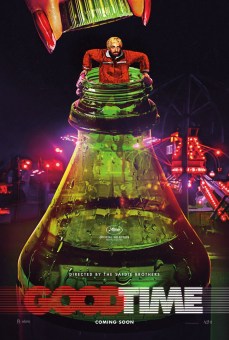 Let me rhapsodize Good Time’s achievements. Its fringe-dwelling camera and elliptical, schizophrenic editing mechanics construe cinema as visual mental collapse while somehow also suggesting that the protagonist isn’t thoughtful enough to have a collapse. All the while, it captures New York as analog-fed nightmare and white-hot horror-show, a backdrop equally viable for a demented, damaged fairy tale and traumatic study in delusional psychosis. Meanwhile, main star Robert Pattinson continues to shed actorly skin, playing a human reptile not as a lounge lizard but as hostile, unthinking, entitled, and deliberately vague 21st century American man who feels bruised by the world and thus treats people of other races as scabs to pick at. Simultaneous breakthrough and breakdown, the beauty of Josh and Bennie Safdie’s Good Time is that it exists simultaneously, and violently, in the middle of a perpetual plunge into a self-destructive stupor and as a continual deferral of realization, a displacement of the epitome or acme of that plunge so that we receive no comeuppance or catharsis, right up until the terrifyingly arbitrary conclusion. Whether or not this film is the initiation of a hopefully long-running new voice in cinema, right now, in 2017, it feels like a wonderfully tempestuous first molotov of a genuinely insurgent cinematic perspective.
 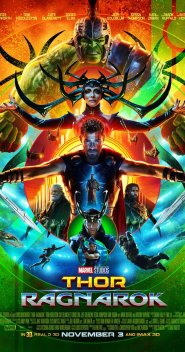 The newest Marvel movie, at its brightest, slides neatly into New Zealand director Taika Waititi’s stable of flippant, pungent comedy freak shows, and “at its brightest” is entirely a function of how cheerfully indifferent the film is to the strictures of Marvel cinema. A much more frivolous, foolhardy film than its two ambivalent predecessors, the mostly personality-stricken Thor and the Game of Thrones costume-swap Thor: The Dark World, Thor: Ragnarok’s ear for the rash and reckless, even the carnival-esque, is inimitably appealing. When his Thor film stops its tracks and stifles its narrative, choosing to hang out, loosen up, limber up, and drunkenly stagger through its paces rather than locking into place or filing in line, Ragnarok is a devilish little curio, a genuine blockbuster oddity even more bent and wicked than either of the Guardians of the Galaxy films. While Justice League was an attempt to mediate (and Marvel-ize) the abnormally pretentious and out-sized histrionics of Batman Vs. Superman: Dawn of Justice, Ragnarok is the genuine anti-Batman, an impish little sidewinder of a film that stands almost defiantly against introspection.
  The Long Take