
 By the looks of things, The Dark Tower – the film – has been shot, stabbed, poisoned, manhandled, fed to the lions, and drawn-and-quartered on its way to release, sending the scattered remains of Stephen King’s I’m-told-dense seven-novel book series to random corners of the Earth. At a scant, emaciated 95 minutes, the filmic adaptation of the tale has been limned and trimmed down to a shockingly skeletal version of the story. This isn’t inherently an evil. We live in an era of blockbuster bloat and vacuously overdriven narratives that slog through 150 minutes of screen time, dragging their thematic underbelly on the ground as the asphalt scraps away any of the depth hanging beneath all the filmic fat.
Comparatively, The Dark Tower is maniacally expedient, a 100-mile-an-hour lamborghini that turns into a wheezing, huffing junker within minutes. It falls apart before our eyes, struggling to keep its intestines inside its near-hollow body cavity. It’s deeply flawed, but at least it has the common courtesy and goodwill to end itself before it commits to too much damage. The Dark Tower has a faint, barely-beating heart, but at only 95 minutes, you don’t have to wade through corpulent, clogged arteries to stab it with a stake and put it to eternal rest. Continue reading
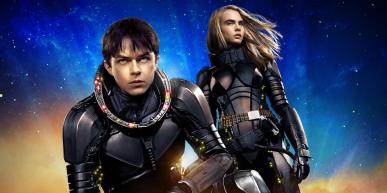 Leave it to Luc Besson to turn a mere diversion into a proper plunge into the headstrong imagination of a topsy-turvy grown-up-adolescent with decades of mid-century fiction in the heart and worlds of possibility in the brain. Valerian radiates unchecked ambition and rains down wild-eyed mania like a convivial, cosmopolitan celestial star. Let’s go ahead and say it is a feature film, because if I don’t start with that as a certainty, I’ll speculate and speculate until its wobbly, star-bright edifice collapses upon me. And it does collapse after a fashion; its two protagonists are mismanaged and a paper-thin foundation for the deafening array of stylizations and imaginations Besson spews on top of them. But blockbusters today all have their edges sanded off, playing – like biopics and every other populist genre – like museum pieces beset by the deadening, franchise-conscious, homogeneously styled eyes of a JJ Abrams or some similar soul. Comparatively, even a filmmaker as brashly awful as Michael Bay seems like a breath of auteurist fresh air, a genuine iconoclast of garbage in an era of bland, indifferent, tidy, and thus flattening, cinematic perfection. In its ambition to exhaust the sensory and its imperfections, Valerian isn’t just warts and all. Its warts fuse it together.
 The Founder is neither a jubilant cheer for bootstrap American capitalism (a gross idea, but committed) nor a lament for genuine compassion and humanity, a film hued in shades of wrath and righteous indignation. It seems not to have much of a perspective at all. Instead, it is a careful, timid, tempered, cautious film that is deliberately micro-managed to dip neither into hagiography nor legitimate criticism. Sure, it acknowledges McDonald’s “founder” Ray Kroc’s venom and the foul underside of capitalism, but the dominant thrust of the narrative – the very oxygen it breathes – is the piston-like ambition of Kroc and his achievements. In some sense, The Founder is even more sinister than an overt hagiography. In clotting the free expression of Kroc’s passion, The Founder reminds us that Hollywood is self-aware enough to manage its enthusiasm for capitalism, not enough to actually challenge it, but simply to let it run free in a slightly less liberated, minutely more compassionate tone.
  Atomic Blonde’s director, David Leitch, is the now-credited ghostly second-director on the original John Wick, but if Atomic Blonde is evidence, he was anything but a phantom limb. If John Wick 2 took John Wick, steel-forged its core and galvanized it in added layers of classical, tactically ornate imagery, Atomic Blonde rains down post-punk shards, showing off its reptilian physique, a frigid tempo, and a temperature that explodes the membrane between hot and cold altogether. Atomic Blonde is Wick 2’s sister film, hardly out of the family. It’s not exactly that it’s an opposition or alternate future for the Wick franchise, but it is dirtier, grimier, like it’s been dusted off of skid-row after a weekend bender and is walking around in perpetual hangover.
  A spectrum of heterogeneous voices and layers of reality rhyme with one another in Abbas Kiarostami’s Through the Olive Trees, a seemingly meta-textual work without any of the narrative gamesmanship or self-conscious striving for iconographic importance that characterizes most films in the post-modern idiom. Kiarostami loves cinema too much and is too taken aback by the empathetic, observational powers of his medium to abstract it to a narrative game or an analytic formal exercise; his films remains low to the ground, in the trenches of being, alive to the anecdotal energies that frizz within the rural Muslim community Through the Olive Trees sets its eyes on.
  Claire Denis works in a slightly different idiom from many other filmmakers who train their eye and heart on the landscape of Africa, mainly because she is plainly aware that there are clear if not quite terminal welters in her relationship with those filmmakers. Namely, she is white, and they aren’t. More than that, she isn’t African, although her memories of growing up the daughter of a colonial civil servant in French West Africa inform her every film. Colonial history shadows her every film, but also a sense of fragile distance, an attitude of not only forbidding and crippling economic and psychological depression but of being withheld from that depression, of a European child who lives in African but unmistakably confronts it partially as vacation-land or fairy tale. A child only aware in fits and spurts of the oppressive economic shackles upon which her life is built, who sees her family’s black servant as friend, father, and many other things, but not necessarily understanding that he is forced into that position, or that he operates out of coercion.
  Don’t have a particularly piquant reason for catching up with this film at this moment in time, although I am moving to upstate New York later this month, and perhaps no film I can think of evokes the wintry, wilted spirit of that location, at least as it exists in the mind, so there is a certain poetic coincidence in this review.
  Ouija: Origin of Evil
 The Long Take