 Update 2018: JFK is such a wonderfully misunderstood film, and one that opens itself up so heroically to criticism. For instance, it would fit so well into Frederic Jameson’s analysis of post-modernism as the cultural logic of capitalism, where any semblance of truth, social fixity, or totalizing connection between layers of society is totally unmoored, leading to a dangerous relativism that occludes how capitalism reinforces its own social structures. In this criticism, post-modernism dreams a liberation from the social structures that bind us, a dream that dangerously inclines toward individualistic narratives where we all control our own futures, where no social structures confine us, where truth doesn’t constrain our options and is simply a ruse. The form of relativism JFK traffics in – nothing is true or fixed, everything is a lie, etc – veers toward a vision of uncertainty that would probably veer for Jameson toward hiding, rather than revealing, how capital and the oppression caused by capital is the truth which creates and limits possibility, which master-hands reality, which decides who wins and who loses, etc.
It’s easy to disown JFK along these lines. Except that JFK’s abiding well of skepticism for classical guarantees of legitimate truth are heavily tied to both its conscious critique of capitalism’s manipulation of fact and its visual and aural explosion of the capitalistic technologies and visual regimes – tv, film, media – which technologically and stylistically embody modernity and construct reality. Perhaps this makes it more of a modernist film – aware of social totality but skeptical of our ability to visualize it – than a post-modern destruction of any true social totality. But there’s something so conniving and devious about Stone’s vision that it seems to simply decompose the distinction between modernism and post-modernism altogether, as though suggesting that one can argue that truth exists and that truth doesn’t exist and that this is no contradiction. Or that it is a contradiction, and that the best films, Stone’s or otherwise, live within contradiction rather than beyond them.
Frederic Jamerson’s classic analysis of the “conspiracy” aesthetic also applies to JFK, at least on the surface – it’s easily one of the most infamous and infamously perturbed conspiracy films of its decade. Conspiracy stories fail, of course, for Jameson, because oppression isn’t a conspiracy masterminded by a select few autonomous higher-ups conscious of all their actions but a much knottier, more tangled social fabric. Media which can only imagine a conspiracy controlling us visualize the forms of oppression which shape society but can’t surpass the limited view that there are a handful of individuals to “blame” for this oppression.
Nominally, JFK also falls prey to this critique, but its relativistic mise-en-scene, heterogeneous, fragmented audio, and impossible sense of perspective all suggest, at a formal level, something far more perplexed, garbled, and impossible to pigeon-hole than the conspiracy that opiated-masterpiece Kevin Costner’s character divines out of his rattled brain. Playing with its own reality as much as ours, the film offers no incontestable position of mastery over its narrative environs, and it never treats its story as one inarguable truth replacing the one we thought we knew. It does not simply “give us” a conspiracy to explain the JFK assassination; rather, it effuses a skeptical energy, cultivates an inquisitive tendency, handing us a piecemeal truth that the form of the film is already actively questioning and contesting as it is being given to us. It asks us to question its own pessimistic conspiracy as much as we are meant to question the prior optimism of mid-century Americana that the JFK assassination itself dissolved into the ether. Antsy to the bone, Stone’s film seems to be wriggling away from us as it is being composed in the first place.
Original review:
Twenty-five years later and it would take a flotilla of steamrollers to drive over the knotty indiscretions and lapses in logic that stitch (or don’t) Oliver Stone’s JFK into an argument, leading to the common critique of this much-maligned film that it accomplishes nothing so much as a conspiracy nut’s wet-dream power-point about the JFK assassination. That argument is airtight but misdirected, laboring under the assumption that film should only bear witness and testimony to reality, especially historical reality. As most pro-JFK critics have retorted, this is the part where I would say “it’s only a movie” and wipe the slate clean to judge Stone’s film as mere fiction, thus neutralizing the question of whether it is history in the first place, of what actually happened, and of the film’s relationship to historical investigation. Continue reading →

 Not really progenitors to any new film specifically so much as to the spirit of every Christmas movie. Again, I recognize I’m a couple weeks late here. Enjoy nonetheless.
  Actor Robert Mitchum’s bedraggled visage in The Friends of Eddie Coyle lays bare the crippling exhaustion of nearly two decades slugging it out to remain relevant after his early run of alternately lusty and haunted film noirs cast him as the de facto face of wounded mid-century existence. Back in the day, his slightly slurred baritone was the perfect mouthpiece for the archest of masculine men revealing the hesitancies and anxieties behind their robustly manly confrontations. But by 1973, Mitchum was no longer a white-hot emblem of a vision of American questioning itself. Decades of both personal and national tension remade him as the hoarse, dog-tired poster child for an America that was now not only struggling but seemingly disqualified, and The Friends of Eddie Coyle takes full advantage of every crack adorning his face. With an uncertain humor and paranoid visual style, director Peter Yates’ film is a return, and an extension, of that very spirit of wounded noir cinema. Not only a work of darting eyes more than the classical steely glares that punctured many classical film noirs, it is also a return to the forefront for Mitchum that paradoxically revitalizes his screen life by casting him in a faded, funereal gloom that drives him right back into the grave. Eddie Coyle’s skeletal framework, with an emphasis on absence rather than presence, suggests a world of unassimilable people splayed across a suffocatingly finite space, lost in a dulled, silenced universe.
  While so many of his kindred company directed films so busy getting high-strung, coked-out, and animated with a life on the edge, reveling in the tension of their own deathless drive teetering on the edge of demise, Hal Ashby’s unhurried The Last Detail may actually be mistaken for druggy, hazed-out ‘70s relaxation. However, peering beyond the tempo of the film, or reading it more accurately, reveals that Ashby’s looseness is less relaxation than resignation. The Last Detail, like many of his films, is a sighing and reflexive awareness of the essential anonymity of energetic wild-man rebellion against a system designed to truck on against you until it flattens you to the pavement of a hopelessly square, domesticated existence. Wounded and shot-through with a brittle awareness of the ephemeral nature of the hippie dream, the film embodies the weary, wounded trajectory of time. It replaces Scorsese’s or Coppola’s nervous alacrity, a fear aimed at a coming insurrection, with a post-destruction elan, a strained sense of giving in to the amiable pleasures of fooling around as the only leftover joy during the decade-long amble that was the American ‘70s.
  Dimensions of Dialogue
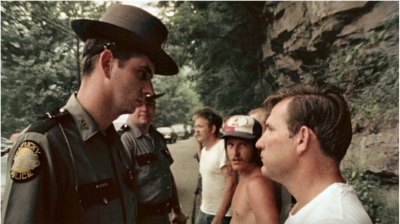 Humanistic agitprop at its finest, Barbara Kopple’s documentary is the rare cinematic work that is both a ferocious vanguard for humanity and a glimpse into the heart of a depleted American identity. Adopting the verite mantra as a way of life and exploring the months-long United Mine Workers strike in Harlan County Kentucky, Kopple’s film rings out with both the dust-caked haziness of human exhaustion and the fevered perception of dissent against all odds. One can feel how the miners had spent months incubating in harsh conditions without losing sight of the hard sear they bring to strife and soldiering on. Kopple’s film, although entirely humble, takes them out of the crawlspace of American memory and uses the currency of the camera to explore the potholes of American existence with venom and frailty in equal measure. The experience of the strike was no doubt fatiguing, and Harlan County, USA is a dispiriting film that nonetheless energizes itself with cinematic gusto in a bold attempt to fight against the dying of the light, mimicking the miners who no doubt had to invent an excuse for continued passion at any cost.
  Quixotic and paranoid in equal measure, Grey Gardens’ protagonists Big and Little Edie Bouvier outstrip a legion of Rocky Horror vamps for moxie and general disarray. They live in a perpetual fugue state that also doubles as filmmaker Albert and David Maysles’ vision of the American Mishap. If the 1970s carried a stench of permeating, askew discombobulation for the American public, Big and Little Edie serve as reflections that perverse economic conditions don’t always heed seemingly iron-clad class boundaries and notions of cultural capital. Beyond that, their connection to the Kennedy family not only enhances the admittedly trashy, voyeuristic pleasure of the film. It also transforms the film into an off-kilter work of near-speculative fiction, like some demented teenagers’ cultural pile-up of inverted Americana iconography and nastied-up sitcom routines. The infested, post-hurricane manse at the center of Grey Gardens is like some parallel universe missing link between Munsters’-level suburban middle-class cultural airs and Addams Family-caliber aristocratic eccentricity. How fitting is it that the film’s central gruesome twosome boasts both the populist twinge of desire to belong and the need to assert difference from the rapidly homogenizing American public, a central dialectic of American culture’s existence post-WWII. These two blue-bloods act like reptiles and yet, in their own way, they reflect an equally mordant and morose breakfast nook of the wayward American dream.
 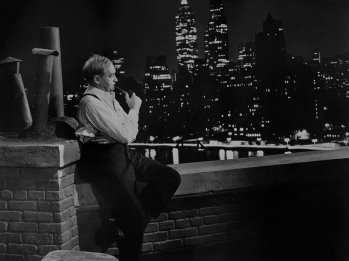 Excuse anyone expecting a grizzled true crime story from this early work from Jules Dassin, arguably the missing link between American noir and those malarial European art-house crime pictures of the ’50s and ’60s, films that in their own way paved early ground for the spatially-focused art-cinema likes of Antonioni. For those filmmakers, narratives were but loose constellations of events to hang questions of human modernity and architectural geometry on. And while those filmmakers would truly reorient cinema, Dassin’s films peek open the door that someone like Jean-Pierre Melville (not to mention the French New Wave) would eventually dynamite, laying brick work for a cabal of hungry young American film school students with a voracious appetite for anything radical and foreign. So the name Jules Dassin is, if nothing else, a name you, the consummate cinephile and obscure film blog reader, ought to know.
 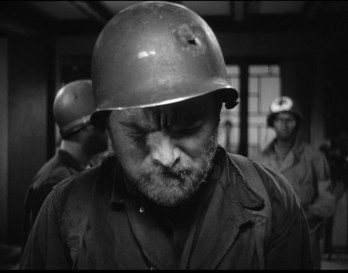 The first Korean War film, Steel Helmet was released mere months after the war formally began, and it benefits from the kind of irrevocable, in-the-moment anxiety that all of director Sam Fuller’s films do. Frankly, the master narrative about the war was still a bundle of unconnected nerves with no central focus yet, so Fuller did what a good Fuller was accustomed to doing: he grabbed the nerves by the claw and jostled them even further. Steel Helmet is infused with a ramshackle vitality and a sense of vicious, viscous dirt seeping into every crack that Fuller so astoundingly tightens up with garrote wire. This is catgut filmmaking, muscular and taciturn and brutish in the manner of a war of attrition mixed with a combustible blitzkrieg, and more importantly, its expediency ensures that the film cannot bother with the tangled geopolitical board-room ideologies of war in a broad sense. Because the war had no overarching narrative (yet), the film only had one choice, the Fuller special: to leave the board rooms behind and make things deeply, uncomfortably intimate, as in camera-too-close-to-the-character-sweat intimate.
 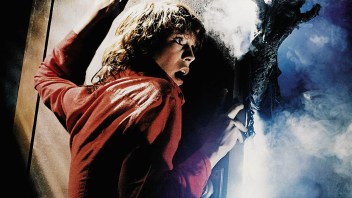 In late ’70s and early ’80s, an era of rapid-onset gigantism from both young blockbuster wannabes (see Lucas, Spielberg) and the then-old New Hollywood dogs who hadn’t learned new tricks but sure dug learning how to spend more money on the old ones (see Coppola, Cimino, both of whom I adore), John Carpenter was a breath of shedding, frigid air. His run from Assault on Precinct 13 through Halloween, Escape from New York, and The Thing is simultaneously a breathless rush and malarial lurch (that contrast being Carpenter’s hometown) through old-school B-picture primitivism updated with hungry young carnivorousness. Smack dab in the middle was the ugly duckling of the bunch, his somewhat forgotten ghost story The Fog, another obvious ode to Carpenter’s youth in the form of a relatively classical, compositionally sound ghost story. Although its reputation hardly precedes it, The Fog is an always humble director at his most humble, maybe his most straight-faced, and, well, not his best per-se, but nearly his moodiest.
  The Long Take