
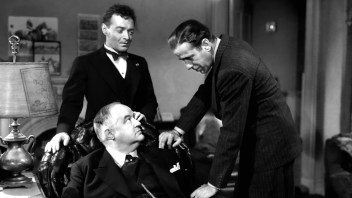
 2016 is 75 years on from 1941, one of the finest years ever in cinema. Let’s dredge up a little history for the week in honor of that cabal of films.
An ice-cold film, and a stone-cold masterpiece; beneath John Huston’s ostensibly congenial and cordial conversation piece beats the pitch-black heart of an interior-trapped world opening its eyes to the search for meaning, even if nobody knows what they’re looking for. The Maltese Falcon’s place in film history is enshrined in the decades of films that have imbibed in its reverberations throughout time. Often cited as the first noir, which may or may not be true, the film was more importantly the introduction to fame for Humphrey Bogart and the first film of legendary director John Huston. A duo that would light a fire and blaze a trail though cinema for a little while, their masterpiece was still seven years away as of The Maltese Falcon’s release in 1941. But if the knuckle-dusted and iron-clad The Maltese Falcon lacks the monumental quality of the hot-headed, thousand-shades-of-grey tall tale from across the border, The Treasure of the Sierra Madre, then their debut doesn’t stand exclusively on its reputation either. Nearly silent though its craft may be, The Maltese Falcon is a film where each person is a potential swindler, each step a threat of the world collapsing around you, and each shot a last will and testament. Continue reading
 Years later, even if it isn’t always effective filmmaking, it is plainly apparent that Don Bluth’s second film with Fox Animation was never given its due process. Hired to best Disney at their own game with 1997’s Anastasia, Bluth had a one-film hot streak under his belt when he fearlessly jumped into the animation deep end with its follow-up, 2000’s Titan AE. His arrival at that point, the world now on his shoulders, was a two-decade-long torrid affair with the powers that be. After originally rising through Disney’s ranks in the ‘70s, when the company was in a downhill slide, he absconded in the ‘80s in belief that he could outdo them. His dream of besting his once-master was briefly given feral life, but Disney’s ‘90s renaissance was too much for him to handle, ultimately resulting in screwing himself over in the early ‘90s in a desperate craze to keep up with his former masters resulting in failure after failure. His career was over, until Fox Animation ceremoniously afforded him one more shot to best his former bosses (admittedly, he was the only one in history that had accomplished this goal before, so one can see why he was the natural candidate). Anastasia triumphed commercially just as Disney was beginning to falter itself, and the stage was set for Bluth to return to investigating the crevices of animation rather than simply aping his former masters as he did with Anastasia.
  With all the slashing and piercing found within, it isn’t really a surprise that John McTiernan’s disastrously over-budget The 13th Warrior is so disemboweled. This tonally promiscuous production vacillates between effectively brazen horror viciousness and petty, watery cartoon-viking bombast, the two tones functioning like combative enemies rather than fascinatingly differentiated tonal inversions. Devious wrongdoings behind the camera and disastrous reshoots ensure a production that runs the gamut from pastoral myth to Manowar album cover, a grungy, dirge-like epic of alternately jaundiced and flowery discombobulation.
 An elephantiasis-afflicted, dismal anti-epic of undying malfeasance, Kevin Costner’s The Postman is positively drunk on its own grotesque patriotism and egotistical self-interest. From the man who directed Dances with Wolves and starred in (and may have directed) Waterworld, The Postman is just plain engorged, a foolishly endearing attempt to flare-up every operatic cue and hyperbolic shot in those films, fling well past the point of common logic, and invade the realm of Rococo drama. Fittingly, it is a missed target of a distinctly and unambiguously Costner-esque caliber. While Dances was a questionable but undeniably poetic epic that suggested something of America’s own mythic grandeur, The Postman finds the bottom falling out as Western pastiche becomes accidental Western parody.
  The early ’90s was a phoenix-like ascent for animation, a time to rise from the grave of the ‘70s and ‘80s and flaunt the medium’s wares anew. Taking little time to clear its throat, a renewed Disney Animation huffed and puffed The Little Mermaid, Beauty and the Beast, Aladdin, and the epochal The Lion King out into the world in a manner of years. In doing so, they blew down the house of their reputation as a failed, past-its-prime studio of has-beens. Meanwhile, Don Bluth, the rising star of the studio and its potential savior throughout the ‘70s, had jumped ship – firmly believing his clout was wasted on the irrelevant Disney old fogeys of the ‘70s – and by the late ‘80s, his own star was shining with works like An American Tale and The Land Before Time. Although both pillars of animation would struggle before the decade was out (Bluth faltering almost immediately upon the turn of the ‘90s), the landscape was hot for the moment, so hot that even animation’s famous bad boy (long dormant and lost in the fray) couldn’t miss out.
  Monkeybone represents director Henry Selick’s well-meaning attempt to disrupt the live-action realm with the furious might of his expressive, cocaine-addled stop-motion cinema. While his previous efforts behind the camera were all compromised in one way or another (often to their benefit), this deeply uncentered film is the most immediately adept at cracking into his singular mind. While The Nightmare Before Christmas was an acolyte of Tim Burton and James and the Giant Peach indebted primarily to the Roald Dahl tradition, Monkeybone feels like Selick in his purest form, Selick unhinged. And also, perhaps necessarily, Selick on a reckless rampage that leaves him both struggling to handle the reins and at times completely distracted from the havoc his feral beast has wrought.
  The newest in a long trickle of good-to-great DC Animated Universe films, Batman: The Killing Joke, is to be released this week, and in theaters no less (the realms of kiddie animation really have grown up). Since the film is based on the most famous Batman vs. Joker comic, one that partially inspired the gothic milieu of one of the most important blockbusters of all time, and because the DCAU itself was so heavily influenced by that blockbuster’s noir-baroque vision, it seems appropriate to take a trip back to the past with a review of the progenitor of this whole 25 year Batman love-affair-cum-epidemic that nerd culture has been afflicted with.
  I meant to review this a while ago, but the year of its twentieth anniversary seems as good a time as any. Noah Hawley’s television show is every bit the film’s equal, but there’s nothing wrong with the primordial ooze of the original.
 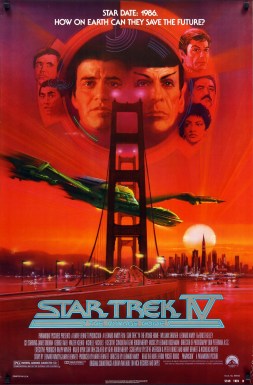 Two of the even ones. You know what that means.
  You know Star Trek. This isn’t it.
  The Long Take