 Update early 2019:
In my original review I referred to this as cinematic rock ‘n’ roll, but Beasts of the Southern Wild is really more in the spirit of its ancestor, a bayou spiritual. Although it could be accused of wielding the filmmaker’s gaze to exoticize impoverished communities, it doesn’t fetishize its access to marginalized communities, and although it burrows right into the soul of a marginalized child with a fantastical charge, it preserves her opacity and doesn’t flaunt its access to her. Both a lament and an ecstasy, this folksy fairytale inhabits the spirit and follows in the wake of over a century of African-American folktales which both cross-examine the social tapestry, eulogize the lost dreams of the unheard, and catalyze their future aspirations.
Loyal to reality without being a simple duplication, Beasts of the Southern Wild porously flows from naturalism to fantasy without necessarily mapping the two in any Manichean fashion. Although it’s a little too preoccupied with its own inexorable fantasy at times, it’s seldom (or never) precocious, and, increasingly, it strikes me not as entombed within appropriated affectations but as inspired by an incredibly pregnant, overflowing history of marginalized populations reclaiming cultural (and pop-cultural) space denied them in manifold ways. It’s a tender but tough film, strange but not estranging, and it floods our synapses with a poetry that dredges-up submerged epistemologies from the past without forgetting how swampy its truths, and ours, are. Or how raging, tangled, and torturous the currents of the present can’t but be.
And what currents! The film is a vaporous tapestry, its restless vulgarities and energies diffusing into the ether, resulting in a film that is weighty but never weighted-down, always able to fluidly outflank any potential distrust with sheer, uncynical cinematic sublimity, shaded and even shadowed by gusts of self-awareness, premonitions of a wider world. It dazes us with its earth-ravaged beauty, somehow both transcendent and realist, exorcizing so many implacable spirits and unsettled energies, from Hurston to Baldwin to Malick, all of whom make perhaps strange bedfellows, but all both kindred in their dialectics of mysticism and materiality, spiritual and secular radiance, and Beasts of the Southern Wild summons their collective ethos and stays true to their spirits partially by disobeying them and materializing its own adjacent but not adherent attitudes.
It also shares those authors’ sometimes offhand toward the comingling of the personal and the political. Although it certainly inclines toward anarcho-syndicalism, or at least letting alternative communities be on their own terms, it doesn’t demonize the government so much as construe them as a foreign, monolithic interloper, with all the connotations that entails. It’s certainly aware that the government’s interventions into marginalized communities tend toward the palliative, at best, and the prejudicial and paternalistic, at worst. Although Beasts is mostly a parable of personal becoming, it’s also a plea to reconsider the hegemony of an empathetic but sometimes unthinking system which, the film ponders, cannot colonize all walks of life.
Original review:
Beasts of the Southern Wild feels like fightin’ words to the modern motion picture industry, a line in the sand with aesthetic-less lo-fi indies and sanded-off, corporate Oscarbait on one side, and Beasts carnivorously lurking on the other. It is above all a very instinctive motion picture, primordial and sensuous and rebellious in a way that eschews the intellectual, the analytic, and the rational for a burst of bedlam and commotion that feels, if not entirely structurally sound, all the more emotionally true for how close it comes to bursting. It’s cinematic rock ‘n’ roll. Continue reading →

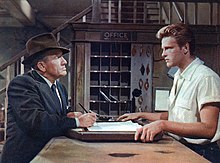 John Sturges, mostly famous for his two later rugged process-driven films, The Great Escape and The Magnificent Seven, drew out a mostly forgotten niche of manly not-quite-action films. They weren’t really violent, but they had the soul of action entertainment in their braggadocio and mechanics-first brand of raspy storytelling. His two most famous films are given at least the repute of minor-classics, but he is not particularly associated with them. He was a man who worked with groups of talented actors, and they often dwarfed him in the final analysis, not because he was appreciably under-skilled, but because he always subsumed his skill to the mechanics of the narrative, and we as a society tend to focus on actors and narrative at the expense of directors. He didn’t have a truly unique style, so to speak, but he was an ultra-competent director, and arguably the ultra-competent director. And his competence never tipped over into out-right genius quite like it did in Bad Day at Black Rock. Continue reading
  You can not find a more breathlessly adventurous and rewarding a period of Japanese cinema than the golden years of 1950-1955. The number of era-defining international monsters of world cinema produced by Japan in this period is arguably unmatched in any national cinema over any five year period: Kurosawa’s The Seven Samurai, Ikiru, and Rashomon, Yaujir
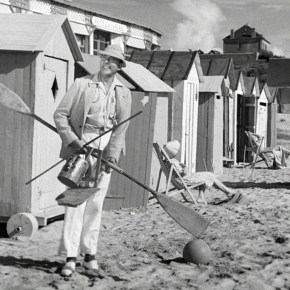 Has the cinema ever known the pleasures of a greater humanist than Jacques Tati? Charlie Chaplin, who Tati is generally compared to, comes to mind, but Chaplin at his best could draw fangs. His post-silent productions are nasty-minded masterpieces, works of barely-hidden discontent more than whimsical discovery. Tati could poke fun with the best of them, but never ruefully, and anger may not have been a word he knew. Certainly, it wasn’t a word he wanted to room with, or even walk in the same neighborhood as. Chaplin could love his audience or laugh at them, and he sold both as well as any filmmaker ever did. Tati was never not laughing, but always with us, never at us, and his laughs were laughs of love.
 Othello should not exist. Not William Shakespeare’s venerable play, one of the great tone poems to dueling egos and wanton desire filtered not through hero and villain but split personalities tearing each other apart until neither can have what they want. But Orson Welles’ Othello, a work of ramshackle, stitched-together genius if ever humankind has produced one. It isn’t Welles’ greatest film, but it is likely the surest explanation of his unmatched gall, of his unending sweat, and of the limits, or lack thereof, of his genius.
 You couldn’t find a more idiosyncratic director in classic Hollywood than Robert Wise. Sweaty potboilers, abstracted populist science fiction, howling horror, atomic age message pictures, and gilded, gloriously melodramatic maxi-packed musicals. All bubbled under his domain. Plus, he contributed the insurmountably essential, firecracker editing for no less a picture than Citizen Kane back when he was still in his pre-directing days. He was something of the ultimate Hollywood jack of all trades, and it is true that he wasn’t the greatest master of any single genre. But he was more than a shadow passing through genres as a director-for-hire. He put his personal stamp on every film he ever touched, and he never gave a picture less than 100% of his charisma.
  The two principles of David Lean’s Brief Encounter never consummate their love, or even acknowledge it, but of all the movie characters to have fallen in love over the past century, no two may mean more than Laura Jesson (Celia Johnson) and Dr. Alec Harvey (Trevor Howard). When they meet at a railway station cafe, they fall for one another, but they are denied their romance by social convention; they are both married, and, although the film doesn’t state it, the then-knowledgeable sense that divorce was frowned on in their world becomes palpable almost from the first instant. Which is the essence of Brief Encounter: not ashamed of itself and totally sincere, but minimalist and hauntedly hinting when other movies would openly declare. More than realism, Brief Encounter is the ultimate study in unfulfilled love and the quiet doom of knowing the end is near, only to have it forced upon you against your own terms.
  In 1945, Billy Wilder was still becoming himself, but he wasn’t a Hollywood newbie. The Lost Weekend, would win him two Academy Awards for writing and for directing (he would win again for writing in 1950 for Sunset Boulevard and become the first person to win separate Oscars for writing, directing, and producing in the same year with 1960’s The Apartment). It would firmly plant him in the big leagues of Hollywood, but the picture was made on the back of his supremely successful hard-boiled exercise in nihilism, Double Indemnity, from the year before. In this light, had it not been for Double Indemnity, it would be easy to claim that The Lost Weekend just wasn’t quite there yet, or that it was still the product of a director and a writer identifying their place in Hollywood. But then, Double Indemnity burns with Wilder’s patented fiery brand of ice, and The Lost Weekend is merely a sharp noir in full-on potboiler mode. Good Wilder, surely, but not Wilder at his best.
  The Long Take