 With The Shape of Water, Guillermo Del Toro effuses different fluids from those in the vein-severing Crimson Peak, and I’m not only writing of the ones which discharge when protagonist Elisa (Sally Hawkins) does have sex with the gilled-man at the center of The Shape of Water, as has been widely reported. But Shape of Water isn’t primarily a carnal tale, nor a bloodthirsty one, nor one that is drawn primarily to the weirdness and curiosity of the body and its fluids at all. In fact, it’s almost devoutly un-perverse, afraid of unpacking its questions even as it freights the film with those very questions. Despite the wonderfully imagined suit that animates him, the film’s amphibious man (Doug Jones) is obviously a purely abstract construction, a metaphor for human preconception and the loneliness and ennui and that beleaguers protagonist Elisa (Sally Hawkins) and her fellow cleaning lady, the African-American Zelda (Octavia Spencer, the most spirited member of the cast, and probably the best if we rule Jones out). Although Jones drip-feeds the creature a personality through visibly hesitant gesticulations and a curiosity exposed only through his eyes, the character is plainly allegorical. Which also means that he never has the capacity to resist the confines of his allegory. Continue reading
Review: The Shape of Water
Leave a reply
 Director Sidney Lumet’s Murder on the Orient Express is little more than a palate cleanser, a film-length hangout-sesh with various actors dropping in to bide time with Lumet while he’s stuck between his point of origin, his scintillating 1972 Serpico, and his destination, the sun-scorched, swelteringly humid Dog Day Afternoon from 1975. In the latter film, every drop of sweat hitting the ground both stems from the pours of and falls into the cracks of a deeply torpid, entirely exhausted post-civil-rights, post-dream America just waiting for a 12 hour news story both to shock itself back to attention and to distract it even more. That’s a real masterpiece, and Serpico is a quiet near-masterpiece as well. The middle passage film, Orient Express, is a lark, a nice way to spend a couple of hours, but don’t miss any sleep over not seeing it, unless you have a fetish for showpiece ensembles coasting on their fame. (I mean, who doesn’t?)
  Justice League arrives in theaters with the stench of self-seriousness, not to mention the load of legitimizing a frail, failing franchise, on its back. While its predecessor, Batman V Superman: Dawn of Justice, remains a perennial fanboy punching bag 18 months after its release, the light of the much-adored Wonder Woman, for me at least, grows more dim by the day in both its faux-feminist politics and its glum, dirge-like aesthetics. Now, I’m no Marvel partisan. Even the frissons in those films, from Dr. Strange’s psychotropic visual shenanigans to the feisty caper escapades of Ant-Man to the comic filigrees of James Gunn’s Guardians dyad, only nominally search for an escape hatch from their franchise’s homogeneity. In actuality, they mostly stress-test the walls of their franchise by providing merely minor disturbances that the Marvel Universe can still accommodate. The ebullience of their alternative imaginations of a “Marvel Movie” is routinely limited by the dawning awareness of the unactualized possibilities they imagine for films actually unmediated by the Marvel Machine. A go-for-broke James Gunn space comedy, a true-blue hallucinogen, a real-deal frothy ‘60s comic caper flick. Marvel films gesture toward these alternative paths, but they cushion their weirdness by shoring up the house that contains them. They’re the cinematic equivalent of receiving a flu shot: small doses of bodily insurrection in service of making Disney’s profits all the healthier in the long-run.
  The big story with Coco is the film’s endearing expression of Mexican cultural forms. But the even bigger story, to my mind, should be how disturbingly assimilable these norms are to the way Pixar always tells stories. Someone, of course, will make the case that it’s “positive” that society can tell normative stories which happen to be inhabited with Mexican cultural forms that do not really challenge mainstream styles, that Mexican culture can be “normal”. But if Coco is a case of integration rather than mere assimilation, it also relegates Mexican culture as a passenger. The culture gilds this particular film nicely, but what does it say that it’s a “major” achievement for a film studio to make the same film they’ve been making for years, only now with Mexican culture along for the ride? I’m tempted to write off this kind of film as a nice moral achievement or “good on social issues” without actually being all that much of a film. Except I’m not entirely sure this is a moral achievement.
  Embedded within but highly subversive to the American Western, Kelly Reichardt’s wilderness of small-scale conversations and un-obtrusive insight suggests that there is no physical space as trying to master as that of the internal. She singularly offers another vision of a feminist Western that is actually unmoored from the decorum of romanticism or the bindings of mythopoetic malehood. In place of high-stakes conflicts and brooding, unfettered soul-searching, she lyrically produces a handful of uncanny, narratively-unkempt stanzas on lost dreams, stagnant desires, and interpersonal dilemmas that are far more truly disjunctive to masculinity than women with guns because only the former actually erode masculine storytelling structures at their very bones rather than simply placing women within them unabated. Rather than physical conflicts belying and then bearing quandaries of the mind and soul, as most superior Westerns do, Reichardt more purely distills the latter, dispensing with guns, ammo, and posturing entirely. Wringing herculean drama out of the seemingly diaphanous, Reichardt’s exploration of a polluted but hopeful world draws a supple mood of traumatic disquiet, a more minor-key crisis for a series of women in modern day Montana than the kind of consternation most Westerns are willing to deal with.
 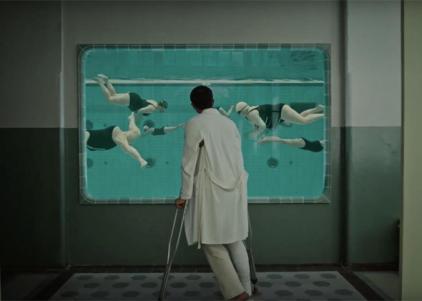 A calamity of inspiration and ingenuity, along with banality and over-indulgence, Gore Verbinski’s chilly, Euro-malevolent A Cure for Wellness is the tonal opposite of the brash, giddy Americana of his previous feature, The Lone Ranger, but they are undoubtedly kindred spirits. Three years after having written it, I remain wracked by my review of that earlier film, lost as it was in its own incredulous eccentricities and tonal spasms that destabilized it to its very core. But I now suspect that I and other reviewers were as misguided as the film was, and I now appreciate The Lone Ranger – at great cost in cognitive-dissonance to myself – as not only an undeniably peculiar blockbuster but a boisterously, almost radically singular one. Not a film as compulsive, fanatical, and personally tormented as, say, Speed Racer, to name the reigning misunderstood blockbuster of the past decade, but the rare tentpole that stands up in the name of individual vision even in the face of individual blunder. A Cure for Wellness similarly missteps all over the place, but it is also a riposte to corporate homogeneity, the caliber of visionary medium-budgeted film that used to populate the multiplexes off and on but is now nearly extinct. Situationally, then, A Cure for Wellness often feels like a sudden discovery, a giddy “they spent how much money on this?” curio that suggests Verbinski’s Pirates of the Caribbean good faith will never run out.
  Early on, James Franco’s ostensible-lark The Disaster Artist seems oddly generous, even generative, with its themes, as though willing to interrogate questions ranging from auteurism, to film-set camaraderie (or lack thereof), to intentionality, to interpersonal relationships and the cost of friendship. In other words, director-actor James Franco’s film adaptation of Greg Sestero’s tell-all book about the making of the cult anti-classic The Room has ideas both for and about Tommy Wiseau, director and star of The Room and all-around human enigma, here played by Franco as well. Which means that it escapes, at least for a duration, the obvious narrow corridor of an in-joke about a film that is, itself, a joke. The early-goings flare with at least mild possibility. They glint with shards of not only genuine cinematic joie de vivre but dueling absurdist tragedies. One tragedy, Sestero’s, is a modern day James Dean story of a rebel with a cause, and the other is of a man who at least believes himself to have a cause.
  Stan-up comedian Kumail Nanjiani plays a somewhat fictionalized version of his real self in the breakout romantic comedy of 2017, The Big Sick, a film with the disheveled, low-key vibe of a personal anecdote, a story you tell to your friends about how you and your partner met. How they, in this case Nanjiani and his wife Emily Gordon (fictionalized and played by Zoe Kazan here), come across one another at Kumail’s stand-up show in Chicago. When? Sometime after the Pakistani-American Kumail has feigned interest in and given up on numerous potential planned-marriage partners from his parents Azmat (Anupam Kher) and Sharmeen (Zenobia Shroff). And sometime before Emily contracts a life-threatening disease that inadvertently forces Kumail in the hospital, after their break-up no less, to sign her into a medically-induced coma.
  The lion’s share of films about racism tend to denature race’s own construction, neutralizing its existence in time and space as a material-but-conceptual reality that is institutional and structural in nature. They miss that racism is assembled, modeled, fashioned, and implemented rather than simply felt or present as an assumption. But even films aware that race is constructed often neutralize its instability by fleeing from its paradoxes: that race is arbitrary yet all-encompassing, fragile yet galvanized, collapse-able and implacable in one. These films empty race out of its peculiar qualities, favoring one of two constructions that overlook the dialectical rather than dichotomized nature of race as material and ideological in one. In the first construction, they may consider race as a simple accident that recuses the film from having to critique democracy wholesale. They consider the material presence of racism not as a symptom of a democratic syndrome that begets race but as an addendum, alternate, or holdover that democratic theory has not successfully stamped out, not for want of trying. Racism becomes a rogue insurgent in democracy and America rather than a foundational element. Alternately, films may define race as a more immanent problem for America, but only as husk of abstraction, a foundational accident in American democratic theory but one which plays out purely at a theoretical rather than material level. Thereby, these films do not have to expose and express the way race is reified in practice. They dare only to understand democracy as a concept, not as a material and temporal process.
  Notionally a point of departure for playwright-turned-writer-director Martin McDonagh after the just-dandy In Bruges and the eccentric but flippant Seven Psychopaths, Three Billboards Outside of Ebbing Missouri not only turns McDonagh’s wandering eye to America – either Middle American or the South, depending upon your placement of the pointedly liminal Missouri – but to a deepening of themes, a reckoning with untouched subjects and untapped potentials. The story of an implacable mother, Mildred Hayes (Frances McDormand), who erects three incendiary billboards chastising the local police for their failure to solve the rape-murder of her daughter, Three Billboards is, as we say, going for it. At the same time, I’m not entirely sure the film does go for it, which is where its problems commence.
 The Long Take