Film Favorites: Lone Star

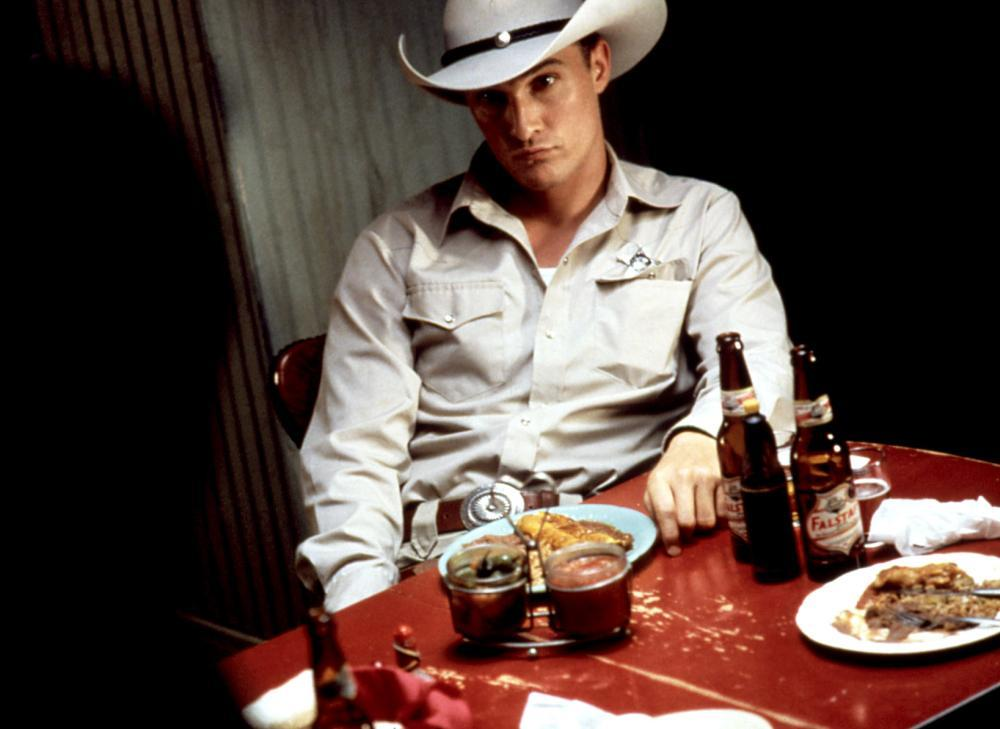
In a key mid-film moment in John Sayles’ beguiling neo-Western Lone Star, a flashback to the early 1970s begins on an image of a film screen at a drive-in showing Black Mama White Mama, a classic about an interracial pair on the run from the forces of law, categorization, and entrapment. The camera skulks down below to the car-bound audience watching the film, a pair of sheriff boots on the prowl to capture another pair of outlaws: two teenagers, the sheriff’s white son and his Mexican American girlfriend enjoying a night of relative freedom watching a movie. In this case, the authority figure hunting the two teens made his name – became a myth in the border town of Frontera, Texas – precisely by rejecting a horridly racist sheriff himself. He is both a frontiersman boldly resisting authority and a specter of his former enemy and the peculiar version of freedom – the freedom to control others, to resist order while sustaining it – that he once stood for, and that defines so much of American outlaw lore. Lone Star asks us to sit with that, with the paradoxes of power and rebellion, with the ambiguities and contradictions of American outlaw culture, with a past that is a multiplex of sensations and memories shot through with false truths and dim presences. It dwells on a history where identities are forged out of cinema-style myths of Americans escaping their pasts, a cinema of the frontier that looms large in the American imagination, a ghost in the machinery of much American violence.

In other words, Lone Star is a knot in a tangle in a labyrinth, a film whose irresolvable complexity is not the result of any unexpected occurrences in the narrative (although there are plenty of those) but of the intricacy and empathy of its interpersonal curiosity. Like any truly great film, it is defined by its mettlesome texture, upsetting any conclusions we draw on a scene-to-scene basis. Its moral imagination is its ability to delineate human relations and then unravel those delineations even in the act of drawing lines. The past will weigh heavily on the present throughout Lone Star, which continually moves across decades without even cutting, but the present is also loose to itself, containing many overlapping currents and frayed stories that circle around but also unravel its seemingly central mystery – whether one sheriff did, in fact, kill his authoritarian predecessor to take over the job, and what happened to the body – a mystery that is the film’s pretext but not its reason. This film continually implies that whatever resolution it can offer us to that story does little to resolve the pressing problems facing the town in many other tales only being briefly visited. Lone Star is a work of fascinating, beautiful, continual disappointment.

Continue reading

Midnight Screamings: Fright Night

Writer-Director Tom Holland never went very far. His somewhat stunted career is partially the result of his plunge into the dark depths of the Stephen King miniseries mirror-universe (including taking the dreaded “King miniseries” to new lows with the truly abysmal The Langoliers). But even his successes are compromised in various forms, and none of them distinctly insist on his role in developing them. His screenplay for Psycho II was directed by Richard Franklin, and that sequel was as much a calling card for returning star Anthony Perkins, whose androgynous and nervously gentle form never quite found a home in Hollywood. 1988’s Child’s Play, thoughtfully directed with a classical eye for perspective and absence by Holland, would soon become the brainchild of franchise mastermind Don Mancini, who eventually took the killer doll to new heights of meta-ironic deconstruction and (beautiful) lows of self-debasement,  transforming the franchise into a labor of diabolical love. Tom Holland, a comparatively straight shooter who seemed mostly content with craft rather than art, never stood a chance.

Which isn’t to say that Fright Night is ready and willing to salvage a would-be auteur by rediscovering a particularly idiosyncratic text birthed into the world by a heroically singular voice. Fright Night is, in fact, a thoroughly, proudly old-fashioned picture, a piece of quality machine work, both as a matter of content and a principle of form. Its interests are salvaging and remounting a tradition, not personalizing a voice. The film’s pitch was to to see whether an old-time horror film could, as it were, survive in an era of the slasher craze. This has an ever-so slight patina of meta-textual self-referentiality, but Fright Night mostly plays it straight. It isn’t as dexterous in its tonal mischief as Evil Dead II nor as frisky in its manipulation of the body as Re-Animator. If it doesn’t reach the fiendishly playful heights of either of those films, it never really seems interested in them in the first place.

Continue reading

Film Favorites: Anatomy of a Murder

After the modernist assault of Saul Bass’ title credits, which abstract and sever a minimalist outline of a human body like an anatomical puppet or an animator’s specimen, backed by Duke Ellington’s bracing, off-kilter jazz score, Otto Preminger’s Anatomy of a Murder throws us a sly curveball. Preminger drops us into a noirish, endless sequence of shots of a car driving through the middle-of-nowhere, slithering on the path to ill intent, seemingly backing up the credit sequence’s promise of nefarious activity underfoot. Except when the driver gets out, it’s Jimmy Stewart, and he’s just been enjoying a leisurely afternoon fishing. And then when Stewart wanders into his unassuming house, a flick of the light switch suddenly reveals a studious, forbidding wall of mighty legal tomes. We get the sense less that we’ve moved from one world to another than that the mise-en-scène has folded multiple layers of existence into one another, layering a chiaroscuro noir on top of a lazy-day comedy on top of a legal drama. This is a man as inviting, and as pungent, and as confusing as an onion, and this will become a film that is interested in casually, continuously peeling, scraping, away at society’s facades rather than giving the audience the satisfaction of a carefully resolved mystery or rushing toward something as superficial as a “guilty” or “innocent” verdict.

Anatomy of a Murder takes its time here and throughout. It never insists on anything, offering a leisurely, observational sidewind through a densely knotted tangle of a crime the film is more invested in walking around and peering at than really untangling. The closest analogue I can think of is Howard Hawks’ loquacious Rio Bravo from the same year, a film that turned the promise of a strenuous, sinewy siege-Western into a loose, go-nowhere hangout picture. Just as surely as that film was a kind of response to the tight-and-trim High Noon (also great), Anatomy of a Murder feels like the anti-12 Angry Men, staging not a masculine juror’s thrust toward the achievement of legal doubt enshrined as a personal moral victory but a complex, latitudinal portrait of loose community layered with decades of history. Certainly, Anatomy has a much nastier bite than Hawks’ laconic oater, but they share an ethos of investment more in the minuscule gestures that define mutual relation than the brutal efficiency of forward movement. While 12 Angry Men can never quite escape the sense that it is moving us to a position we are already, inevitably, primed to support, Anatomy splays out. All while seemingly wasting time with the minutiae of every detail, it secretly, invisibly stabs so many knives into human morality that we can only walk away with our sense of truth having been quietly, almost invisibly pulled out from under us, our hope for what constitutes proper justice melted into a swampy morass of questions and conundrums.

Continue reading

Midnight Screamings: Night of the Demons

Night of the Demons was released near the end of the 1980s, after the Hollywood horror boon had already worked itself out and then reworked itself to death. In the back-half of the decade, the slasher films became both more banal and more outré. Sometimes this simply meant films flailing around, trying whatever they could think of, to get attention. Sometimes it meant that the films were genuinely chasing unclarifiable interests and stray sensations toward unexpectedly exploratory truths. Sometimes the difference could be impossible to discern.

Case in point: 1988’s Night of the Demons, a ghoulishly opaque slasher that is, on one hand, exceedingly debased, necessarily brutal, and grossly misogynist, investing fully in the baser elements of the genre. On the other, Night of the Demons joins films like Hello Mary Lou: Prom Night II and Slumber Party Massacre II in being not only a supernatural slasher but a surpassingly strange one, a film whose limitations double as an exploration of the genre’s own failure. Night of the Demons depicts a genre so routinized and ossified that it was both flatlining and collapsing in on itself. The film figures the Reagan decade as a literal haunted house locked in a perpetual cycle of recurrence, tormented by unseen, tenuously acknowledged forces from the past. This is a film whose failures are not a matter of the film exploding out, but imploding inward on itself.

Continue reading

Midnight Screenings: Flesh + Blood

While Paul Verhoeven would strike Hollywood pay-dirt with 1987’s famously acid-spewing actioneer Robocop, his first English language production is in every sense an even more bilious distillation of the director’s blackhearted cinematic glee. This 1985 medieval anti-adventure is a film in which two of the would-be swooners in a nominal love triangle have their romantic “meet-cute” while two painstakingly-detailed, putrescent rotting corpses hang like Christmas tree ornaments on either side of them. The two living participants in the impromptu foursome are presently debating the merits of the mystical “mandrake root” the woman has found beneath the corpses, supposedly gifted with the power to ensure love at first sight for the two who eat from the flesh of the root. The man, who doesn’t even believe her, responds that the root’s powers are the result of the corpses dripping semen on the ground as they hang, a vicious circle where unceasing, unnecessary murder literally seeps into a would-be love that can only be taunted. I can think of no purer distillation of Verhoeven’s worldview.

One can hardly be surprised, then, that 1985’s Flesh + Blood failed at the box office. This is a downright dastardly production, a necrotic fable with Nietzschean disdain for notions of Medieval honor and an ironist’s smug, knowing detachment from the conventions of chivalry and triumph underpinning the mid-‘80s sword-and-sorcery film revival. Those films, so thick on the ground during the Reagan years, launder their noxious visions of self-centered masculinity and brutal, Aryan individualism in chimerical but hidebound frameworks of honor and duty. Flesh + Blood cuts those ideas straight to the bone. It assumes, both as a matter of course and philosophical first principle, that people are fickle, that love is transactional, that the bonds of brotherhood are suffused with brutal layers of power and potential for perversion, and that the only way to survive the world of the Middle Ages – and perhaps every moment that’s come after – is with a cruel conniver’s wit. In its cheekily mocking mood, this is a wickedly self-debasing anticipation of Rob Reiner’s The Princess Bride from two years later. Verhoeven’s film looks on the backward-looking romanticism of the 1980s with impish, curdled disdain.

Continue reading

Midnight Screamings: Videodrome

Videodrome wasn’t David Cronenberg’s first nocturnal cinematic emission, but even by the standards of the chilliest of Toronto-born filmmakers, this one orbits at a subzero frequency. The film is a dismal emissary from the nastier crevices of everyday life, presenting a psychosexual marsh as a cerebral mire. Cronenberg’s style here is an ice bath, one that chills a  heated and tempestuous world of boiling, subcutaneous human desires and fleshy sensations into a frigid, monstrous exploration of modern uncertainty. If its story ultimately exposes the liminal space between humanity and technology, the film’s texture itself seems to literally turn flesh into a strangely vibrating machine, mutating neurotic, restless passions into fuzzed-out, spacey confusion. A dark dispatch from an otherworld lodged in between the channels, Videodrome feels like it is not so much presented to you as stumbled upon accidentally, a film whose truths are felt like slow chill of your own body while watching, whose reality is barely exposed between lines of static.

Barely. Much of Videodrome is about how little the film can really tell us, how subordinate to wider flows and forces it is, and we all may be. If David Cronenberg’s ostensibly more commercial film from the same year, the spectral and hallucinatory The Dead Zone, depicts a man whose sudden trauma morphs into a genuinely revelatory second sight, the capacity to see the future in however unstable a form, Videodrome is about a man whose perceptual awareness is cunning and calculated but finally insufficient to the vicious, slippery contours modernity he is a child of. Unlike Christopher Walken’s newly-awake Johnny Smith, the protagonist of The Dead Zone and an Emersonian romantic with a capacity to peer beyond the dim propsects of the present, James Woods’s Max Renn is a shadow able to hide in modernity’s cracks. Renn is deeply comfortable skulking through the dingy halls of a ghostly world with sinister intent. In an increasingly disembodied space, only a wraith is at home. But the film reminds us that the contours of a rapidly expanding world, separating and connecting people whose bodies seem increasingly tenuous, is always one step ahead of him.

Continue reading

Midnight Screamings: Frankenstein Unbound

A bonus review of his final directorial effort in honor of the master’s life. RIP.

I for one cannot say what precisely motivated Roger Corman to take up the holy calling of the director’s chair after a 15-year sabbatical, following the phenomenally lurid Death Race 2000, nor to do it in the name of an adaptation of Brian Aldiss’s 1973 novel Frankenstein Unbound. But having seen it, I’m fairly comfortable being happy that he did. It’s as though Corman himself saw into a crystal ball that Universal Horror adaptations were about to become a momentary trend in Hollywood again and, unable to pass up an opportunity to steal the zeitgeist for his own purposes, he got in on the ground floor before the films even started being produced. That didn’t help him at the box-office, but thirty-five years later, we still have to reckon with this one-time cinematic mad scientist’s final rodeo.

And a mad scientist experiment it certainly is. While the obvious comparison would be Kenneth Branagh’s Mary Shelley’s Frankenstein from 1994, this is a much closer cousin of Francis Ford Coppola’s quasi-comeback Bram Stoker’s Dracula from 1992, to name a director whose career Corman helped vitalize decades beforehand. Like Coppola’s film, Corman’s has a certain diabolical lunacy in its mind, and you can detect the glimmer of the playfully egotistical in Corman’s eye in the thoroughly injudicious way he unleashes a ludicrously protoplasmic pink (that gestures to the Lovecraftian texture of Corman’s 1963 classic X: The Man with the X-ray Eyes)  or when he closes with a distinctly putrescent green. They look thoroughly absurd on-screen, but can you blame the loopily boastful director for wanting to go a bit overboard, just because he could?

There are obvious differences: Coppola needed Bram Stoker’s Dracula, and he directed it like his life depends on it. Frankenstein Unbound feel more like a victory lap, a charming lark that Corman worked on because he wanted to, or because he was bored and needed something to do, or just to see if he could. If the fire of hell isn’t in it, that doesn’t mean it is just coasting, even if it obviously isn’t the work of a director who felt like he had something to prove. Cheerily idle, you might call it. Perhaps the somewhat lazy, “first thought, best thought” mentality of it all is what allows it to be so offhandedly pleasurable, so uncontaminated by any need to please or to perform to any expectations. So, well, unbound.  

Continue reading

Midnight Screenings: The Intruder

A bit delayed here, but while I happened to post a review of a Roger Corman-produced film two days before his death, I couldn’t not honor the man by reviewing at least one of his self-directed works, and one of the sharpest and most prescient early ’60s films to diagnose America’s ills to boot.

In the final analysis, Roger Corman was really only interested in making a buck cheaply and quickly. He was a particularly vulgar variation of the termite artist, to use Manny Farber’s term, scratching immediately and injudiciously at any and all crevices that had opened up in society’s façade. He could make a womb, and a few dollars, in any space where the world no longer seemed comfortable. Usually, that meant selling audiences on astrological terror or cosmic instability, on the pleasures of momentarily acknowledging the diabolical awfulness lurking beneath the most domestic of exteriors. With 1962’s The Intruder, Corman did something most Hollywood directors then balked at. He looked directly at the fault lines in modern America, casting America’s favorite future explorer of the final frontier as a demonic embodiment of what historian Richard Hofstadter called the “paranoid style” in American politics and what others would go on to call “demonology”: that inimitable ability to assume and mark others, particularly racialized others, as outsiders in need of an exorcism.

On principle, Corman was willing to do almost anything to make money, but many of his films capture the same strange outsider energy of filmmakers like Herk Harvey, fugitives from cinematic corporations working right at the moment where the Classical Hollywood studio system was collapsing. In these directors, we arguably sense the democratic potential of the medium. It is perhaps deeply ironic, then, that Roger Corman’s desire to sell anything for a profit, even the evils of racism, brought us 1962’s The Intruder, a film that viciously skewers the democracy of the masses and that casts as its central character a truly vile, desperate, pathetic man whose crime is that he wants to make a buck by stoking the masses and manipulating the rifts in the world around him.

Continue reading

Midnight Screenings: A Fistful of Dollars

This review written in honor of Clint Eastwood’s 94th birthday.

Superficially, A Fistful of Dollars is Sergio Leone’s remake of Akira Kurosawa’s 1961 classic Yojimbo, a film that was itself influenced by the very Hollywood Westerns that Leone would make a career of commemorating and disturbing. Kurosawa’s interest in American Westerns is well-documented, and it bears testament to the family resemblances between the genres: an investment in rummaging through and investigating classic national myths, a critical appreciation for classical notions of mutual honor and camaraderie. George Lucas, obviously influenced by both genres, was onto something when he decided that the proper location for these questions to unfurl was in the mystical, speculative space-time of “a long time ago and a galaxy far, far away.”

However, Yojimbo was also an interpretation of Dashiell Hammett’s classic 1932 noir novel Red Harvest, from which it, and thus Leone’s film, draws its central narrative conceit. The noir universe marks a disturbance in the two genre’s mutual force, a moral void enervating the classical textures and moods that preoccupy both many American Westerns and Japanese Jidaigeki (“period drama”) films. What we might call the “Hammett” transfusion, a means of infusing new blood into the genres, was also a way to slit both genre’s throats, to poison them from the inside, to indulge in the noir universe’s mockery of classical order and moral harmony, to appreciate modernity’s beautiful rot.

Leone’s Italian Western follows suit. It takes a vibrant cross-cultural exchange in which the mythic types of the U.S. and Japan resonated in new contexts, and it brutally stamps that conversation down under the bitter heel of raw, un-ornamented force. Drawing on Yojimbo and Hammett and matching them every for sheer brutality, this is a vicious, mean-spirited film, one whose perspective on the universe is also its own self-justification. We didn’t need a remake of Yojimbo, but Leone’s film is both an argument and its own evidence. The world this film depicts, where those who exert an unyielding and forbidding force win, is also the world in which Leone can kidnap Yojimbo and brutalize it. Pure cinematic gristle, pure force of energy, can punish the audience into sheer appreciation. Tight, savage, and even bullying, this is Hobbesian cinema, an exercise in strength of mettle and the force of skill, one that justifies itself as a remake simply because Leone’s film is just so damn Nietzschean: if you will it strong enough, it will come.

Continue reading

Midnight Screenings: The Cotton Club

This review in honor of Francis Ford Coppola’s Megapolis. Not it’s quality – I haven’t seen it – but just the sheer existence of the damn thing.

A famously mistreated and malformed major studio picture with a post-release to rival Orson Welles’s The Magnificent Ambersons, 1984’s The Cotton Club was, for 35 years, a deeply circumscribed experience. Viewers would be forgiven for expecting that some of that had to do with director Francis Ford Coppola himself, whose passion projects (and even his workaday productions), are – even absent any studio interference – absolutely not sturdy objects. Coppola’s best films are visual arias invested as much, if not more, in texture and tone than in plot or logical coherence. Defiantly cinematic, Coppola’s Godfather pictures are baroque operettas looking back at the gristmill of 20th century capitalism. His masterpiece The Conversation istheir grimier, tetchier, thoroughly shaken nervous wreck of a sibling. His Dracula isKabuki theater crossed with a travelling carnival.

And those are just the films that didn’t nearly bankrupt him or destroy his career. When 1979’s Apocalypse Now nearly lost its mind, it also contributed to losing New Hollywood its head. The kind of money and effort he was spending was, suddenly, only to be handed out for relatively streamlined, sure-fire projects. Personal projects were on austerity, gone the way of the Dodo. By the end of the 1970s, Coppola, like Robert Altman and others, seemed like unhinged mavericks absolutely lost in their own delirious cinematic fever dreams (and I mean that as a statement of affection). Apocalypse Now is, as he famously and self-aggrandizingly noted, an imperial project, an act of mutually assured destruction for the people behind and in front of the camera (which Coppola apparently, incorrectly, thought let him off the hook).

Distorted though his claims and films (and that narrative about the demise of the New Hollywood) could be, Coppola seemed unambiguously committed to not listening to anyone but himself when he outdid even his own ego with his fascinating one-from-the-heart picture One From the Heart drawing more from Von Sternberg than the realist textures of the New Hollywood at their grittiest. No one knew what to do with it, except put him on thin ice. It is certainly no surprise that his new film Megalopolis positions itself as a grand cinematic comeuppance, an existential statement of world-shaking import, and it will surely be no surprise when it makes no money at the box office.

Continue reading